



Miniature Zakopane Cottage Interior: A Sunlit Folk-Art Nook Full of Tiny Warmth
Opening – First Impressions in Miniature
There are miniature rooms that politely say, “Please admire my craftsmanship,” and then there are miniature rooms that grab you by the sleeve, hand you a tiny mug of tea, and insist you sit by the stove because “you look chilled, dear.”
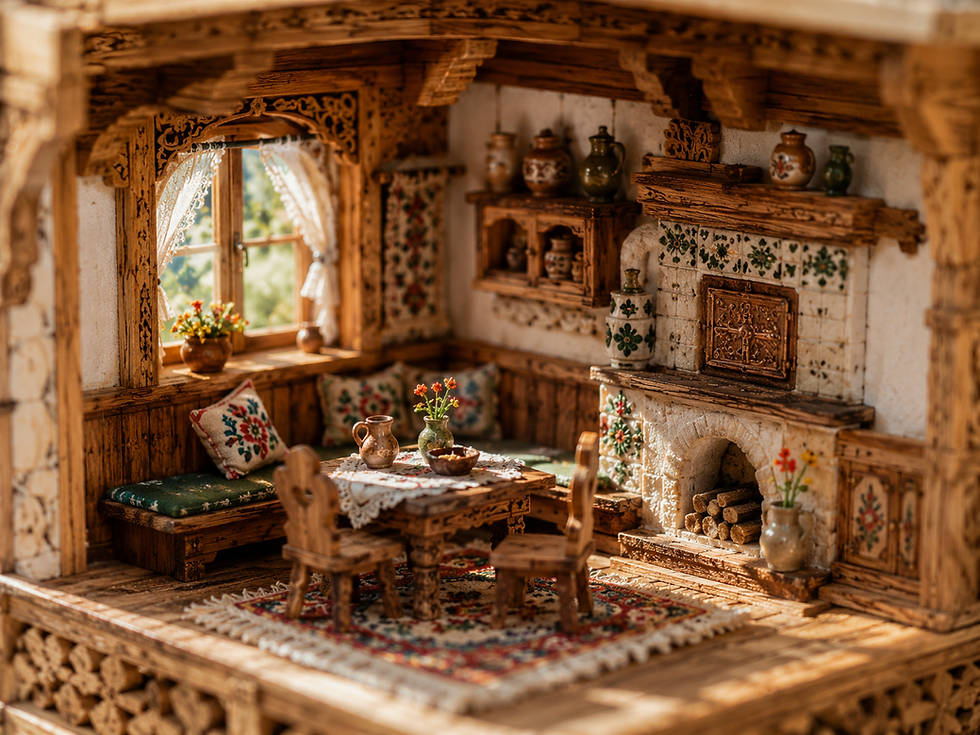
This Zakopane-style miniature cottage interior is very much the second kind.
I love the carved timber beams, the embroidered cushions, the tiled stove, the little table cloth, the bright window light, and that general feeling that someone just stepped out to pick flowers and argue with a goat.

Above is the exterior cottage concept too, just to imagine where this room might live, but today’s build guide is all about creating an interior diorama with this same warm, folk-art, alpine cottage spirit.

Why This Photo Needs VIP Treatment
A quick note before we unpack the tiny teacups: the photo you see online is web-optimized, which means it is perfect for scrolling, admiring, zooming in suspiciously, and whispering, “Is that a vase the size of a lentil?”
But for wall art, you want the fancy version. A high-resolution canvas print gives the carved wood, soft sunlight, painted stove tiles, and woven rug their proper moment. The pro canvas option includes FREE U.S. shipping, which is my favorite kind of shipping because it leaves more budget for tiny chairs. Priorities.
Miniature Backstory – The Tiny Tale
Welcome to Cottage Pod Migdałowym Piecem, or “The Cottage Under the Almond Stove,” founded in 1904 after a highly dramatic village disagreement about whether a proper sitting nook required one pillow, two pillows, or “as many pillows as human decency allows.”
The cottage sits just beyond a cheerful little timber exterior inspired by Zakopane architecture: steep roof, carved trim, flower boxes, stone base, and enough decorative woodwork to make a scroll saw sit down and breathe into a paper bag. Inside, this sunny corner belongs to Aunt Zosia Malina, the unofficial keeper of tea, secrets, and aggressively embroidered cushions.

According to local gossip, Zosia’s great-grandfather was a carpenter who carved one too many floral patterns into a ceiling beam and accidentally started a family tradition. Every generation added something to the room. A painted cabinet. A shelf of pottery. A rug with colors so confident they need no permission. A tiny vase of flowers on the table that absolutely knows it is charming.
This miniature also hits a personal note for me. I have Polish heritage on my mother’s side; my maternal grandmother was half Polish Jewish and half Sicilian Roman Catholic, which is a family pairing that sounds like the beginning of either a beautiful love story or a dinner table debate that lasts until Easter. Maybe that is why this room feels so familiar to me: layered, lively, warm, and very prepared to feed you.
Easter egg for sharp-eyed readers: somewhere in this imagined cottage lives a single mismatched ceramic cup known as The Cup of Unsolicited Advice. Spot it in spirit. It sees you. It has opinions.

A Guided Tour of the Build
The window is the soul of this miniature room. Daylight pours through soft lace curtains and lands across the wood floor like honey. The sill holds a tiny flower pot, small enough to be ridiculous, bright enough to run the household emotionally.
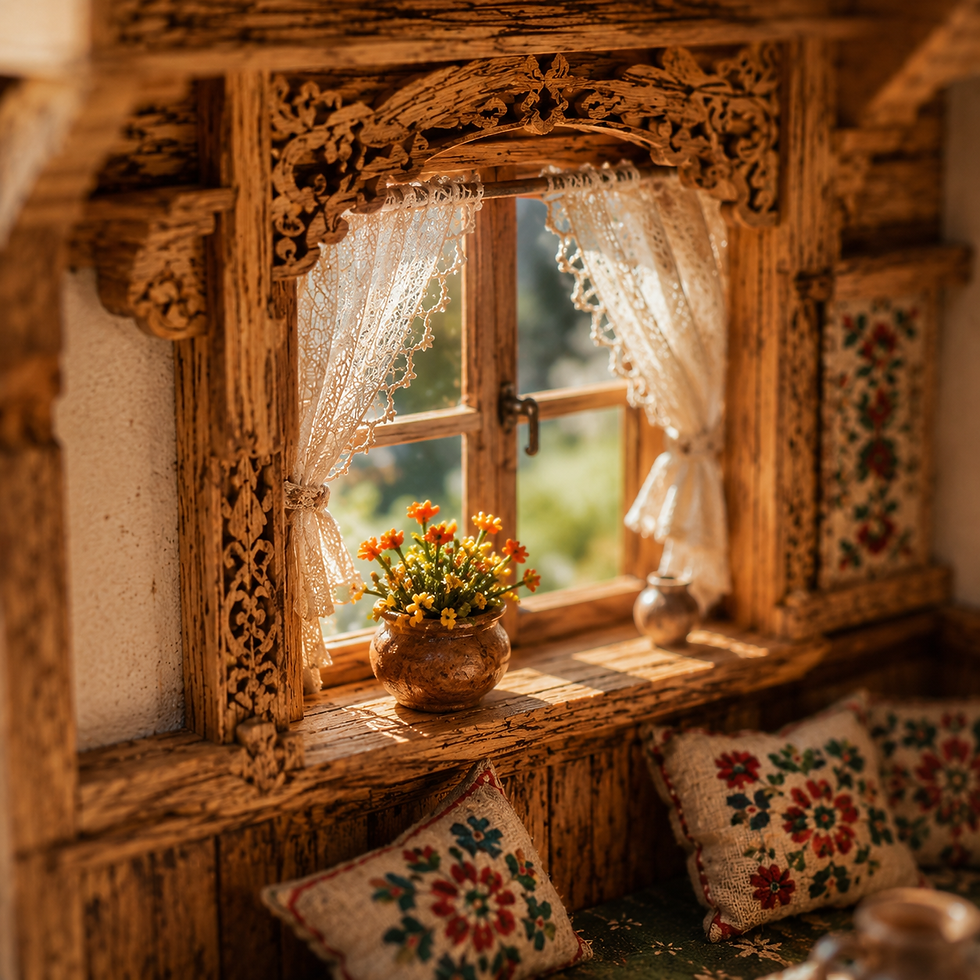
The left-hand bench is all comfort and folk pattern. Green upholstery grounds the corner, while embroidered pillows add red, blue, cream, and floral detail. It feels like a place where boots come off, stories begin, and someone announces soup for the third time.

At the center, the little carved table gathers the room together. A cloth drapes over it with miniature softness, and the pottery pieces feel gently used rather than staged. That matters. Perfect miniatures are impressive; lived-in miniatures are lovable.

The tiled stove on the right is the big personality in the room. White tile, green floral motifs, warm carved wood, a tiny arched firebox, stacked logs, and a decorative metal door all say: “I am practical, beautiful, and slightly dramatic.”

Above everything, the carved timber beams create a snug alpine canopy. They are not just trim; they are atmosphere. The ceiling presses the room into coziness, making the whole scene feel like a storybook tucked under a blanket.

Inspirations – From the Big World to the Small
Zakopane Style, also called Witkiewicz Style, grew from the highland traditions of Poland’s Podhale region and was shaped by artist and architect Stanisław Witkiewicz. Villa Koliba, built in the 1890s, is widely recognized as the first major Zakopane-style house, blending local highlander building traditions with refined villa living.
The style is famous for carved wood, steep roofs, folk ornament, Tatra-inspired motifs, and interiors where furniture, textiles, structure, and decoration speak the same language. Witkiewicz saw highlander carpenters and woodcarvers as essential collaborators, which is exactly the spirit I want miniature artists to carry forward: make the structure and decoration feel like they grew from the same hand.

For real-world inspiration, look at Villa Koliba, Dom pod Jedlami, and the Jaszczurówka Chapel. In miniature, those influences translate beautifully into carved beams, patterned furniture, floral tiles, layered wood tones, and rooms that feel crafted rather than decorated. Dom pod Jedlami is especially useful as a reference because it was conceived as a more complete expression of Zakopane Style inside and out.
Artist Tips – Make Your Own Magic
You are not building an exact replica here. You are stealing the mood like a very polite raccoon with excellent taste. Use this guide as inspiration, not a blueprint. Scale, materials, patience, caffeine levels, and whether your glue bottle decides to behave will all affect the final result.
Also, I write these blogs and use AI image generation to create the illustrations, which means sometimes the tiny world comes out gorgeous and sometimes it invents a chair leg that has unresolved personal issues. That’s fine. We take the good ideas, translate them into real-world miniature methods, and keep moving. Small World Miniatures is built around that mix of image, story, design lineage, and practical making. My background in interior design is a big part of how I think about proportion, light, circulation, and materials at miniature scale.
Shopping List
Raid the house first: cereal box chipboard for walls, coffee stirrers for trim, bamboo skewers for carved beam blanks, scrap fabric for cushions, lace scraps for curtains, toothpicks for chair legs, jewelry findings for stove handles, and bottle caps or beads for pottery.

Structure and walls: basswood strips and sheets, MDF boards and sheets, chipboard, and dollhouse wood floor planks.
Trim and carving cheats: pre-made dollhouse trim, Dollhouse scrollwork appliques, laser-cut details, and styrene strips and sheets.
Paint, glue, and finish: tacky glue + fabric glue, hot glue + PVA/wood glue + super glue, acrylic paints + matte varnish, filler/putty, and gloss gel medium.
Interior goodies: dollhouse upholstery fabric, miniature rugs, dollhouse crockery sets, 1:12 baskets, jars, and bottles, air-dry or baked polymer clay, and mini LEDs and string lights.
A quick note on the links: these are Amazon affiliate links, which means if you buy through them, a tiny bit comes back to help fund Small World Miniatures. I use these instead of those creepy tracker ads that follow you around the internet like a haunted pop-up goat. I’d rather keep the blog cozy, useful, and private-feeling — more tiny teacups, fewer digital goblins.

Deep Dive: Interior Diorama Guide
1. Plan the scale and crop the room
Work in 1:12 scale if you want dollhouse-friendly proportions. A good display nook might be around 10 inches wide, 7 inches deep, and 7 inches tall. You only need two walls, a floor, and a partial ceiling beam system. Don’t build the entire cottage unless you enjoy turning “quick weekend project” into “see you next season.”
Sketch the window on the left wall, the stove on the right, and the bench wrapping the back corner. Keep the table slightly forward so it catches light in photos.
2. Build the bones
Use MDF, foam core, or thick chipboard for the base walls. Reinforce corners with square basswood strips. Add floorboards from coffee stirrers or dollhouse planks, leaving tiny irregular gaps for realism.

For the ceiling beams, use basswood strips around ¼ inch wide, stained dark honey-brown. Add thinner trim strips beneath them to mimic carved profiles. You can carve shallow notches with a craft knife, or fake carved ornament with glued-on scrollwork appliques.
Safety note: sharp blades are tiny goblins. Cut away from yourself, use a metal ruler, and keep your fingers out of the plot.
3. Frame the window
Cut a window opening around 2½ inches wide by 3 inches tall. Use clear acetate or acrylic sheet for glass. Add thin mullions from coffee stirrers or styrene strips.

For curtains, use lace scraps or tissue-thin cotton. Stiffen with diluted white glue, then drape while damp. A soft bow or gathered side panel makes the scene feel cheerful without turning it into a fabric wrestling match.

4. Create the carved wood look
Base coat the wood in a mix of raw sienna, burnt umber, and a touch of yellow ochre. Try roughly 3 parts raw sienna, 1 part burnt umber, ½ part ochre. Once dry, dry-brush lighter tan along edges, then glaze recesses with thin burnt umber.

For folk-style carved patterns, use a fine brush to paint dark scrolls and floral marks onto beams and trim. Don’t overdo every surface. Let some areas rest. Even a maximalist cottage needs to blink.

If you prefer carve the details, start gently. Soft woods like balsa or basswood are your friend here because they let you make shallow marks without needing to become a mountain cabin woodcarver overnight. Sketch a few simple scrolls, leaves, or flower stems with pencil first, then use the tip of a sharp craft knife to make tiny V-shaped cuts along the lines. Keep the blade angled low, take several light passes instead of one dramatic “I am an artisan now” gouge, and always carve away from your fingers. If carving still feels too bossy, press the design in with a dull pencil or embossing stylus, then darken the grooves with thin burnt umber paint. At miniature scale, suggestion does most of the heavy lifting.
5. Build the tiled stove
Foam board, chipboard, or lightweight spackle over a small box form works well. Make it about 3 inches wide, 1½ inches deep, and 4 inches tall. Score tile lines into the surface or glue on small squares of cardstock.
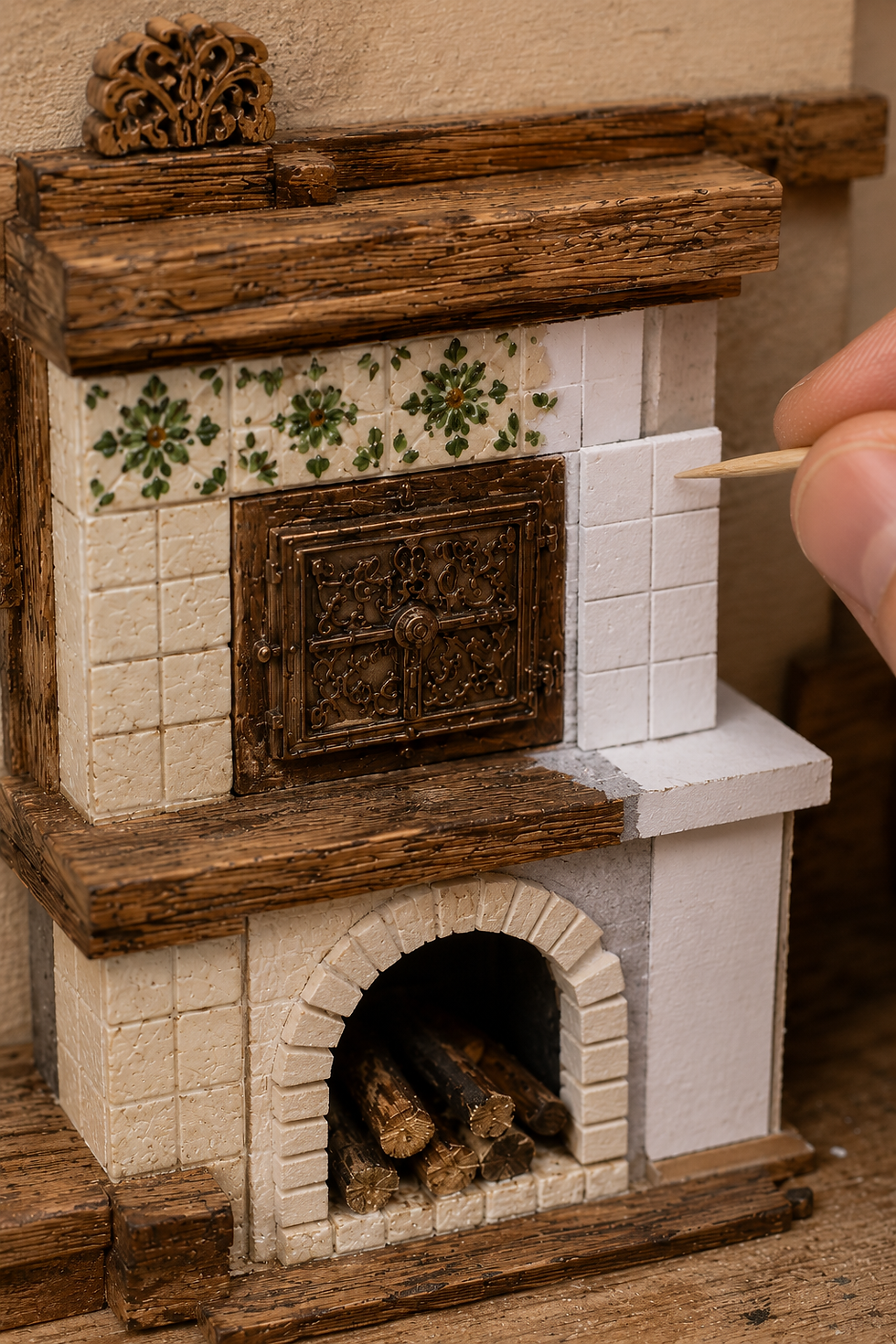
Paint the tiles warm white, not refrigerator white. Add green floral motifs with a toothpick or micro brush. The firebox can be a small arched cutout with black paint inside, stacked twig “logs,” and a bronze-painted rectangle for the stove door.
For a glazed ceramic look, dab on gloss gel medium or gloss varnish only over the tiles. Keep the surrounding wood matte for contrast.

6. Add the bench, table, and chairs
The bench is a simple box with carved trim added to the front. Use thin upholstery foam or quilt batting under fabric for the cushion. Dark green works beautifully against warm wood.
The table should feel chunky and handmade: square top, thick legs, maybe a carved apron. Chairs can be pre-made, kit-bashed, or built from toothpicks and basswood. A heart-shaped or rounded cutout in the chair back gives that folk-cottage feeling.

7. Make textiles do the talking
Use printed fabric scraps, embroidery floss, ribbon, or even reduced paper patterns sealed with matte varnish. For pillows, cut tiny rectangles, glue three sides, stuff with a speck of batting, and close the fourth side while muttering encouraging things.

The rug can be a printed miniature rug, woven ribbon, or fabric sealed to cardstock. Add fringe with embroidery thread. Fringes are tiny drama. Respect them.

8. Add pottery, flowers, and story clutter
Use polymer clay for bowls, pitchers, and vases. Roll bead-sized forms, poke openings with a toothpick, bake or air-dry as directed, then paint with cream, terracotta, green, and blue accents. If you are new to miniature ceramics and pottery, check out our Ultimate Guide to Miniature Ceramics and Pottery!

Shelves need uneven groupings: one tall pot, two squat jars, a tiny bowl, one suspiciously important cup. Add flowers from wire stems and colored paper dots, or use scenic foliage. Keep the palette tied to the room: red, green, cream, ochre, and warm brown.
9. Lighting the scene
For daytime, place the main light outside the window. A warm-white LED panel or desk lamp works nicely. Inside, hide a tiny LED near the stove or behind a beam for a soft golden lift. Aim for 2700K to 3500K warmth indoors and slightly cooler daylight from the window.
Diffuse harsh light with tracing paper. Do not let hot bulbs touch paper, fabric, or foam. Tiny cottage, yes. Tiny electrical incident, no thank you.
10. Finish with a unifying glaze
Mix a very thin glaze: 1 part burnt umber paint, 8–10 parts water or matte medium. Brush lightly into corners, beam joints, under shelves, and behind furniture. This pulls the room together and adds age without making it look abandoned by everyone except spiders.
Troubleshooting
Wood looks flat → Add two dry-brush passes: tan first, then pale cream just on edges.
Room feels too busy → Remove one pattern. Usually the loudest pillow is the culprit.
Tiles look toy-like → Add off-white variation and tiny gray cracks before gloss.
Furniture floats visually → Add shadow glaze under legs and along wall edges.
Window light is too harsh → Diffuse it with tracing paper or move the lamp farther away.
Scale feels wrong → Add a familiar tiny object, like a cup, book, or flower pot, to reset the viewer’s eye.
Photo Tips
Shoot from slightly above table height so the room feels immersive. Use a printed forest or mountain backdrop outside the window, blurred by distance. Put the light source outside the window and let it rake across the table, stove, and rug. A shallow depth of field makes the room feel intimate, but keep the stove and table readable. For a clean gallery look, crop out your workspace completely. No tools, no cutting mat, no glue bottle lurking like an uninvited uncle.

Closing – Until Next Time in the Small World
This little Zakopane-style cottage interior feels like the kind of place where the stove is always warm, the cushions are always embroidered, and Aunt Zosia is absolutely about to tell you that you are holding the teacup incorrectly.
That’s the charm of miniature interiors: they don’t need much space to feel inhabited. A window, a bench, a stove, a rug, a few tiny vessels, and suddenly the whole room has a memory.
Leave a comment with your favorite detail: the carved beams, the tiled stove, the lace curtains, or that tiny table that looks like it has hosted 400 serious snack meetings. Share your own creations with #smallworldminiatures, sign up for the newsletter, take a stroll through the online shop, and keep an eye out for the canvas print version with FREE U.S. shipping.
May your glue dry clear, your chair legs stay even, and your miniature goats remain fictional.
#smallworldminiatures #miniaturediorama #miniaturecottage #zakopanestyle #miniatureinterior #dollhouseminiatures #miniatureartist #miniatureart #scaleモデル #scalemodeling #dioramaart #folkartdecor #cottagestyle #alpinecottage #miniaturephotography #tinyworlds #handcraftedminiatures #dollhouseinterior #miniaturefurniture #miniaturetutorial #miniaturecollector #architectureminiature #fantasyminiatures #cozyminiatures #makersgonnamake






Comments