



The One With the Tiny Purple Door: A Miniature Monica’s Kitchen and Entry Diorama from Friends
Updated: 2 hours ago

First Impressions in Miniature
Could this miniature Monica’s kitchen and entry diorama be any more instantly recognizable?
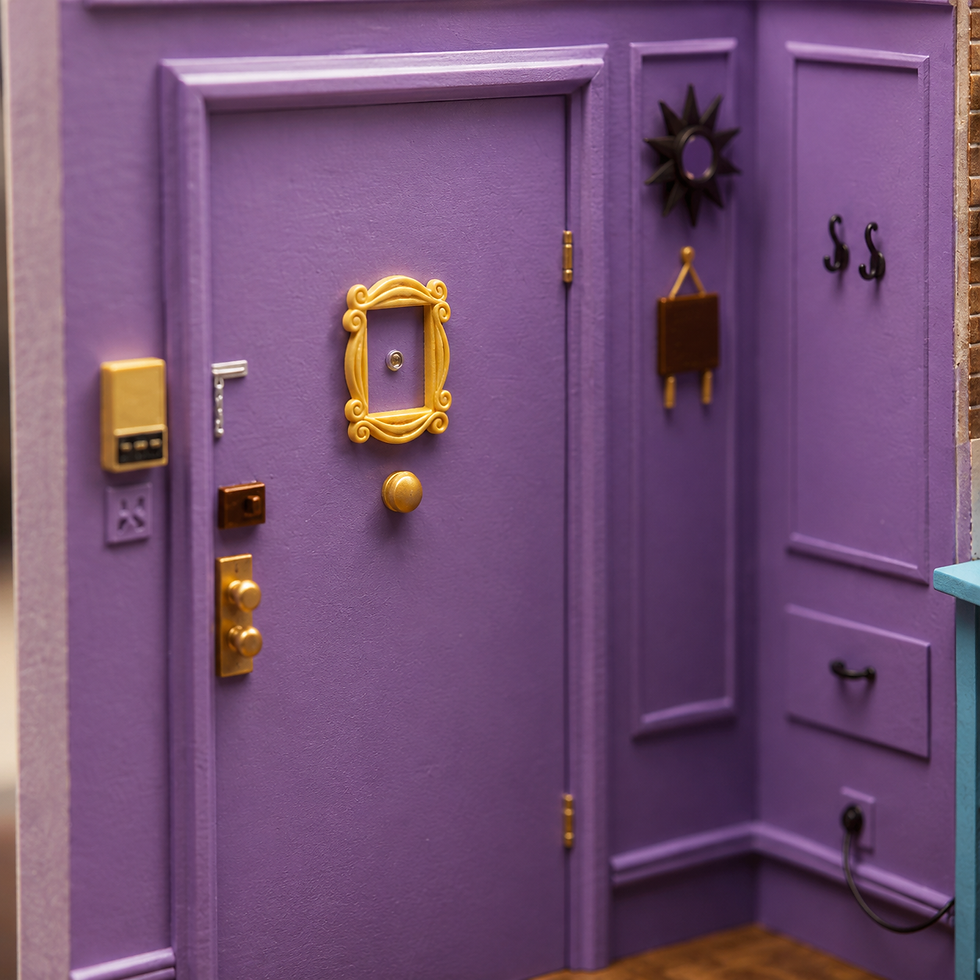
There’s the purple entry, the sunny yellow peephole frame, the exposed brick, the blue kitchen cabinets, the round table, the white fridge, the little pots and dishes, and just enough domestic chaos to suggest somebody is about to announce dinner while five other people interrupt with emotionally urgent nonsense.

I love this model because it captures the Friends apartment feeling without needing the whole living room. It’s a compact slice of TV comfort food: half sitcom set, half dollhouse kitchen, and fully prepared to host a Thanksgiving meltdown. Keep reading, because later in the post we’ll get into a practical build guide for making your own Friends-inspired miniature apartment kitchen, from kitbashed cabinets to tiny show easter eggs.
The One Where the Set Became a Character
Since this miniature is based on Monica’s kitchen and entry from Friends, our “Tiny Tale” is less invented folklore and more production lore—with a side of me standing at Warner Bros. Studios in California grinning like I’d just found Ugly Naked Guy’s binoculars.
Friends debuted on NBC on September 22, 1994, and ran for 10 seasons and 236 episodes before the finale aired on May 6, 2004. It was created and executive-produced by Marta Kauffman and David Crane, with Kevin S. Bright also serving as executive producer, and it was shot at Warner Bros. Studios in Burbank while pretending, with magnificent confidence, to be Greenwich Village.

The apartment set has its own miniatures connection, which delights me to no end. Production designer John Shaffner has talked about presenting a small white model of the set, then painting it purple when the producers asked about color. That choice helped make the apartment read instantly on television: switch channels, see purple, know you are home.
The real set was full of deliberate visual storytelling. Shaffner told Architectural Digest that
Monica’s apartment pulled from memories of his own New York walk-up, including open kitchen shelving and that romanticized, slightly softer version of city life where everyone’s door is apparently unlocked and nobody is worried about package theft. The pilot sets were built on a tight budget, and the famous apartment became a collage of smart compromises, borrowed scenic backdrops, secondhand-feeling objects, and color choices strong enough to survive standard-definition television.

A few set details are practically begging to be miniaturized. Monica’s walls are often associated with Benjamin Moore’s Persian Violet 1419, while the kitchen balances that purple with blue cabinetry, exposed brick, golden curtains, and warm neutral furniture. The peephole frame is so beloved that the Warner Bros. Studio Tour shop currently sells a replica door frame, which tells you everything you need to know about the power of one ridiculous yellow rectangle.
When I toured the Friends set area at Warner Bros., the thing that struck me most wasn’t just the nostalgia. It was how theatrical the space is in person. TV sets are not normal rooms. They are traps for light, movement, jokes, and entrances. Everything is slightly arranged for performance. That’s exactly why the apartment works so beautifully as a miniature: dollhouse builders already know how to make a room feel alive from one viewing angle.

Easter egg to spot in your own version: tuck a tiny frame, a jam jar, a Thanksgiving turkey reference, and a little “Transponster” note somewhere in the kitchen. It is not a word, but it is absolutely a tiny paper prop.
A Guided Tour of the Build
The entry is pure purple confidence. The door sits inside a paneled wall with trim that feels almost too grand for a New York apartment hallway, which is part of the joke. The gold peephole frame glows against the violet like a tiny museum label for domestic nonsense.
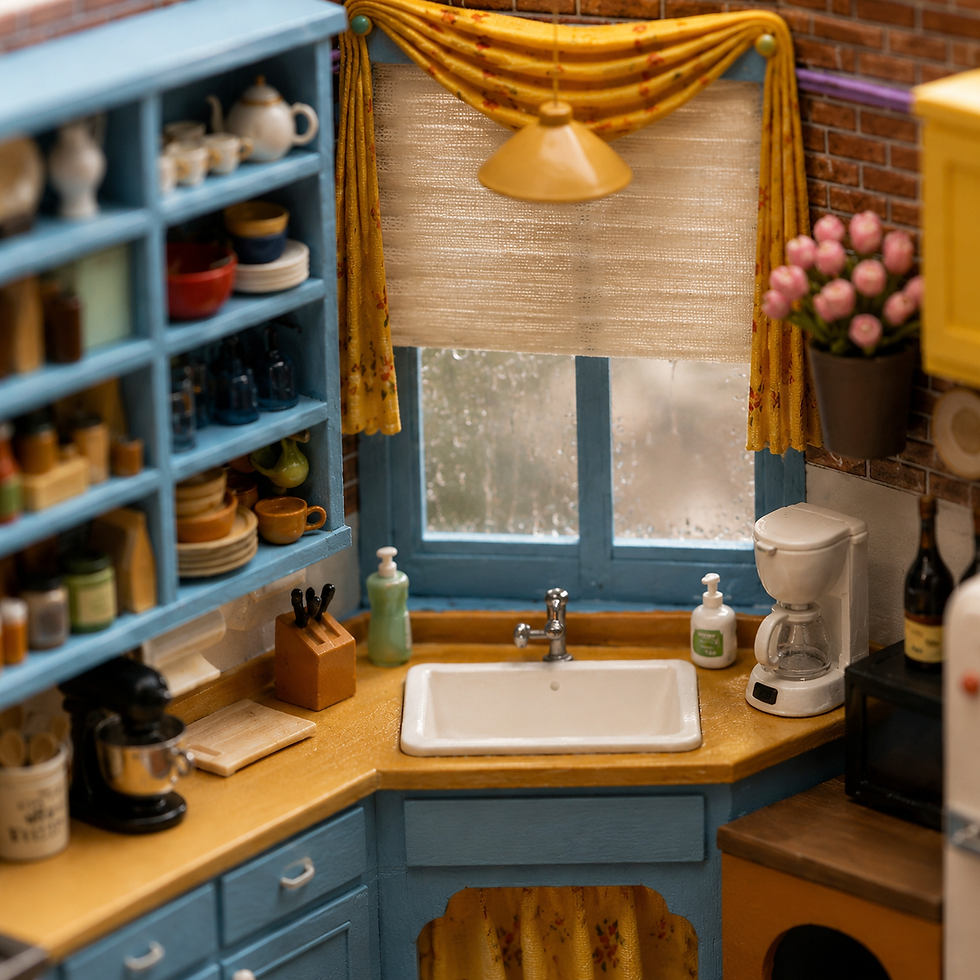
The kitchen begins at the exposed brick wall, warm and textured behind the open shelving. The blue shelves are packed with bowls, jars, plates, and little bits of color, giving the scene that “collected over years” feeling instead of “everything came from one matching catalog.”

The counter run curves around the sink and window, where the pale blue frame and golden curtains soften the brick. It feels like morning coffee, rainy glass, and someone yelling from the other room that they were on a break.
The stove area is wonderfully busy. Hanging pans, a red pot, a yellow kettle, and a small lamp make the kitchen feel mid-use, not staged. It’s exactly the kind of space where a miniature apple bowl becomes a tiny supporting actor.

The dining table brings the scene forward. The mismatched chairs, breakfast plates, coffee mugs, and scattered paper give the model its lived-in rhythm. A perfect miniature room should look like the people just stepped away. This one looks like they stepped away because someone said something unforgivable about dessert.

Inspirations – From the Big World to the Small
This miniature sits in a fun design family tree: Greenwich Village walk-up meets 1990s sitcom set meets flea-market maximalism. It is not sleek. It is not minimal. Thank goodness. Minimalism would have lasted eight minutes in Monica’s apartment before someone labeled the negative space.

The first real-world influence is the old New York apartment. Shaffner specifically connected
Monica’s apartment to his West 14th Street walk-up memories, and you can feel that DNA in the open shelves, exposed brick, and slightly improvised domestic charm. In miniature, that translates beautifully through layered shelves, visible cookware, and walls that look like they have survived several roommates and at least one emotionally charged lasagna.

The second influence is the theatrical sitcom soundstage. Warner Bros. Studio Tour currently includes recreated Friends spaces, including Monica’s apartment, Chandler and Joey’s apartment, Central Perk, and a Greenwich Village set area inside Stage 48: Script to Screen. That matters for miniature artists because a TV set is already a kind of life-sized diorama. It is built for sightlines, color reads, and story at a glance.
The third influence is eclectic apartment decorating—the sort of found-object style associated with secondhand shops, sidewalk finds, mismatched furniture, and “this lamp has a past, but we don’t ask questions.” Shaffner and set decorator Greg Grande leaned into Monica as someone who would gather interesting pieces, and the apartment’s mix of blue, purple, brick, gold, wood, and vintage oddities made her home feel personal. In miniature scale, that means you do not need perfect matching sets. You need contrast, repetition, and a few objects with personality.
Artist Tips – Make Your Own Magic
You’re not building a museum-certified reproduction here. You’re making a Friends-inspired miniature kitchen diorama with the spirit of Monica’s apartment, not a court-admissible floor plan. Results will vary, scale will argue with you, and at some point a tiny spoon may disappear into another dimension. I write the blogs, and some of the tutorial illustrations I use are made with AI image tools, which means the occasional chair may have mysterious ambitions. Treat this as inspiration, not gospel.
For personal fan art, keep trademarked logos and copyrighted imagery out of anything you plan to sell unless you have permission. For your own shelf, go wild with references. For your shop, be careful and make it “inspired by” rather than a direct branded replica.
Shopping List
I use Amazon affiliate links for supplies where helpful. They help fund the tiny world without those creepy tracker ads that chase you around the internet whispering, “Remember that glue you looked at once?”

Structure and walls: Reuse foam board, mat board, cereal box cardboard, coffee stirrers, old picture-frame backing, or packaging chipboard. Buy MDF boards and sheets, chipboard, basswood strips and sheets, or XPS foam board.
Cabinets and built-ins: Reuse popsicle sticks, bamboo skewers, gift-card plastic, toothpaste-box cardboard, and bead caps. Buy basswood strips and sheets, styrene strips and sheets, styrene rod and tube, pre-made dollhouse trim, and miniature hardware pulls.
Floors and finishes: Reuse printed paper, scrapbook paper, wood veneer scraps, brown paper bags, and matte packaging. Buy dollhouse wood floor planks, acrylic paints and matte varnish, modeling paste/lightweight spackle, pigment powders, and satin/gloss varnish.
Props and kitchenware: Reuse beads, pen caps, tiny buttons, jewelry findings, foil, seed beads, bottle caps, and printed labels. Buy dollhouse crockery sets, 1:12 baskets, jars, and bottles, air-dry or polymer clay, 3D-printed accessories, and dollhouse accessories.
Windows, lighting, and glass: Reuse clear packaging, acetate from product boxes, tracing paper, fairy lights, and old phone-screen protectors. Buy pre-made miniature windows/doors, acrylic sheets, light diffusion film/tracing paper, and mini LEDs/string lights/light kits.
Tools: You’ll want a hobby knife with fresh blades, metal ruler and cutting mat, tweezers, sandpaper/emery boards, pin vise/tiny drill bits, clamps or pins, and a fine detail brush set.

Deep Dive: Build the Apartment Chaos
1. Safety first, because tiny stitches are still stitches
Use sharp blades, cut away from yourself, and ventilate when painting or gluing. Keep solvents away from flames, pets, snacks, and children who believe every bead is a forbidden cereal.
2. Plan the scale and footprint
For 1:12 scale, a compact room box around 14–18 inches wide, 10–12 inches deep, and 9–10 inches tall gives you enough room for the purple entry, kitchen wall, table, and fridge without needing a Manhattan lease. Sketch the back wall as an L-shape: entry on the left, kitchen along the back, fridge and yellow wall cabinet on the right.
3. Build the bones
Cut the base from MDF or foam board. Add two walls at a right angle and brace them underneath with scrap blocks. Score panel lines in the purple entry wall before painting. Add baseboards, chair rail, and door trim from basswood or styrene strips. Keep everything square; sitcom friendships can wobble, but your walls should not.

4. Make the purple entry
Mix a purple close in spirit to Monica’s walls: 3 parts violet, 1 part warm lavender, a dot of gray, and a tiny touch of cream. Paint the wall matte, then dry-brush a lighter lavender on raised trim. For the yellow frame, bend thin wire into a rectangle or cut one from cardstock, then paint it buttery gold-yellow. Add a bead or nailhead for the doorknob.

5. Add brick without losing your mind
Use embossed brick paper, egg-carton bricks, or scribed foam. Paint a base of terracotta, then dab individual bricks with burnt sienna, brick red, tan, and muted brown.

Wash the mortar lines with thin gray-beige. Too clean looks fake. Too filthy looks like the landlord gave up in 1987. Aim for warm and lived-in.
For more ways to give that wall its lived-in texture, explore the miniature masonry guide, with brick patterns and weathering ideas you can adapt to the kitchen.

6. Kitbash the kitchen cabinets and built-ins
Use basswood or chipboard boxes for lower cabinets. Doors can be rectangles of cardstock with thin trim strips. Paint the cabinets a cheerful blue: 2 parts turquoise, 1 part sky blue, a pinprick of gray. For the open shelf unit, build a shallow rectangle, divide it into cubbies, then fill it with plates, jars, bowls, and books. The secret is density. One bowl looks lonely. Twenty tiny things look like Monica has a system.

7. Build the counters, sink, and stove zone
Use coffee stirrers or painted chipboard for butcher-block counters. Stain them honey brown, then add a thin sepia wash along the edges. The sink can be a small white plastic tray, polymer clay rectangle, or painted bead packaging. Faucet: bent wire plus seed beads. Stove knobs are seed beads or tiny punched circles. Pots are bead caps, buttons, and painted polymer clay.

8. Make the fridge and yellow upper cabinet
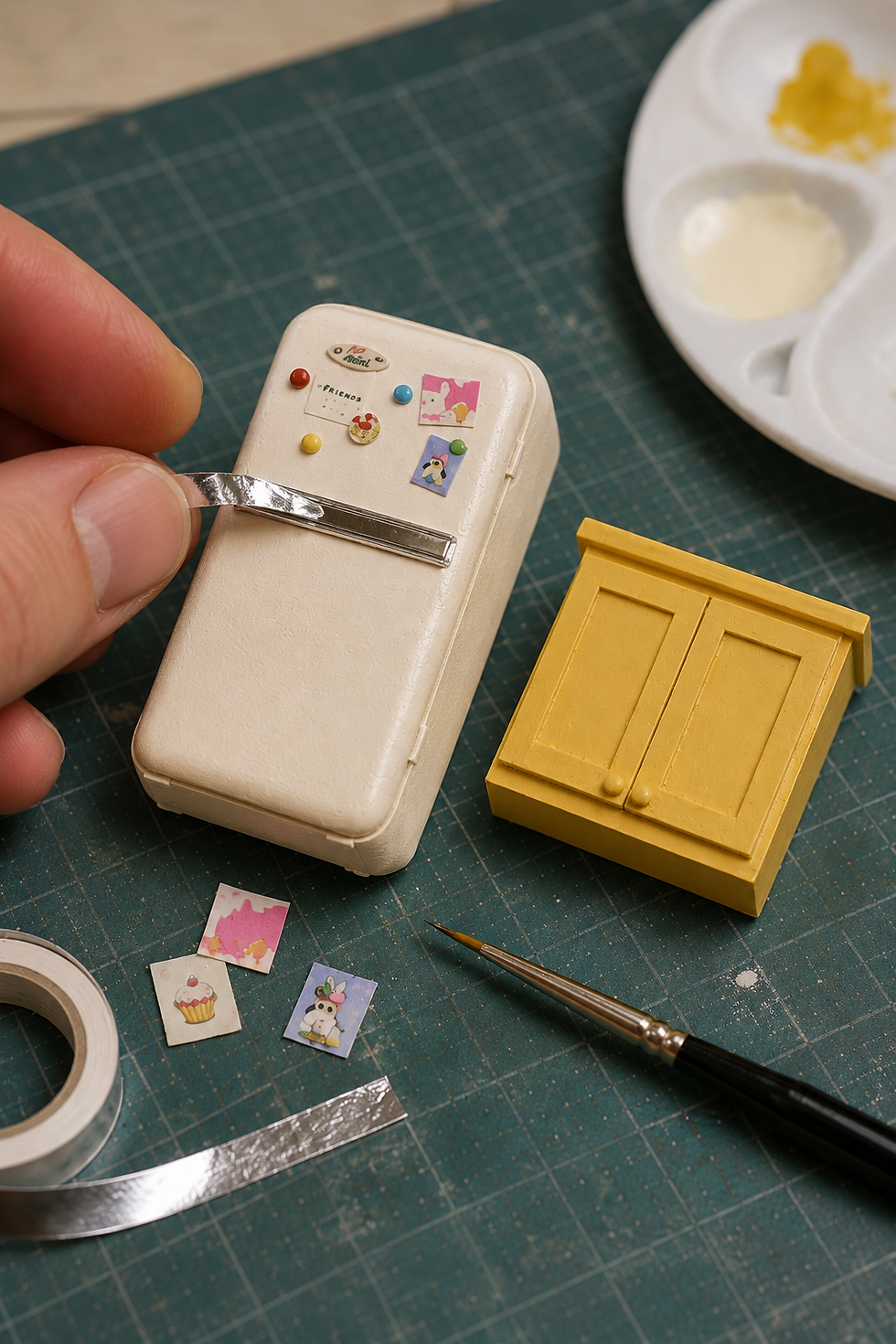
The fridge is a rounded rectangle illusion. Cut a foam or wood block, sand the edges, paint warm ivory, and seal with satin varnish. Add chrome strips from foil tape. Magnets can be tiny paper scraps sealed with matte varnish. The yellow cabinet above it should be simple and chunky, painted golden yellow with a pale highlight on the top edge.
9. Build the table and chairs
For the round table, cut a circle from basswood or layered cardstock. Use a dowel or thread spool core for the pedestal, then stain with walnut and dry-brush amber. Chairs can be purchased, 3D printed, or kitbashed from coffee stirrers and toothpicks.

Mismatching is your friend. Paint one white, one natural wood, one with a purple cushion, and suddenly it feels collected instead of assembled by a committee.

10. Add curtains, plants, and soft details
The curtains should be golden yellow, slightly theatrical, and a little too fabulous for the window. Use thin cotton, tissue soaked in diluted glue, or ribbon. Pleat it while damp and let it dry. Add pink flowers by rolling tiny polymer clay dots or using flower flocking. A black planter against the brick gives the window a nice punch.

11. Light the scene
Warm white LEDs are best. Try a small USB-powered light strand tucked behind the upper wall, with tracing paper or diffusion film to soften hotspots. Keep the temperature warm, around 2700K–3000K, so the blue cabinets stay cozy instead of dentist-office blue.
12. Add easter eggs from the show
Make a tiny jam jar, a Thanksgiving recipe card, a “Transponster?” note, a little yellow picture frame, a mini foosball reference on a scrap of paper, a tiny turkey, or a folded “Pivot” moving plan. A small black umbrella near the door is another fun nod. Keep them subtle. Easter eggs are seasoning, not soup.

13. Photograph it like a TV set
Place your diorama on a table near a window, but diffuse the sunlight with a white curtain. Use a dark blurred background so the colors pop. Shoot low, around table height, so the viewer feels invited inside. Add one practical light in the room and a soft fill from the front. The best angle for this scene is slightly above table level, looking from entry toward fridge, so the purple wall and kitchen both get their moment.

Troubleshooting
Purple looks too loud → Add a thin gray-lavender glaze and matte varnish. It should sing, not honk.
Cabinets look flat → Dry-brush pale blue on edges and add darker blue in panel grooves.
Brick looks printed → Stipple a few bricks with tan, rust, and brown, then add a dusty beige wash.
Props look oversized → Group large items toward the back and reserve the table for the best-scale pieces.
The room feels empty → Add layered clutter: hanging pans, counter jars, folded towels, paper scraps, bowls, and one suspiciously important mug.
Lighting is too harsh → Bounce the light off white card or add tracing paper between LEDs and the scene.

Until Next Time in the Small World
This miniature makes me want coffee, Thanksgiving leftovers, and a group of friends willing to deliver a punchline from the doorway. Monica’s kitchen works because it is colorful, specific, and packed with memory. In miniature, those qualities get even better. A tiny yellow frame is funny. A tiny yellow frame on a purple wall is practically a doorbell you can hear.
Tell me your favorite detail: the fridge magnets, the blue shelves, the purple entry, the little table, or the inevitable off-screen argument about whether something was, technically, a break. Share your own creations with #smallworldminiatures, sign up for the newsletter, and wander through the online shop.
Until next time, may your walls be square, your glue behave, and your tiny kitchen never run out of coffee.
#smallworldminiatures #miniature #miniatures #miniatureart #miniatureartist #miniaturediorama #dioramaart #dollhouseminiatures #dollhousekitchen #miniaturekitchen #miniaturefurniture #miniatureprops #kitbash #kitbashing #scalemodel #scalemodeling #roomBox #tvsetminiature #friendsinspired #ninetiesnostalgia #tinyworld #tinythings #handmademiniatures #miniaturephotography #interiordesign #setdesign #architectureminiature






Comments