



Miniature Crete House Interior: Whitewashed Walls, Blue Windows, and One Very Opinionated Teapot
Updated: 4 hours ago

Opening – First Impressions in Miniature
You know a miniature is doing its job when I can practically hear the wooden chair scraping the tile and smell something garlicky simmering in a pot the size of a lentil. This traditional Crete house interior miniature has everything I love: chalky white stucco, weathered blue doors and windows, warm clay floor tiles, rustic shelves, woven textiles, tiny pottery, and a view through the open door that basically says, “Cancel your plans. We live here now.”
I have not made it to Greece yet, but it is high on my list for the next few years. Classical world history was one of my favorite subjects in school, and I was always fascinated by Greek architectural tricks, especially columns designed to bulge slightly at the center so they looked perfect to the eye. Tiny buildings do the same kind of magic. They lie beautifully.
Stick around, because later we’ll walk through how to create finishes inspired by this piece: stucco, stone, terracotta tile, sun-beaten wood, textiles, furniture, décor, and that wonderful little rear-door illusion where the room appears to open into a whole blue-and-white world.
Miniature Backstory – The Tiny Tale
Welcome to The House of Auntie Kalliroe’s Missing Ladle, founded in 1897, according to a cracked tile near the doorway and one extremely confident goat who claims he witnessed the ribbon cutting.
The house sits in the fictional village of Koumbaki-by-the-Sea, a place so small that the town square is technically just a chair everyone agrees not to move. Auntie Kalliroe ran the house as a rest stop for fishermen, traveling pot menders, runaway poets, and cousins who arrived “for one night” and stayed through olive harvest.

The blue chairs belong to Uncle Manolis, who paints them every spring, whether they need it or not. The shelves hold jars of oregano, mysterious copper pots, and one bottle labeled “medicine,” which everyone knows is either raki or furniture polish. The hanging lamp is said to flicker whenever someone lies about how many honey pastries they ate.
Local legend says Auntie Kalliroe’s ladle vanished during the Great Lentil Stew Incident of 1923. Some say it was stolen by a jealous neighbor. Others say it gained sentience and fled. Keep your eyes open later: I’ve hidden the missing ladle in the build discussion as an Easter egg, because every tiny house deserves one tiny scandal.

A Guided Tour of the Build
Start at the front edge, where the stone threshold and terracotta floor tiles feel sunbaked and slightly uneven. The floor looks like generations of sandals, chair legs, and dropped olives have done their noble work.

On the left, the blue bench is piled with patterned pillows and striped fabric. It feels soft, casual, and lived-in, the kind of seating where someone says, “Just five minutes,” then wakes up at dinner.

Above it, framed art and small wall objects dot the white stucco. The wall texture is rough, bright, and imperfect, catching shadows in all the little dents and ridges.

In the center, the arched opening frames the back room and the open blue door beyond it. That glimpse of sea and sky is the miniature’s best bit of stagecraft. It turns a shallow box into a whole vacation.

To the right, shelves carry pots, jars, baskets, folded textiles, and a hanging copper light. The clutter feels practical, not random, like everything has been used recently and put away with Mediterranean confidence.
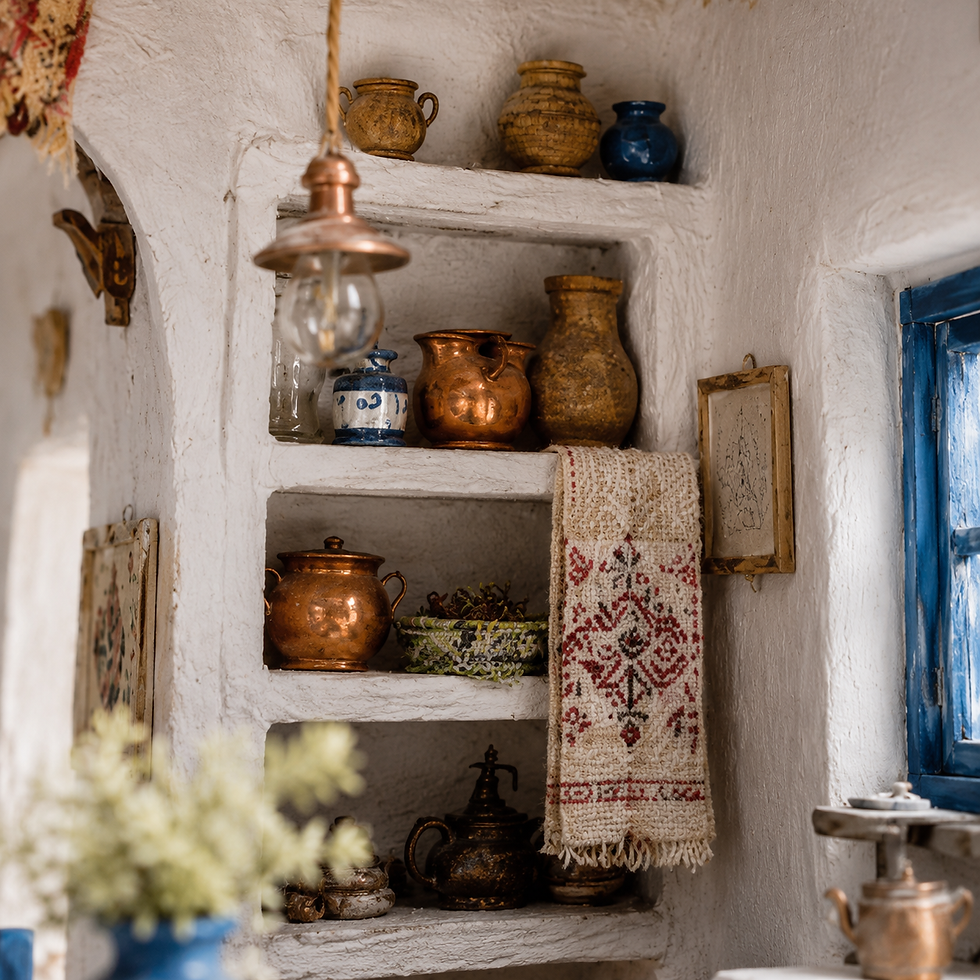
The dining table and blue chairs anchor the room. They bring the eye down to human scale, which in this case is very tiny and probably arguing over bread.

The fireplace in the lower right gives the room its cozy corner. With the basket, kettle, and plants nearby, it becomes the spot where the house whispers, “Yes, I am charming. No, I will not apologize.”

Inspirations – From the Big World to the Small
This miniature belongs to the family tree of traditional Cretan and Cycladic interiors: whitewashed walls, blue-painted wood, handmade surfaces, arched openings, thick walls, exposed beams, and practical built-ins. It also shares visual DNA with vernacular Mediterranean homes where beauty comes from climate, craft, and daily use rather than fuss.
I think of the palace complex at Knossos in Crete, not because this room looks palatial, but because Crete has a long architectural memory: painted surfaces, courtyards, thresholds, storage vessels, and rooms shaped around use. Then there are the old Venetian and Ottoman layers visible in places like Chania and Rethymno, where stone, plaster, timber, and color all overlap in streets that look like history kept changing its mind.

For a miniature artist, the lesson is not “copy this exact house.” It is “borrow the logic.” Thick walls become chunky foam or board. Sunlight becomes warm paint. Sea air becomes chipped blue edges. Handmade pottery becomes clay beads and uneven little vessels. The goal is not museum perfection. The goal is a room that looks as if someone left five minutes ago to yell at a cousin.

Artist Tips – Make Your Own Magic
You are not building an exact reproduction of this miniature. You are borrowing its sun, its textures, its little blue-chair attitude. Your results will vary, and honestly, that is where the fun lives. I write these blogs as Brandon, but when process illustrations appear, I may use AI image generation to help visualize ideas, and sometimes the tiny digital gremlin gives a table three shadows and a vase that looks suspiciously like a potato. Treat this as inspiration, not sacred building law.
Shopping List
Some links below are Amazon affiliate links. Buying through them helps fund the tiny world, which keeps the miniature chairs employed and the imaginary goats supervised.
Structure and surfaces: cereal-box chipboard or scrap mat board; purchasable options include chipboard, MDF boards and sheets, XPS foam board, and modeling paste/lightweight spackle.
Woodwork and furniture: coffee stirrers, popsicle sticks, toothpicks, bamboo skewers, matchsticks; or use balsa wood strips, basswood strips and sheets, dollhouse wood floor planks, and pre-made dollhouse trim.
Tiles, stone, and clay décor: egg carton, air-dry clay, paper clay, broken cork, foam scraps; or try air-dry or baked polymer clay, acrylic paints + matte varnish, and gloss gel medium.

Windows, doors, and details: packaging plastic, toothpicks, thin card; or use pre-made miniature windows/doors, styrene strips and sheets, styrene rod and tube, miniature hardware pulls, and laser-cut details.
Textiles and soft goods: old handkerchiefs, worn cotton shirts, ribbon scraps, embroidery thread; or use dollhouse upholstery fabric, mini trim, lace, and micro fringe, thin upholstery foam + quilt batting, and miniature rugs.
Plants, shelves, pots, and room clutter: dried herbs, tea leaves, beads, bottle caps, paper rolls; or use scenic foliage, dollhouse crockery sets, 1:12 baskets, jars, and bottles, and 3D-printed accessories.
Lighting and adhesive: leftover fairy lights, parchment paper for diffusion, white glue, tacky glue, wood glue, hot glue; or use mini LEDs and string lights, tacky glue + fabric glue, and hot glue + PVA/wood glue + super glue.

Deep Dive: Building a Crete-Inspired Interior Diorama
1. Plan the room like a stage set. Start with a shallow box: roughly 10–14 inches wide, 8–10 inches tall, and 6–8 inches deep for a comfortable 1:12-ish display. Sketch the main shapes first: left bench, center arch, rear doorway, right shelves, fireplace, dining table. Keep the back door slightly off-center so the sea view feels discovered rather than pasted on.
2. Build the bones. Use foam board, MDF, or sturdy chipboard for the walls, floor, and side returns. For thick Cretan-style walls, double up foam board or glue strips around door and window openings. Add the central arch with layered card or carved XPS foam. Do not chase machine-perfect edges. This room wants hand-shaped, sun-worn wonkiness.

3. Create the stucco finish. Mix lightweight spackle or modeling paste with a little white acrylic paint and a drop of tan. Spread it thinly with a palette knife, old gift card, or your finger in a glove. Dab with a stiff brush for texture. Once dry, wash with diluted warm gray, then dry-brush ivory and soft white over the raised areas. Keep corners darker. Real walls gossip in the corners.

4. Make the terracotta floor tiles. Cut individual tiles from thin cork, egg carton, chipboard, or air-dry clay. Aim for imperfect squares and rectangles around ¾ inch wide for 1:12 scale. Glue them with hairline gaps. Paint a base of burnt sienna, raw umber, and a touch of yellow ochre. Sponge in pale peach, dusty gray, and brick red. Add a thin dark wash between tiles, then dry-brush the edges with pale sand.


5. Add stonework without making it look like a dungeon. For the front threshold and wall edges, use egg carton stones or carved foam. Paint them warm limestone: ivory, beige, gray, and a little raw umber. Avoid heavy black lines. Mediterranean stone usually feels sun-bleached, not haunted-castle dramatic. A final dry-brush of off-white ties it back to the stucco.

6. Build the blue doors and windows. Use coffee stirrers or basswood strips. A simple door can be three vertical planks on two horizontal braces. Paint it deep Aegean blue, then streak with turquoise, navy, and pale sky blue. When dry, lightly sand the edges or dab on tan chips with a tiny brush. For glass, use clear packaging plastic or acrylic sheets. Keep panes slightly reflective with a touch of gloss varnish.

7. Fake the view beyond the rear door. This is the trick that makes the room breathe. Place a small printed or painted seascape 1–2 inches behind the open doorway, not directly on the wall. Blur the horizon slightly. Add a tiny balcony edge, potted plant, or white wall silhouette in front of it. The layers fool the eye into reading distance. Blue door, pale sky, dark sea line, tiny plant: boom, vacation portal.

8. Weather the wood beams. Use twigs, carved balsa, or basswood strips. Gouge shallow grain lines with a blade or wire brush. Base coat in raw umber, wash with dark brown, then dry-brush tan and gray. Add a few almost-black knots. For aged overhead beams, keep the underside darker and the top edges dusty, as if the house has been collecting summer for a century.

9. Craft the bench and chairs. For the bench, build a simple box base with arms from basswood or scrap sticks. Paint it the same blue family as the doors but slightly lighter or more worn. Chairs can be made from toothpicks, square dowels, and thin strips. For woven seats, wrap embroidery thread or raffia around the frame. Do not panic if the first chair looks tipsy. Tiny furniture has opinions.

10. Make the table and shelves. A rustic table is a square top on chunky legs with cross braces. Distress the top with scratches before painting. Shelves can be built directly into the wall using strips of wood or card, then blended with stucco around the edges. This makes them feel carved into the house rather than installed after a miniature shopping spree.

11. Add pottery, baskets, and kitchen clutter. Roll tiny pots from polymer clay or air-dry clay. Beads also make excellent jars if you cap them with clay circles. Paint pottery in ochre, umber, copper, cream, and dusty blue. Baskets can be coils of twine around a small form. Add a little kettle, bowls, folded towels, and yes, Auntie Kalliroe’s missing ladle tucked behind a pot on the right shelf.

12. Create textiles with believable weight. Use thin cotton, gauze, or worn fabric. For pillows, wrap fabric around a bit of quilt batting or upholstery foam and glue the back seam. Add stripes with paint pens or embroidery thread. For hanging towels and rugs, fray the edges, add micro fringe, and dirty the lower edge with diluted tan paint. Textiles should look soft, not like laminated napkins.

13. Paint pattern without losing your eyesight. For Cretan-inspired textiles, suggest pattern instead of reproducing every stitch. Use repeating dots, X marks, diamonds, and short red or blue lines. A 3:1 mix of fabric color to water keeps the paint from sitting too thick. Red, indigo, cream, and faded brown look right at home here.
14. Light it gently. A warm white mini LED strand or USB-powered light works beautifully. Hide one light above the shelves or behind a beam. Diffuse it with parchment paper, vellum, or frosted plastic so it glows instead of blasting the room like a tiny interrogation. Warm light, around the color of a candle or old bulb, makes the stucco and terracotta sing.
15. Photograph with a believable backdrop. Place the diorama near a window with soft side light. Use a gray, cream, or pale blue background outside the model so the white walls stand out. Shoot slightly below eye level, as if you are standing in the room. For the rear doorway, make sure your seascape is softly lit and not too crisp. Real distance loses detail.

Troubleshooting
Stucco looks like cake frosting: Sand lightly, then dry-brush with ivory to calm the peaks. Next time, apply thinner layers.
Tiles look too clean: Add diluted raw umber into the grout lines and dab pale dust near edges.
Blue paint looks plastic: Sponge on gray-blue, sand edges, and add a matte varnish.
Furniture looks oversized: Trim legs and backs first. Tiny chairs become believable when the seat height feels right.
Backdrop looks flat: Move it farther back, blur it slightly, and add a foreground object like a plant or balcony rail.
Textiles look stiff: Wash fabric first, use thinner material, and shape it while damp with watered-down glue.
Closing – Until Next Time in the Small World
This miniature Crete house interior has me ready to book a ticket, study ancient columns again, and apologize to Auntie Kalliroe for suspecting the goat. The white stucco, blue woodwork, clay tiles, rustic furniture, and tiny sea view all work together like a good family dinner: loud, warm, slightly chaotic, and impossible to leave early.
Tell me your favorite detail in the comments. Is it the fireplace, the blue table, the open door, the textiles, or the possibly guilty pottery shelf? Share your own miniature creations with #smallworldminiatures, sign up for the newsletter, and wander through the online shop.
Until next time, may your glue dry clear, your chairs sit level, and your missing ladles return before soup.
#smallworldminiatures #miniatureart #miniaturediorama #dollhouseminiatures #miniaturehouse #cretehouse #greekarchitecture #mediterraneanstyle #traditionalcrete #miniatureinterior #miniaturefurniture #dioramaart #scalemodel #modelmaking #miniaturetiles #miniaturestucco #miniaturewoodwork #miniaturetextiles #tinyworld #miniaturephotography #handmadeinspiration #architecturalminiature #fantasyminiature #miniaturecollector #tinyhouseart










Comments