



A Tiny Hacienda of Suds: A Traditional Mexican Bathroom Miniature Diorama (and How to Build Your Own Little Oasis)

Opening – First Impressions in Miniature
You know a miniature has the juice when you look at it and immediately want to wash your hands—politely, reverently, and maybe while humming a dramatic telenovela theme song.
This little bathroom vanity scene hits me like a warm blast of lamplight: sun-baked plaster walls, joyful Talavera-style tiles, shelves packed with pottery, and that absolutely scandalous ornamental mirror frame that looks like it could whisper, “Don’t worry, I know you’re late. I won’t tell.”
Also: stay with me, because later in this post I’m dropping a full, practical build guide so you can make your own version of this vibe—tiles, textures, pottery and all.
Why This Photo Needs VIP Treatment
This image is dressed for the web—meaning it’s crisp enough to make you zoom in and start emotionally adopting tiny jars, but it’s not optimized for that print-sharp, hang-it-on-the-wall-and-stare-at-it-during-Zoom-meetings life.

If you want this scene in full “gallery lighting, forever” mode, this is exactly the kind of piece that deserves a high-resolution canvas print. Think: rich colors, that warm glow, and tile patterns that don’t mush together when you step closer. And yes—if you order the canvas print, it ships FREE in the U.S. (Your wall gets a tiny vacation. Your guests get confused in a good way.) https://www.smallworldminiatures.com/product-page/mexican-bathroom-vanity-el-lavabo-de-la-suerte-miniature-canvas-print
Miniature Backstory – The Tiny Tale
Locals call it El Lavabo de la Suerte—The Lucky Washbasin—and if you believe the rumors (you should), it’s been quietly blessing messy lives since 1932, when Doña Mireya “borrowed” a sink from a closing hotel and installed it in her family courtyard home with the confidence of a woman who never once asked permission from a man named Harold.
The vanity became a neighborhood landmark. People didn’t just wash hands here—they came to reset their luck.
A musician would rinse his fingers before a show so the chords behaved.
A baker would dab water behind her ears so her conchas rose properly.
A kid would stare into that ornate mirror and practice brave faces before the first day of school.

Over the years, the shelves filled with tiny proofs of life: a striped jar from a cousin in Puebla, a lidded pot traded for a basket of limes, a little bowl that definitely once held candy and now holds “bathroom necessities” because adulthood is just re-labeling things.
And in the middle of it all, the tiles—bright and stubborn—kept the whole place cheerful even when the day wasn’t. Easter egg to spot: there’s a suspiciously heroic little accent in the décor that locals swear is a nod to San Jabón, patron saint of soap and second chances.
A Guided Tour of the Build
Step closer and it’s all texture and warmth.
The walls have that hand-troweled, sun-worn plaster look—like a place that’s heard a thousand conversations and survived at least three dramatic family reunions. The lower wall band glows in earthy orange tones, the kind that makes everything feel like late afternoon.

Then the tilework kicks in—playful patterns, floral bursts, little geometry moments—like the wall itself decided to throw a party and invited every color it’s ever met. The floor continues that rhythm, patchwork-style, with each tile behaving like it has a personality (some are tidy, some are chaos goblins, and somehow it all works).

Center stage: the vanity. Carved details, a stone-like counter, a simple basin that feels cool even in miniature. Underneath, woven baskets line up like they’re waiting for instructions. Above it all is that mirror—ornate, swirling, and slightly theatrical—reflecting a warm interior glow that makes the whole scene feel inhabited.

And the shelves? Absolute bliss. Pottery in different shapes and stripes, tiny bottles, folded towels, a little plant in a pot, stacks of small items that read as “someone lives here” instead of “a display was staged here.”

There’s even seating—because this is the kind of bathroom where someone would sit down and say, “Okay but listen to what my cousin did…”
Inspirations – From the Big World to the Small
This miniature is rooted in real-world Mexican design language, and you can feel the lineage.
Frida Kahlo’s Casa Azul (The Blue House) Not because this scene is blue—more because Casa Azul is a masterclass in color as a heartbeat. Bold color + grounded tradition + personal objects everywhere. The miniature captures that same “collected life” feeling: functional space, but with art baked into the everyday.
Luis Barragán (especially Casa Gilardi vibes) Barragán’s work is famous for emotional color, quiet drama, and the way light turns a wall into a mood. That warm glow reflected in the mirror? That’s the miniature equivalent of “architecture as feeling.” Simple forms made cinematic through texture and color choices.

Talavera tradition (Puebla’s ceramic heritage) Those tile motifs—florals, geometric bands, bright accents—echo the spirit of Talavera-inspired surfaces: pattern as celebration, craft as identity. In miniature scale, that energy becomes even more powerful because each tiny motif reads like an intentional brushstroke.
What’s special here is the adaptation: the “big world” references translate into small-world decisions—thicker texture so plaster reads from a distance, bolder contrast so tiles don’t blur, and carefully clustered accessories so the shelves feel abundant without becoming visual clutter soup.
Artist Tips – Make Your Own Magic
You’re standing in front of your own blank little wall, and you can already smell the imaginary warm air and hear the tiniest faucet drip. This is where the fun starts.
Quick note before we sprint into craft chaos: this guide is inspiration, not a carbon-copy blueprint. Your build will have its own quirks—because your hands are different, your materials are different, and also because the tiny “illustrations” in my head occasionally insist a towel is a croissant. (It happens. We move forward bravely and try to ignore the hate comments on Pinterest from anti-AI evangelists.)
Shopping List (with clever household swaps + buy-it options)
Structure & walls
Household: cereal box chipboard, foam packaging, thin corrugated cardboard, popsicle sticks
Buy-it: XPS foam sheets, basswood sheets, chipboard panels
Tile & pattern
Household: scrapbooking paper, junk mail gloss, tissue paper, washi tape, empty tea box cardboard
Buy-it: printable waterslide decal paper, miniature tile sheets, patterned scrapbook pads
Plaster texture
Household: baking soda + PVA glue, lightweight spackle, old makeup sponge
Buy-it: acrylic modeling paste, texture paste, fine filler/putty

Vanity, shelves, trim
Household: coffee stirrers, toothpicks, takeout chopsticks, broken picture frame bits
Buy-it: basswood strips, pre-cut trim, miniature corbels
Pottery & accessories (the stars!)
Household: air-dry clay, toothpick handles, beads, pen springs for coils, fabric scraps for towels
Buy-it: polymer clay, miniature ceramic-style jars, dollhouse bottles, tiny baskets
Paint & finishing
Acrylic paints (warm whites, terracotta, turquoise, mustard, deep brown)
Matte varnish, satin varnish (for glazed pottery moments)
Dark brown wash (or make your own with paint + water + a tiny drop of dish soap)
Where to buy:
https://www.miniatures.com
https://www.michaels.com
https://www.dickblick.com
https://www.greenstuffworld.com
https://www.etsy.com (search: "1:12 miniature pottery", "talavera miniature tiles")
Deep Dive:
1) Safety + sanity first
Cut away from your fingers. Your fingers are not replaceable like foam board.
Ventilate when using super glue, spray products, resin, or hot wire cutters.
If sanding foam or plaster texture: mask up. Tiny dust is a tiny menace.
2) Planning & scale notes
Pick a scale (1:12 reads perfectly for this kind of vanity scene).A solid “mini bathroom corner” footprint can be around 6–9 inches wide per wall, with 6–8 inches height for the visible wall area (adjust to taste).

Do a quick paper mock-up: wall + floor + vanity block. If it looks good in plain shapes, it’ll look amazing dressed up.
3) Bones (base structure)
Build an L-shaped corner: foam board, XPS, or thick chipboard.
Add a floor plate and brace the corners from behind so nothing warps.
Score “plaster cracks” lightly before texturing so they look embedded, not drawn on later.

4) Windows and doors (yes, even if it’s just “a suggestion”)
This scene has that left-side doorway vibe—perfect for depth.
Cut a doorway opening and add simple trim.
For a door panel: layered card + a thin strip as a frame.
Paint it a muted cool tone (dusty teal/blue-gray) so it contrasts warmly with terracotta walls.
5) Finishes: plaster, base color, and the weather stack
Plaster texture:
Smear lightweight spackle thinly with a card.
Tap with a sponge for irregular pores.
Let it dry fully before paint.

Paint recipe (loose, forgiving ratios):
Base wall: warm off-white + a touch of tan (about 5:1)
Warm stains: glaze thin terracotta in patches (about 1:6 paint to water)
Age: a soft brown wash in corners, wiped back with a damp brush
Seal with matte varnish so later washes don’t bite too hard.
6) Tilework (Talavera-inspired without losing your mind)
You have three good options:
Hand-paint: cut tiny “tiles” from card, paint patterns with a micro brush.
Print: design a tile sheet, print on matte paper, seal, and apply as panels.
Hybrid: print the complex motifs, then hand-paint highlights so it feels handmade.
Add a thin gloss or satin varnish over tiles to mimic glazed ceramic.
Pro tip: Slightly vary tile tone (a whisper of cream vs white) so it looks like real mixed batches.

7) Hero piece: the vanity + mirror
Vanity base: stacked chipboard layers or foam, skinned in thin card.
Carving illusion: use layered cutouts, then soften edges with filler.
Countertop: paint as stone—speckle with a stiff brush (cream + gray + a hint of pink).
Mirror trick: use a scrap of mirrored plastic, chrome vinyl, or even smooth foil burnished flat.

8) Utilities and greebles (tiny realism boosters)
Faucet: bent wire + a bead as a knob.
Outlet/switch: tiny card rectangle + a dot of paint.
Soap dispensers: beads, cut sprue, or tiny bottles.
These little “modern crumbs” make the scene feel lived-in.

9) Furniture & soft goods (towels, stools, baskets)
Towels: thin fabric or tissue soaked in watered-down glue, folded naturally.
Stool: a small wood dowel slice or stacked card disks with wood grain painted in.
Baskets: buy tiny baskets or wrap thin paper strips around a form and seal with glue.

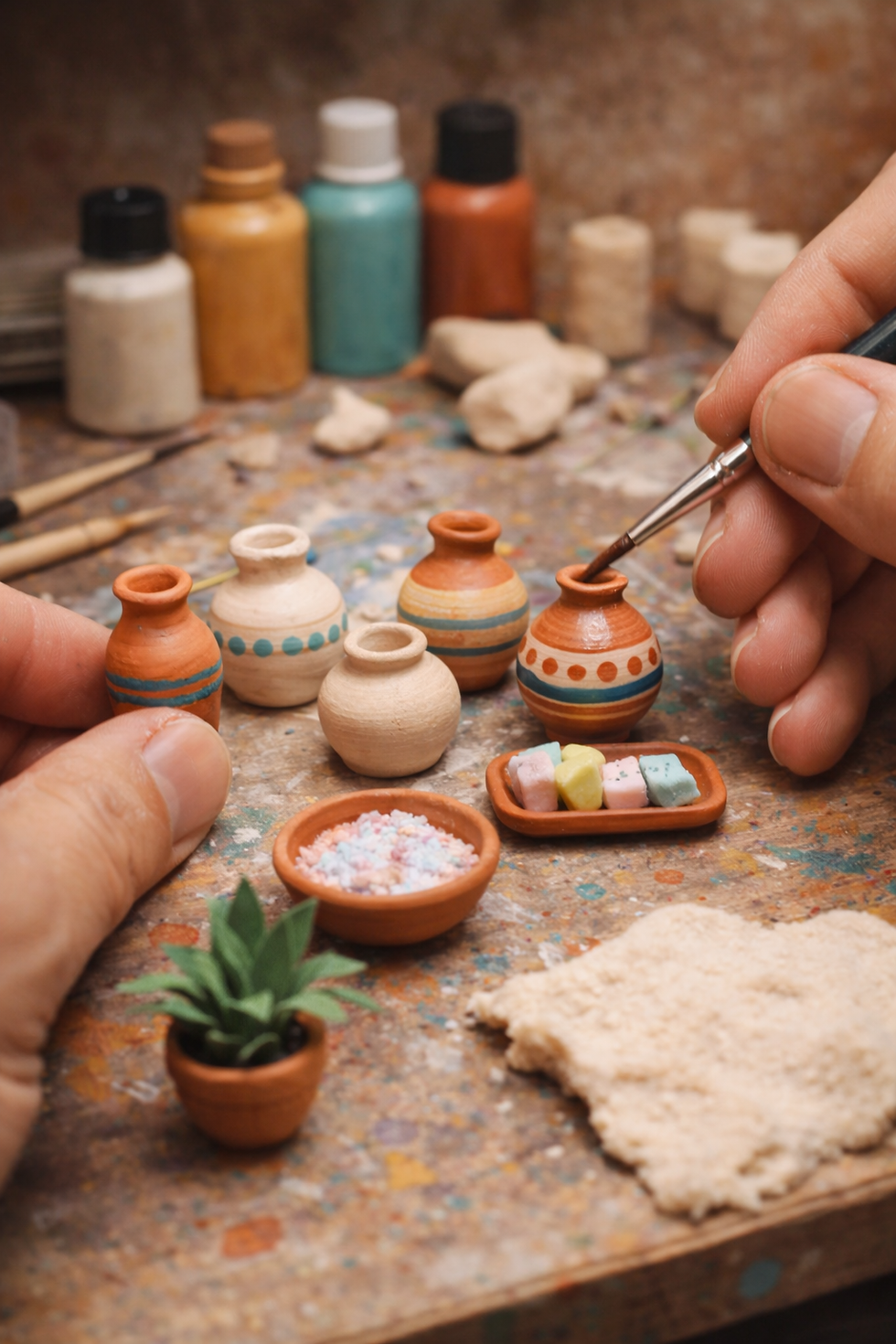
10) Pottery & accessories (don’t skip this—this is the flavor!)
For the pottery look:
Shape small jars from air-dry or polymer clay (simple silhouettes win).
Paint base coats in warm cream or terracotta.
Add stripes/dots in turquoise, mustard, and burnt orange.
Finish with satin varnish so they read as glazed.

Accessory ideas to match this scene:
Tiny bowl with “bath salts” (fine sand + glitter speck)
Little tray of soaps (cut pastel foam, bevel edges)
A plant: paper leaves or clay leaf shapes with a darker green wash
11) Lighting (simple, cozy, believable)
Keep it easy:
USB-powered warm-white mini LED strand behind the scene
Diffuse with tracing paper so it doesn’t look like a tiny interrogation room
Aim for warm temperature so the terracotta sings
12) Story clutter + Easter eggs
Add 3–7 “whispers of life”:
A folded towel slightly off-square
A tipped bottle
A little dish with something bright
One hidden symbol: San Jabón, a tiny luchador sticker, a miniature postcard—your call

13) Unifying glaze/filter + finish
Once everything is in place:
Apply a very thin warm glaze (tan + lots of water) in patches
It pulls the colors together and “ages” the scene instantly
Matte varnish overall; satin selectively on pottery/tiles
14) Photo tips (make it look full-size)
Shoot at eye level with the vanity, not from above.
Use a simple backdrop: warm gray, muted teal, or “stucco beige.”
Add one soft key light + one bounce card (white paper works).
If your phone allows it, tap-to-focus on the sink edge and lower exposure slightly.

15) Troubleshooting (problem → fix)
Tiles look too busy → mute with a thin dusty glaze; reduce contrast on a few tiles
Plaster looks like cake frosting → sand lightly; repaint with thinner layers
Pottery reads like blobs → sharpen silhouettes; add a darker rim line + satin finish
Scene feels flat → push shadows under shelves and inside baskets with a soft wash
Everything looks “new” → edge-wear drybrush + tiny grime in corners
Glue shine everywhere → matte varnish pass, then re-gloss only what should shine
Closing – Until Next Time in the Small World
So that’s El Lavabo de la Suerte: a tiny, tile-happy bathroom corner where the mirror is dramatic, the pottery is proud, and the towels are forever folded better than mine will ever be in real life.
Tell me in the comments—what’s your favorite detail? The ornate mirror? The patchwork floor? The shelves of little jars that look like they’re one secret ingredient away from curing heartbreak?
If you build your own version, I want to see it. Post it with #smallworldminiatures so I can cheer wildly from my desk like a supportive goblin.
And if you want this piece on your wall: consider the canvas print (FREE U.S. shipping). Your hallway deserves a tiny vacation.
Also: newsletter signup is the easiest way to catch new builds, guides, and whatever tiny nonsense I’m making next. And take a quick tour through the online shop while you’re at it—there’s always something small and delightful lurking in there.
#smallworldminiatures #miniatureart #miniaturediorama #miniaturebathroom #dollhouseminiatures #miniatureinteriors #miniaturedecor #miniaturetiles #talaveratiles #mexicandesign #traditionalmexican #miniaturepottery #miniatureaccessories #dioramabuild #modelmaking #scalemodel #tinyworld #handmadeart #craftingcommunity #miniaturesofinstagram #dollhousedecor #miniaturelighting #terrainbuilding #miniaturephotography #artisttips #mixedmediaart #miniaturecollector #architecturelovers






Comments