



A Paper-Origami Miniature House in Bloom: The Folded Fern Cottage and Its Tiny, Unreasonably Dramatic Garden

Opening – First Impressions in Miniature
You know that feeling when you see a miniature and your brain does that delighted little “oh no, I’m emotionally invested now” thing? Yeah. That’s me with this origami-inspired miniature house.
At first glance it’s a sweet, storybook cottage—white balsa-wood structure, crisp lines, clean trim. Then your eyes adjust and you realize the whole scene is basically a paper-art party where everyone dressed up as a flower and nobody brought a sensible haircut. The roof is this gorgeous green canopy with tiny blossoms and trailing vines like it’s auditioning for “Best Supporting Roof” at the Tiny Oscars. There’s a wraparound balcony with a delicate fence, pots and planters tucked everywhere, and a paper-garden explosion that looks like it politely asked physics for permission and physics said, “Absolutely not.”
And because I love you (and because I also love a good slow reveal), I’m teasing a full “make your own magic” build guide later in this post. If you’ve ever wanted to make paper plants that don’t look like sad confetti, or build a miniature house that feels like it could whisper secrets at night—keep reading.
Why This Photo Needs VIP Treatment
This photo is the online version of showing up to a fancy event in comfortable shoes: totally respectable, very shareable, and optimized for the web. But if you’ve ever zoomed in and thought, “I want to see every tiny petal and every tiny choice that led to this tiny
masterpiece,” that’s where a high-resolution canvas print becomes the red-carpet upgrade.
On canvas, paper textures get that extra “wow.” The layered petals look deeper. The balsa edges feel more architectural. The whole thing turns into wall art that quietly flexes on every visitor who says, “Wait… that’s miniature?!”

If you want this piece hanging in your space like a warm little portal to a gentler universe, you’ll be able to order a gallery-wrapped canvas print with FREE U.S. shipping (product link + product photo will be added on the shop page). Consider it VIP access for your eyeballs.
Miniature Backstory – The Tiny Tale
Locals call it Folded Fern Cottage, but that wasn’t the original name.
According to the very serious (and definitely not gossipy) records of the Paperbark Township Historical Society, the cottage was founded in 1891 by a retired stationery magnate named Myrtle Quill, who believed two things with absolute certainty:
Tea tastes better when served on a balcony.
If you fold something precisely enough, it becomes morally superior.
Myrtle built the house from balsa and paper not because she had to—because she could. She wanted a home light enough to feel like it might drift away on a spring breeze, but sturdy enough to survive the annual festival known as The Great Gust, when the entire neighborhood competes to see whose decorations can almost fly away without actually flying away. (This is a community that thrives on drama.)

The cottage became famous for its “living paper garden,” tended by an unofficial group of locals called The Petal Committee—a rotating cast of hobby botanists, miniature philosophers, and one suspiciously organized squirrel who only answers to “Chairman Nutley.”
And then there are the quirks: the dangling charms on the right-side tree are said to be wish-tags. You write a wish, hang it up, and the breeze carries it to the roof, where it gets reviewed by a highly judgmental vine.
Easter egg for you: there’s a tiny “No Soliciting” sign somewhere in the scene—allegedly written by Myrtle herself after one too many visits from the Traveling Glitter Salesman.
A Guided Tour of the Build
Let’s stroll—tiny footsteps only, please. This place has vibes.
The house rises in two bright stories of creamy white balsa, with arched windows that feel like they belong in a fairy chapel or an extremely tasteful bakery. The trim is clean and confident—like the cottage knows it’s cute and doesn’t need to try too hard. The balcony wraps around the middle level with a delicate fence, and it’s overflowing with paper plants: succulents, blossoms, leafy sprigs, and those cheerful little pops of color that make the whole scene feel alive.
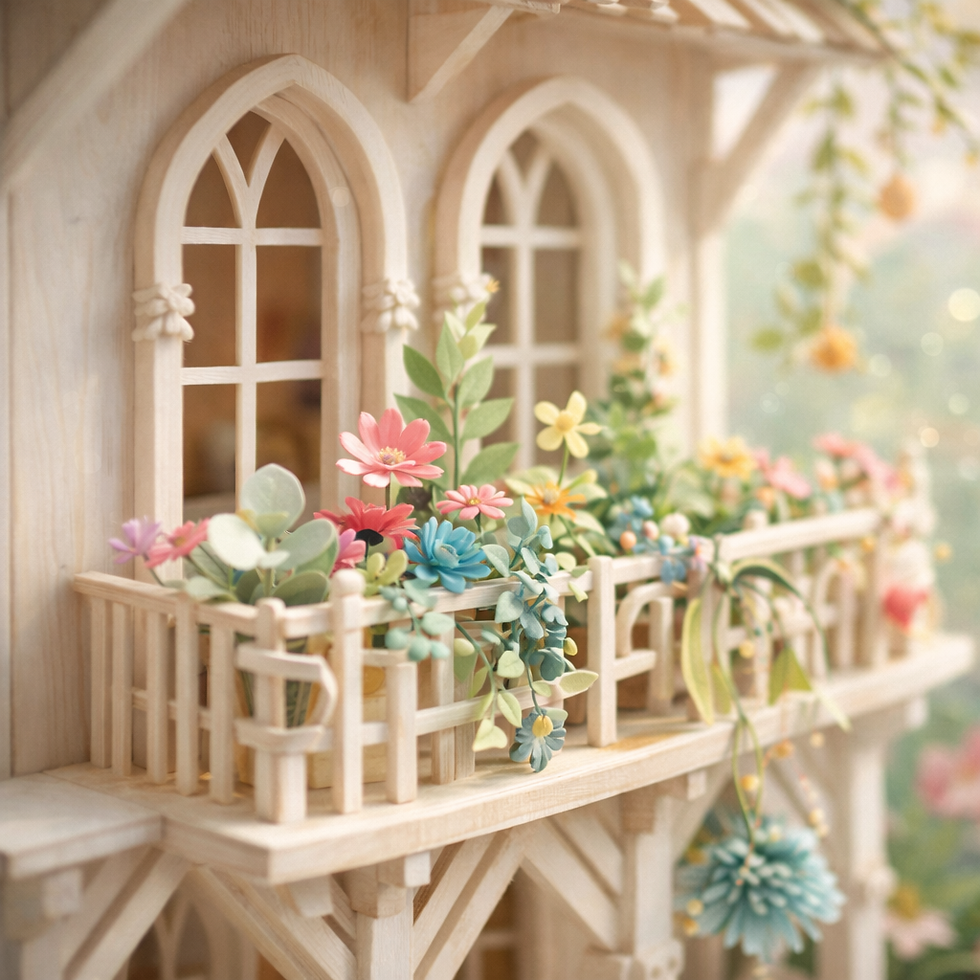
The roof is a standout: green panels layered like folded leaves, sprinkled with little flowers and trailing greenery that softens every edge. It gives the impression of a cottage that’s been gently reclaimed by nature—but in a way that’s still tidy enough for Myrtle’s standards.

On the ground, the garden goes full storybook. Tall paper blooms rise like friendly fireworks. Leaves overlap in crisp layers. There are baskets and pots tucked into corners like the gardener just stepped inside for “one second” and forgot for three hours. The trees frame everything: one side richer and twistier, the other airier with those dangling wish-charms that look like they’d jingle softly if you leaned in close.

Mood-wise? It’s bright, calm, and slightly enchanted—like the whole place smells faintly of paper, tea, and secrets.
Inspirations – From the Big World to the Small
Even when a miniature leans whimsical, it usually has real-world DNA—and this one has a few strong ancestors.
Shigeru Ban (paper architecture + paper tubes). Ban is famous for experimenting with paper as a legitimate architectural material, pushing the idea that “temporary” can still be beautiful and intentional. This miniature echoes that spirit: paper isn’t a compromise here—it’s the point. It’s architecture that celebrates lightness and craft.
Antoni Gaudí (organic curves + nature as ornament). While this cottage is cleaner and more “folded” than Gaudí’s swirling stonework, the philosophy feels related: nature is not separate from the structure. The roof greenery and floral drifts act like architectural ornament—soft, living decoration integrated into the building’s identity.

Hundertwasserhaus (playful color + anti-straight-line joy). The vibe of cheerful rebellion—plants everywhere, ornament as personality, a building that looks like it has opinions—fits beautifully. This miniature keeps the structure crisp, but the garden and roof bring that same “life should be more colorful than beige” energy.
What’s cool in miniature scale is how these inspirations get translated into readable choices: bold silhouettes (big flowers), simplified but intentional geometry (clean trim and arches), and high-contrast layering (paper-on-paper textures) so the eye can “get it” instantly—even at tiny size.
Artist Tips – Make Your Own Magic
You’re standing at your workbench. The room is quiet. Your brain is loud. This is your moment.
Before we dive in: this guide is inspiration, not a forensic reconstruction. Your version will vary—and that’s the joy. Also, whenever I toss in little “visual aids,” just know my digital illustration gremlins occasionally get… creative. If a tiny drawn hand looks like a croissant, you didn’t see anything. You’re building your cottage, not mine, and yours deserves its own weird little legend.

Shopping List (with “use what you’ve got” first)
Paper & Card (the good stuff is often in your recycling bin)
Reuse: cereal boxes, shipping boxes, junk mail, paper bags, old greeting cards, tissue paper
Buy: acid-free cardstock, watercolor paper, scrapbooking paper pads, vellum
Wood & Structure
Reuse: coffee stir sticks, bamboo skewers, toothpicks, leftover craft wood
Buy: balsa sheets/strips, basswood strips, foam board (for templates), chipboard
Adhesives
Reuse: white glue you already own (PVA), glue sticks for quick mockups
Buy: tacky glue (stronger grab), thin CA glue for tiny joints (use sparingly), spray adhesive (ventilation!)
Cutting + Shaping Tools
Must-have: sharp hobby knife, self-healing cutting mat, metal ruler, small scissors
Nice-to-have: bone folder, scoring stylus, micro punch set, mini clamps/tweezers
Color & Finish
Reuse: kid watercolor sets, colored pencils, old makeup brush for dusting
Buy: acrylic paints, artist inks, matte varnish/spray sealer, soft pastels for gentle weathering
Greenery & Details
Reuse: thread, twine, tea bag paper, sand from a craft jar, seed beads
Buy: paper quilling strips, floral wire, micro beads, tiny chain/charms
Lighting (optional, but magical)
Buy: USB-powered mini LED string lights (warm white), coin-cell micro LEDs for single spots, translucent paper for diffusion
Helpful supply links:
Blick Art Materials (cardstock, inks, tools): https://www.dickblick.com/
Michael’s (paper pads, tools, glue): https://www.michaels.com/
Joann (craft supplies, florals, wire): https://www.joann.com/
Amazon (search balsa sheets/strips, LED minis): https://www.amazon.com/
AliExpress (mini charms, micro LEDs, beads): https://www.aliexpress.com/
Make Your Own Magic (Build Steps)
Safety first (tiny world, real-world fingers): Cut away from your body. Always change blades often—dull blades tear paper and your patience. If you use spray adhesive or sealers, ventilate like you’re airing out a dragon’s lair. Super glue + paper = instant bonding + instant regret. Use in pinhead amounts.
Planning & scale notes (future-you will send a thank-you card)
Pick a scale that suits your goal: 1:12 for dollhouse-friendly, 1:24 for compact charm, or “storybook scale” where vibes win.
Sketch the silhouette first: roof angle, balcony line, window arches.
Make a quick paper mockup before cutting balsa—your scissors are cheaper than your time.
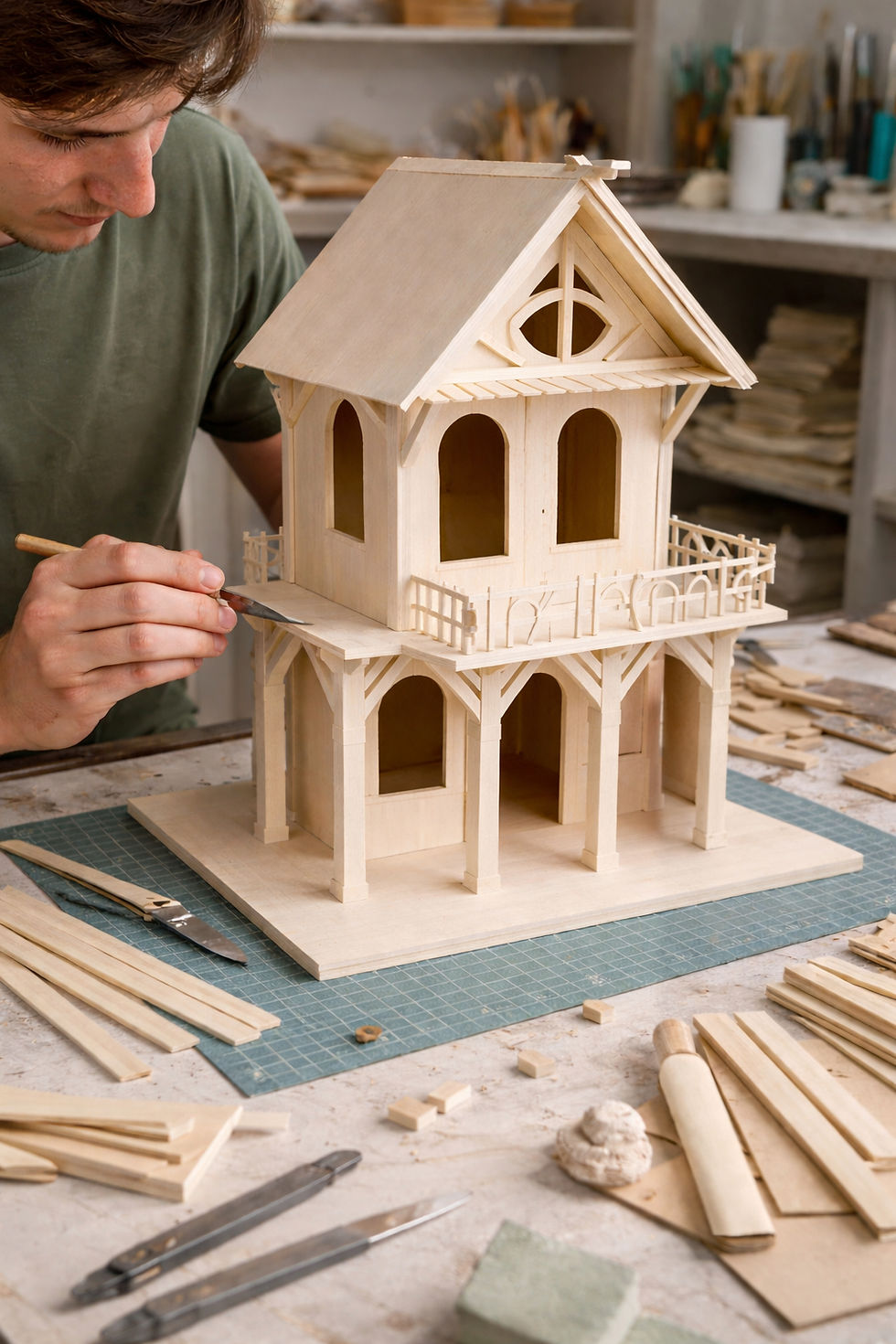
Bones (base + structure that won’t warp into a sad taco)
Build a rigid base: chipboard or MDF, topped with cardstock “ground.”
For the house shell: balsa walls + internal bracing strips (think tiny studs).
Seal balsa lightly (diluted PVA or matte medium) before painting to reduce fuzzing.
Windows & doors (where the story stares back at you)
Create arched templates from cardstock and repeat them for consistency.
For “glass,” use acetate packaging (the clear stuff from boxes) or thin plastic sheet.
Add depth: frame layers (outer trim + inner trim) so windows don’t look printed-on.


Finishes, base color, and the “weather stack” (even paper needs seasoning)
Base palette idea: warm white walls + soft sage/forest roof + pastel florals.
Mix paint like a vibe:
Wall tone: white + a touch of beige (about 10:1)
Shadow glaze: water + gray-brown ink (very thin, like tea)
Edge-color paper pieces with colored pencil/marker so white cut edges don’t scream, “HELLO I AM PAPER.”
Add gentle aging with pastel dust: under balcony rails, around door frames, along the ground line.

Hero piece (pick the star: roof, balcony garden, or mega-blooms)
Choose one focal “wow.” In this scene, the roof-and-garden combo is doing the heavy lifting—in the best way.
Make roof panels as layered strips so it reads as “leafy shingles.”
Add trailing vines in 2–3 greens (light, mid, dark) so it doesn’t go flat.

Utilities & greebles (the tiny realism sprinkles)
Add micro gutters from folded paper strips.
Use beads as “knobs,” “planters,” or “hanging hooks.”
Tiny dowels/toothpick slices become posts, pegs, and structural accents.

Furniture & soft goods (paper can pretend to be wicker, I promise)
Roll thin paper strips for baskets (quilling technique) or fake it with layered rings.
For cushions/blankets: tissue paper + diluted glue, gently crumpled, then painted.
Mini pots: paper cones, reinforced with glue, painted ceramic colors.

Lighting (simple, warm, and not a wiring thesis)
Use warm white LEDs (around 2700–3000K feel) for “cottage glow.”
Hide the string under the base edge, poke one LED up behind a window.
Diffuse with vellum or tracing paper so you get glow, not flashlight-beam.
Story clutter & Easter eggs (the joy is in the “wait, what is that?”)
Add a tiny letter on the porch. A miniature “seed catalog.” A little charm that implies someone lives here.
Put one secret detail where only you know it exists. That’s between you and the cottage.

Unifying filter + finish (make everything belong together)
Do a final whisper-thin glaze: warm beige + lots of water, brushed lightly across areas to harmonize.
Seal with matte varnish to protect paper edges and reduce shine.
Photo tips (make your miniature look like a movie still)
Use a simple neutral backdrop (paper or fabric) so colors pop.
Side light + soft fill light = texture heaven.
Shoot slightly low and close to window height to make it feel “inhabited.”
Add a blurred paper “forest” silhouette behind for instant depth.

Troubleshooting (problem → fix)
Warping paper → glue both sides lightly or laminate to cardstock before cutting.
Fuzzy balsa edges → quick sand + seal with diluted PVA before paint.
Visible white cut edges → color edges before assembly (it’s faster than fixing later).
Plants look flat → layer petals, curl edges, and vary greens (three greens > one green).
Glue shine → use matte varnish after, or switch to tacky glue in smaller amounts.
Scene feels “busy” → create calm zones (one quieter area makes the detail areas sparkle).
Closing – Until Next Time in the Small World
Folded Fern Cottage feels like the kind of place where the tea is always hot, the garden is always overachieving, and the trees are absolutely listening to your conversation. I can practically hear Myrtle Quill muttering, “No glitter near the balcony,” while the Petal Committee holds a meeting about whether the pink flowers are too pink (they are not).
If you could step inside this miniature for one afternoon, what would you do first—sit on the balcony with a tiny cup of tea, or wander the garden like you own the place? And more importantly: what detail is your favorite? Tell me in the comments—I love seeing what your eyes latch onto.
If you build something inspired by this paper-origami vibe, share it and tag #smallworldminiatures so I can cheer wildly from my corner of the tiny universe. Also: consider signing up for the newsletter, taking a stroll through the online shop, and—yes—giving that canvas print another look. FREE U.S. shipping is basically the universe telling you to decorate your walls with miniature magic.
#miniatureart #miniatures #miniaturehouse #paperart #origamiart #papercraft #diorama #miniaturediorama #miniaturegarden #tinyworld #handmadeart #modelmaking #balsawood #miniaturearchitecture #craftproject #dollhouseminiatures #miniaturephotography #artisttips #makersgonnamake #craftingcommunity #mixedmediaart #fantasyart #cottagecore #whimsicalart #scale modeling #tinydecor #creativeprocess #smallworldminiatures






Comments