



Miniature Art Deco Living Room Diorama: A Black, White & Gold 1930s LA Room Box With Serious “Movie Star” Energy
Updated: 11 hours ago

Opening – First Impressions in Miniature
You know that feeling when you look at a miniature and your brain immediately starts playing jazz… but, like, dramatic jazz? That’s what this room box did to me. One second I’m minding my own business, the next I’m mentally wearing a velvet robe, holding a tiny martini, and pretending I’m “just about to take an important call.” In a miniature Art Deco living room diorama that is unapologetically black, white, and gold, no less.
The first thing that punches you (politely, with a satin glove) is the floor: that crisp, high-contrast chevron pattern that basically says, “Yes, you may enter… if your shoes are clean and your secrets are cleaner.” Then your eyes hit the gold wall sconces, glowing like they’ve been powered by pure gossip. And then—boom—the hero: a sunburst wall piece that’s so glamorous it feels like it’s auditioning for a close-up.

I love miniatures that commit to a vibe, and this one doesn’t just commit—it puts the vibe in a tuxedo and gives it a key to the city. It’s 1930s-inspired, sure, but with a twist: the palette is stripped down to graphic noir perfection, and every gold accent feels like a punchline delivered in cursive.
Also: keep reading, because later in this post I’m going to walk you through a full “make your own magic” build guide—not a carbon copy of this room, but a practical blueprint you can riff on. (Think: jazz standards, not homework.)
Miniature Backstory – The Tiny Tale
Welcome to The Gilded Eclipse Parlor, established in 1932, tucked just off a glamorous boulevard in Los Angeles where the streetlights hum and the air smells faintly of perfume… and extremely questionable deals.
Legend says the Parlor was commissioned by a silent-film set designer who wanted a “private lounge” for entertaining producers, starlets, and the occasional mysterious stranger who shows up uninvited but somehow knows your name. The designer insisted on three rules:
Everything must be bold enough to read from across a room… or across a scandal.
The lighting must flatter everyone, including people with alibis.
If it isn’t black, white, or gold, it doesn’t exist.

The locals are… unusual. There’s Sir Sconce-a-Lot, the left wall lamp, who flickers dramatically whenever anyone lies. There’s Madame Sunburst, the wall piece, who has never once reflected a humble thought in her entire life. And somewhere near the right-side console lives Ziggy, a tiny zebra figurine who acts as the Parlor’s unofficial security guard. (He’s very brave. He’s also very small. Nobody tell him.)
Rumor has it the Parlor’s original owner hid something valuable inside the room—something you’d never notice unless you looked closely. That’s your Easter egg challenge: find the “watcher” in the decor—the one detail that feels like it’s quietly staring back at you. (When you spot it, you’ll know. And then you’ll start suspecting all your miniatures are alive, too. You’re welcome.)
A Guided Tour of the Build
Step through the invisible doorway and you’re hit with warm golden light—not harsh, not clinical, but the kind of glow that makes everything look like it has a better credit score. The walls are pale and elegant, framed by architectural trim that feels like a miniature version of a grand lobby. Everything is crisp, symmetrical, and composed—like the room is posing for a portrait.
At center stage: the fireplace wall, dressed in dramatic geometry. The layered, stepped forms feel like a jazz riff made of stone and lacquer. Above it, the sunburst piece radiates like a tiny spotlight—your eye can’t help but orbit around it. It’s giving “grand finale” energy, even though nothing is technically happening. (That’s the magic of good design: it makes stillness feel expensive.)

The left side is softer: a plush, pale sofa with pillows that look like they’ve heard secrets. A small gold table sits nearby like it’s waiting for someone to set down a miniature cocktail… or a miniature resignation letter.
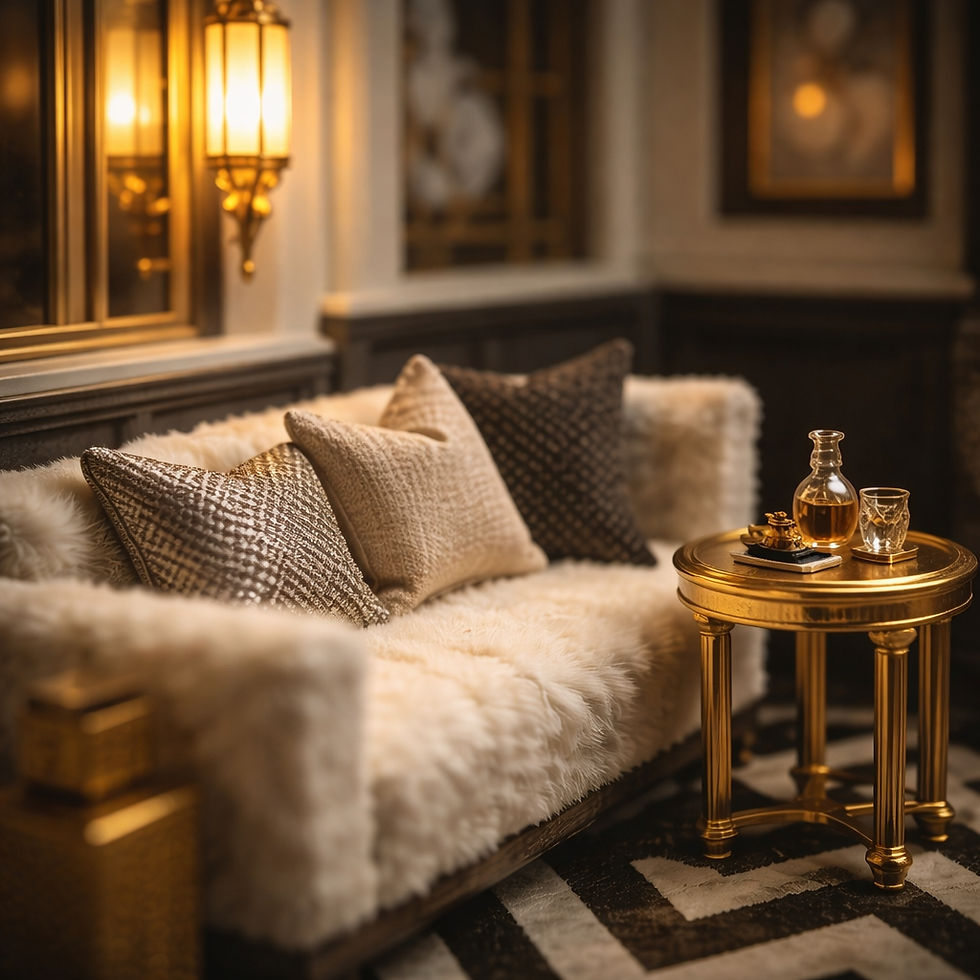
On the right: a round console and sculptural objects—metallic textures, patterned spheres, and sleek vases—like a curated collection from someone who says, “I’m not a hoarder, I’m a collector,” with a straight face.

And underfoot: that black-and-white chevron floor, glossy enough to catch reflections, bold enough to carry the whole room even if you removed half the furniture. It’s the runway. The rest of the room is just walking it.

Inspirations – From the Big World to the Small
This room box is clearly speaking the visual language of Art Deco, but it’s doing it with that very specific, sunlit-glamour-meets-noir vibe you’d associate with early 20th-century Southern California. If you’re into real-world reference hunting, here are a few “big world” cousins that share the same style DNA:
Eastern Columbia Building – That iconic turquoise-and-gold vibe is a Deco love letter to strong geometry and bold ornament. This miniature translates that spirit through its repeated verticals, metallic highlights, and the confident “graphic” contrast.
Bullocks Wilshire – A classic example of streamlined Art Deco with luxurious materials and dramatic lighting. The miniature’s wall sconces and symmetrical architectural framing feel like a tiny nod to that same “retail palace” grandeur—just shrunk into room-box form.
Tamara de Lempicka – Her portraits are all sharp elegance, glossy surfaces, and stylized glamour. This miniature hits that same note: clean lines, high contrast, and metallic accents that feel like they belong in a world where everyone has cheekbones and a plot.

The fun part about translating these inspirations into miniature scale is that you have to exaggerate the essence. In full-size architecture, you can rely on mass and material weight. In miniature, you rely on contrast, repetition, and lighting cues—exactly what this piece does: strong graphic floor pattern, repeated geometric frames in the windows, and warm lighting that makes the gold details pop.
Artist Tips – Make Your Own Magic
You’re standing at your workbench. The room is quiet. The foam board is staring at you like, “So… what are we becoming?” And you get to answer: something bold, Deco, and deliciously dramatic.
Quick note before we dive in: this guide is inspiration, not an exact reproduction blueprint. Your results will vary—and that’s the point. Also, whenever I include little illustrated diagrams in these posts, just know I employ a tireless digital gremlin who occasionally thinks “a rectangle” is an advanced concept. We do our best. The vibes are correct. The math is… enthusiastic.
Shopping List
Use-what-you’ve-got (clever household “mini gold”)
Cereal box cardstock (trim, templates)
Coffee stirrers / popsicle sticks (trim, paneling)
Clear plastic packaging (windows, “glass”)
Aluminum foil (texture stamps, metallic accents under paint)
Toothpicks / bamboo skewers (alignment pins, tiny dowels)
Old gift wrap / patterned paper scraps (Art Deco motifs)
Makeup sponge bits (stippling, texture, soft weathering)
Cheap jewelry chains / beads (Deco details, lamp hardware vibes)

Purchasable equivalents (when you want the easy button)
Foam board or XPS foam sheets (walls, structure)
Basswood strips / styrene strip (clean trim and frames)
Gold paint marker + metallic acrylics (fast Deco shine)
Acetate sheets (crystal-clear windows)
Warm micro LEDs (the “tiny luxury” cheat code)
Pre-made miniature furniture (if you’d rather decorate than fabricate)
Deep Dive Build Guide
Planning & scale notes: Pick a scale that matches your mini life (1:12 is classic for room boxes). Sketch the wall layout: back wall + two side returns. Mark where your “hero wall” goes (fireplace or focal panel). Deco loves symmetry—so even if you go asymmetric, do it on purpose.
Safety first (tiny drama, not real drama): Ventilate if you’re using spray sealers or strong glues. Cut away from your hands. Change blades often—dull knives don’t cut, they argue. If you sand foam, don’t inhale it like it’s a hobby-scented candle.
Bones (base structure): Build a U-shaped shell: floor + back wall + two side walls. Foam board is fast; XPS is sturdy. Reinforce corners with internal strips. Test fit everything dry before glue. The goal: square, rigid, and not secretly leaning like it partied too hard.

Walls & architectural framing: For that 1930s-inspired elegance, add “panels” and trim. Use stripwood/styrene to create rectangles and stepped profiles. Paint the walls a warm off-white (try 8 parts white : 1 part beige : a pinprick of gray). Keep it soft—your black accents will do the heavy contrast lifting.

Windows and doors (optional, but very Deco): Use clear plastic for glazing. For the geometric muntins, cut thin strips and build a pattern that echoes Art Deco grids (rectangles, nested frames, little “steps”). Paint frames satin black; hit edges with a tiny dry-brush of dark metallic to suggest metalwork.

Flooring: the chevron moment: You can fake chevron with printed paper sealed under gloss, or cut the pattern from thin cardstock. Keep the black truly black (add a touch of deep blue to your black paint so it doesn’t look chalky). Seal with gloss to get that “polished lobby floor” vibe.

Finishes: base color + materials stack: Deco isn’t usually “rusty ruin,” but it does benefit from depth. After base coats:
Add a thin shadow wash into trim seams (1 part black or dark brown : 10 parts water).
Wipe back the highs.
Add a gentle satin varnish so it feels like lacquer, not drywall.
Hero piece (your focal point): Choose one big statement: sunburst mirror, fireplace, or sculptural wall panel. For a sunburst, layer thin “spokes” from cardstock or plastic. Paint the center deep black, then dry-brush gold outward. Keep gold controlled—Deco gold is “tailored,” not “glitter explosion.”

Furniture & soft goods: A sofa instantly warms the scene. Use textured fabric (faux fur, velvet scrap) and stuff pillows with tiny bits of batting. Keep the palette restrained: black/white textiles, then one or two gold accents so the eye has punctuation marks.

Utilities & greebles (the tiny believable stuff): Add outlet plates, lamp bases, little handles, and “hardware.” Even one or two tiny details—like a switch plate or a vent—makes the room feel lived-in. Deco rooms love curated objects, so pick 5–7 items, not 50.
Lighting (simple, easy wins): Use warm white micro LEDs (around 2700K–3000K) for that vintage glow. Hide the battery pack behind the back wall or under the base. Diffuse harsh points by wrapping the LED in a bit of parchment paper or thin white plastic. If you want sconces, create a vertical “tube” shade with translucent material and mount the LED behind it.
Story clutter & Easter eggs: Add one odd detail that implies a life: a tiny dropped tassel, a book left open, a mysterious framed symbol. Hide your Easter egg where someone only sees it on the second look—under a table, behind a vase, or reflected in a “mirror.”

Unifying glaze/filter + final finish: To make everything feel like it belongs together, glaze the whole scene lightly: a whisper-thin warm gray over whites, a slightly warm brown-black over blacks. Then seal: satin for walls, gloss for floors, and selective gloss on gold to make it sparkle like it means it.
Photo tips (make it look real): Use a dark, simple backdrop so the gold lighting pops. Shoot low, at “human eye level” for the scale. Bounce a little light off white paper to soften shadows. And take one dramatic “noir angle” shot—because you didn’t build this much glamour to photograph it like a toaster.

Troubleshooting (problem → fix)
Gold looks brassy or chunky → glaze with a thin brown wash and re-highlight with a lighter gold on edges.
Whites look flat → add subtle warm-gray shading in corners and panel lines.
Black looks chalky → add a tiny drop of blue or brown to enrich it, then seal satin.
Floor pattern feels too loud → knock it back with a semi-gloss instead of full gloss, or add a soft rug to calm the geometry.
Lighting looks “bulby” → diffuse with parchment/plastic and hide the LED point behind a shade.

Closing – Until Next Time in the Small World
So that’s The Gilded Eclipse Parlor: a miniature Art Deco living room that looks like it has a talent agent, a secret past, and absolutely no patience for fingerprints on the floor.
If you zoom in and start noticing the tiny details—the warm lamp glow, the geometric frames, the curated objects—tell me: what’s your favorite part? And did you spot the little “watcher” Easter egg I hinted at?
If you build your own Deco-inspired room box (or anything with dramatic lighting and questionable tiny secrets), tag it with #smallworldminiatures so I can see what you’re making. And if you want more miniature tours, build guides, and behind-the-scenes chaos, hop on the newsletter—because I have a suspicious amount of tiny opinions and I’m not afraid to share them.
Until next time in the Small World—where the rooms are glamorous and the drama is conveniently pocket-sized.
#smallworldminiatures #miniature #miniatures #miniatureart #diorama #dioramas #roombox #dollhouseminiatures #miniatureinterior #artdeco #artdecodesign #1930sstyle #losangelesstyle #miniaturelighting #miniaturefurniture #miniaturedecor #modelmaking #scalemodel #miniaturebuilding #handmade #crafting #tinyworld #miniaturephotography #dioramabuild #terrainbuilding #makercommunity #miniatureobsession






Comments