



Where the Mountains Keep Their Secrets: An Andean-Inspired Miniature Sunroom Full of Textiles, Terra Cotta, and Tiny Warmth

First Impressions in Miniature
Some miniature rooms whisper. This one throws open the door, pours you something warm, and says, “Sit down, admire the rugs, and try not to knock over the pottery.”
What I love immediately about this Andean-inspired miniature diorama is how generous it feels. The woven textiles are fearless, the stucco walls are sun-baked and soft, the little terra cotta pots look like they’ve been collecting stories for decades, and that reed roof has just enough rustic swagger to make me deeply jealous of a house that is, frankly, smaller than my microwave. It’s cozy, color-rich, and gloriously alive.
And stay with me, because later in this post I’m walking you through how to recreate the feeling of this build yourself — from the stucco and beams to the pots, cacti, textiles, and that deliciously scrappy wood-slat floor.
Why This Photo Needs VIP Treatment
A quick public service announcement from the tiny design department: the image you’re seeing here is optimized for the web, which means it looks lovely on your screen but isn’t the full, print-ready heavyweight champion.
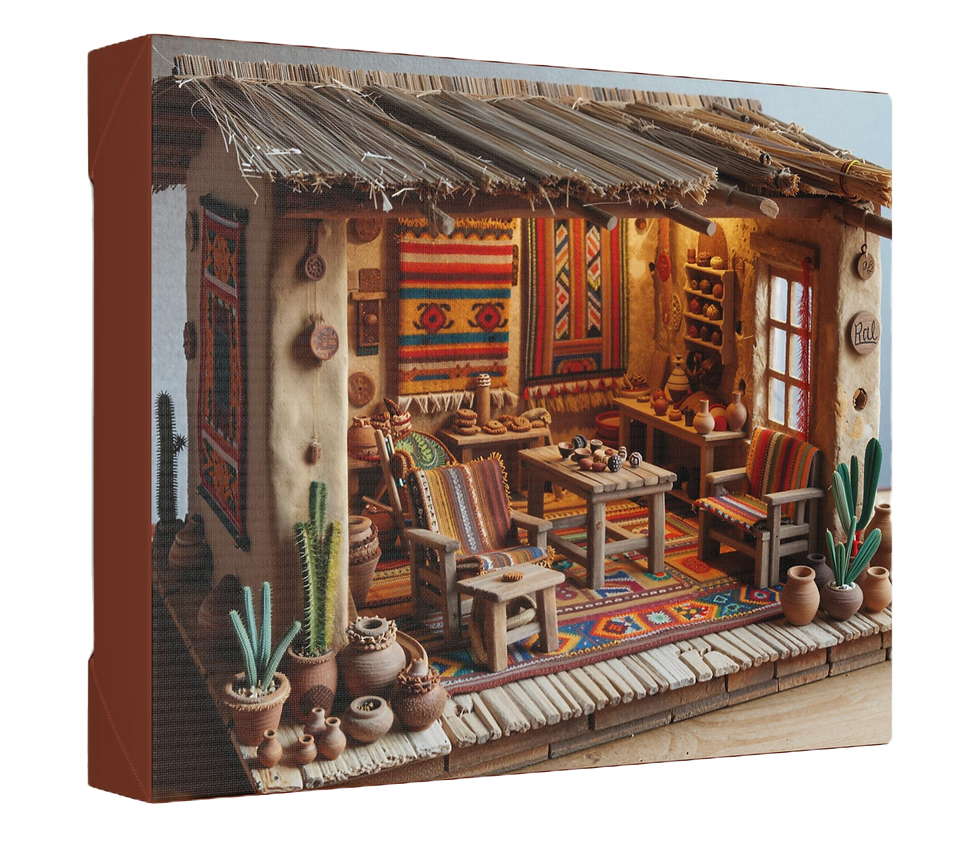
If this little room has already moved into your heart and started rearranging the furniture, I’ll be adding a high-resolution canvas print option below. That version is made for real wall duty, not just browser-tab admiration, and it’ll ship free in the U.S. Because if you’re going to invite a miniature Andean sunroom into your home, it deserves proper star treatment. https://www.smallworldminiatures.com/product-page/andean-cottage-miniature-diorama-miniature-canvas-print
The Tiny Tale
Every good miniature has a backstory. This one practically insisted on one.
I’m calling this place Casa del Sol Trenzado — House of Braided Sun. In the local telling, it was founded in 1912 by a weaver named Ral Quispe, whose name still hangs beside the window on a hand-painted little plaque as if the house itself is too sentimental to let him go. Ral was known for two things: weaving impossible colors into perfect order, and refusing to make a chair that looked uncomfortable just because “it was traditional.” A man after my own heart.
The room began as a family weaving porch, then became a tea room, then a pottery nook, then a place where cousins wandered in, sat too long, and left with gossip and a biscuit. Over time, the family added more rugs, more shelves, more pots, more carved little details, and absolutely no restraint whatsoever when it came to warm color. Bless them for that.
The cacti outside were said to be planted by Ral’s sister, Inés, who believed a home without plants was “just walls behaving themselves.” The striped chair covers were woven from leftover threads after festival commissions. The little pottery collection on the shelves? Half practical, half bragging rights.

And because every Small World Miniatures room deserves a treasure hunt, here’s your Easter egg: somewhere in this scene, the family is said to have hidden a tiny woven symbol of the sun for good luck. If you’re new here, this story-first, detail-hunting approach is very much the Small World Miniatures way, right alongside design breakdowns and maker guides.
A Guided Tour of the Build
The first thing your eye catches is the color. Not one color, but a chorus of them: rust, saffron, indigo, brick red, dusty turquoise, sun-faded gold. They don’t fight. They sing.

Then you notice the textures. The stucco walls are slightly uneven in the best possible way, like they were shaped by hand and warmed by years of light. The beams feel dry and honest. The slatted floor and porch have that silvered, worn timber look that only comes from time, footsteps, and weather doing a little collaborative art project.

Inside, the room glows amber. The hanging textiles pull your eye upward and inward at the same time, framing the whole scene like soft architecture. There’s pottery tucked everywhere — shelves, corners, tabletops, little clusters near the plants. The furniture is simple and sturdy, which is exactly right. Nothing in here is shouting for attention because the whole room already knows it’s beautiful.
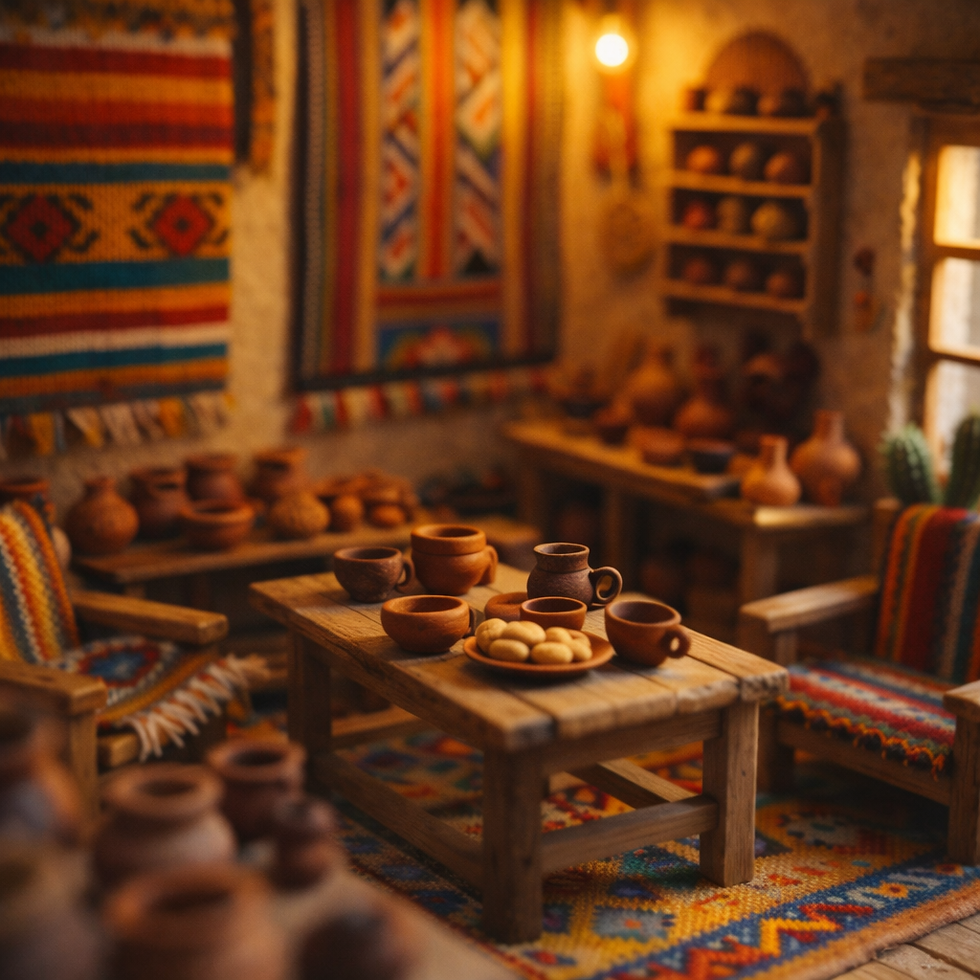
And those cacti out front? Perfect finishing touch. A little prickly punctuation mark around a room that otherwise says, “Come in, stay a while.”
Inspirations – From the Big World to the Small
What I love about this piece is that it feels Andean-inspired, not like it’s trying to flatten an entire culture into one postcard. It borrows mood, material language, color confidence, and hand-crafted warmth.
The textile story is the clearest thread. UNESCO notes that Taquile textile art in Peru is an everyday community practice with roots in pre-Hispanic Andean cultures, and that sense of weaving as identity — not mere decoration — is exactly what this miniature channels in its wall hangings, stripes, and geometric rhythm.

The warmth and gravity of the architecture also reminded me of Koricancha in Cusco, the famed Temple of the Sun, a place long associated with Inti and with a feeling of permanence grounded in mass, light, and devotion. This miniature isn’t copying that architecture literally, but it borrows that same emotional trick: solid walls, sun-filled interior, and the sense that light itself matters as a material.
And then there’s the painterly side. José Sabogal was a leading figure in Peru’s indigenist movement, centering highland culture in modern Peruvian art. That matters here because this room has that same affection for everyday domestic beauty — textiles, handmade objects, earthen surfaces, people-shaped spaces. It doesn’t feel staged; it feels lived.
That’s the magic of miniature scale. You’re not just shrinking a room. You’re distilling a whole design lineage until it fits in the palm of your hand.
Make Your Own Magic
Before we go full tiny contractor, let me offer one cheerful disclaimer from the workbench: this is not meant to be an exact reproduction guide. Think of it as a map, not a photocopier. Your version should wobble a little in its own direction. That’s where the charm lives.
Also, I write these posts, but some of the visuals behind Small World Miniatures begin life as AI-assisted concept art before I translate the mood into practical maker steps — which is wonderfully useful and occasionally a little unhinged. If a concept sketch ever gives me a suspicious extra chair rung or a cactus with too much confidence, we simply smile and move on. The point is inspiration, atmosphere, and buildable ideas, not identical twins.
Shopping List
I always like to start with the “raid your junk drawer like a tiny raccoon” method before buying new supplies. If I mention a store-bought option, that’s where your Amazon affiliate links can go — and if readers shop through them, they help keep the tiny lights on around here.

Structure & base
Cereal box chipboard or shipping box cardboard
Foam packaging scraps or XPS insulation foam
Purchasable equivalent: basswood sheets, foam board, XPS foam sheets
Stucco & earth finishes
Lightweight spackle, wall filler, baking soda, or fine sand
Coffee stirrers for texture tests
Purchasable equivalent: lightweight spackling paste, modeling paste, texture sand
Wood beams, slat floors & furniture
Popsicle sticks, coffee stirrers, bamboo skewers, chopsticks
Old placemat reeds or thin craft wood offcuts
Purchasable equivalent: basswood strips, balsa, miniature lumber packs, micro dowels
Reed roofing
Natural raffia, broom bristles, dried grass, twine teased apart
Purchasable equivalent: raffia bundles, thatching grass, sisal fibers
Pots, cacti & plants
Air-dry clay, polymer clay, toothpicks, floral wire, old paintbrush bristles, flock, jute
Purchasable equivalent: terracotta-colored clay, miniature pots, static grass, floral tape, fine turf
Textiles & detail dressing
Scrap ribbon, embroidery floss, friendship bracelet thread, old woven trims, fabric remnants
Purchasable equivalent: miniature rugs, woven trim, embroidery thread sets, dollhouse fabric
Lighting
USB fairy lights, battery tea-light guts, warm mini LEDs
Purchasable equivalent: warm-white dollhouse LEDs, USB micro LED strands
Deep Dive
1. Safety tips and scale notes
Work with a sharp blade, cut away from your fingers, ventilate when using glue or sealers, and wear a mask if you’re sanding foam, spackle, or dried clay dust. For scale, this room works beautifully somewhere around 1:12 to 1:16. Don’t obsess over perfect math. Obsess over whether the chair looks like a human could actually sit in it without filing a complaint.
2. Bones: lay out the structure
Start with a simple three-wall shell and a shallow platform porch. Sketch your opening first: big front opening, one side wall strong enough to hold a hanging textile, and a window wall that lets the light do its thing. Foam board or XPS works well for the core; basswood strips can reinforce corners. Keep the room a little taller than you think you need so the roof reads airy, not squashed.

3. Build the stucco shell
Coat the walls with lightweight spackle mixed with a touch of tan acrylic and a pinch of fine sand. I like a rough mix around 4 parts spackle, 1 part paint, tiny spoon of sand. Dab it on with an old brush, sponge, or fingertip. Don’t smooth it perfectly. This is a hand-finished wall, not a luxury condo in denial. Dry-brush with warm ivory, dusty clay, and a faint sun-baked ochre.

4. Add wood beams
Use skewers, dowels, or square basswood for the roof supports and lintels. Stain with a thin wash of burnt umber + a touch of black + plenty of water. Wipe back so the grain stays visible. A light dry-brush of gray-beige makes them feel sun-cured rather than freshly bought at Tiny Lumber Depot.

5. Make the wood slat floors and porch
Coffee stirrers and craft sticks are your best friends here. Cut them to varying widths, glue them with tiny gaps, and avoid perfect spacing. Real handmade slat floors have rhythm, not military discipline. Basecoat with a faded taupe-brown, then wash with gray-brown and dry-brush pale driftwood tones. Sand a few edges for wear.

6. Windows and door trim
This build only needs a simple rustic window frame and chunky trim. Use thin stripwood or cardstock layered twice for depth. Glazing can be clear acetate from packaging. To soften the shine, lightly scuff it or brush on a whisper-thin matte medium around the edges so it feels dusty and lived in. Premade dollhouse windows also work beautifully here if scratch-building isn’t your mood.

7. Thatch the reed roof
For that roof, bundle raffia, broom bristles, or dried grass into narrow strips. Glue the strips from the bottom up in overlapping rows so gravity stays believable. Trim unevenly — the charm is in the shaggy silhouette. Once dry, glaze with very diluted tan, raw umber, and a hint of olive. You want “sun-dried reed,” not “freshly shampooed hay.”

8. Craft the terra cotta pots
Roll tiny balls of air-dry or polymer clay, press the center with a ball stylus, and pinch the rim outward. For larger jars, build around a foil crumb or little bead to keep the form light. Texture with a stiff brush, needle, or fine sandpaper. Paint with mixes of terra cotta, burnt sienna, and a speck of dusty pink or ochre so they don’t all match exactly. A matte sealer finishes them. Store-bought miniature clay pots are a great shortcut too.

9. Build the cacti and plants
For upright cacti, use floral wire wrapped with a skim coat of clay, or carve them from foam and seal first. Rib them with a needle tool. Paint in varied greens: deep olive base, lighter sage dry-brush, then a tiny yellow-green edge highlight. Spines can be old brush bristles, cut thread, or barely-there dry brushing. For softer plants, jute fibers, flock, and clipped faux greenery work wonders. Realism comes from variation in height and pot size. If you want a simpler solution you can purchase miniature cactus on Amazon via our affiliate link.

10. Make the wood furniture
Keep the furniture simple: blocky armchairs, squat tables, honest joinery. Basswood is ideal, but popsicle sticks absolutely get invited to this party. Build the frames first, then add seat slats. Stain or paint with the same family of worn wood tones used on the porch, but slightly warmer indoors. Sand the arms and corners so they look touched by years of elbows, not five minutes of assembly. Save time by purchasing pre-made furniture on Amazon.

11. Create the textiles
This room lives or dies by the textiles. If you weave, amazing. If you don’t, cheat beautifully. Use ribbon trims, friendship-bracelet patterns, narrow woven tapes, or printed fabric backed with diluted glue so it hangs nicely. Add fringe from embroidery floss. The key palette is saturated but earthy: tomato red, indigo, saffron, turquoise, rust, cream, and black. Let one textile be the hero and the others support it like a very stylish choir. Save time by purchasing textiles on Amazon.

12. Finishes, shelves, pottery, and hero details
Once the architecture is in, add shelves, bowls, cups, wall medallions, and little clusters of objects. Tiny wooden beads, clay scraps, seed beads, and carved bits of dowel become believable pottery and decor shockingly fast. The hero piece in this room is the central textile wall combined with that front seating arrangement. Everything else should frame that view, not compete with it.

13. Lighting, story clutter, and the unifying glaze
Use warm LEDs in the 2200K–2700K range so the whole room glows like late afternoon. Hide the light source behind the roofline or upper rear beam. Then add story clutter: a bowl on the table, a stray pot near a chair, a tiny folded textile, a cluster of cacti that feels half curated, half accidental. Finally, unify everything with a very thin dusty glaze — something like 1 drop raw umber, 1 drop ochre, lots of water or matte medium — brushed lightly into corners and wiped back. It ties the room together fast.
14. Photo tips and backdrop ideas
Use side lighting to mimic warm mountain sun. A plain blue-gray backdrop works beautifully, especially one that softly fades lighter near the top. Wood tabletop underneath, camera low, lens aimed slightly upward, and suddenly your tiny sunroom starts acting very full-size. Scatter one or two foreground pots just out of focus for cinematic depth.

Troubleshooting
Problem: Stucco looks too smooth.Fix: Stipple on another thin layer with sand or baking soda mixed in.
Problem: Wood looks toy-like.Fix: Desaturate with a gray-brown wash and sand random edges.
Problem: Reed roof looks too tidy.Fix: Trim unevenly and add a few stray fibers near the eaves.
Problem: Pots all look identical.Fix: Vary rim thickness, body width, and paint temperature.
Problem: Textiles overpower the room.Fix: Repeat one grounding neutral — cream, dusty clay, or weathered wood — in several places to calm the palette.
Problem: Cacti look like cheerful green candles.Fix: Add ribbing, uneven color, and tiny shadows where each arm joins.
Until Next Time in the Small World
I love a miniature that feels like it has been sunbathing for a century, and this one absolutely has that magic. Casa del Sol Trenzado may be fictional, but the warmth is real: the reed roof, the dusty porch boards, the woven hangings, the pots lined up like they know something you don’t.
If you build your own version, I’d love to know what detail stole your heart. Was it the stucco? The cacti? The rugs? The little pottery lineup that quietly became the cast of a tiny soap opera? Leave a comment and tell me.
And if you make something inspired by this scene, share it with #smallworldminiatures so I can admire your tiny triumphs. While you’re here, take a peek at the shop, sign up for the newsletter, and keep an eye out for the high-resolution canvas print of this piece too — because some miniature rooms deserve to graduate from screen crush to wall art.
#smallworldminiatures #miniature #miniatures #miniatureart #miniaturediorama #diorama #dollhouseminiatures #andeaninspired #textileart #miniatureinterior #miniaturedesign #terraCotta #miniaturepottery #miniatureplants #cactusart #stuccowalls #rusticdecor #bohominimalism #handmadehome #architecturalminiature #tinyworlds #scaledesign #makersgonnamake #fantasydecor #interiordesigninspiration #miniaturefurniture #artisanmade #warmminimalism








Comments