



A Miniature Andean Fireplace: A Little Poem in Color, Carving, and Firelight

First Impressions in Miniature
What grabbed me first was the color. Not just bright color, but confident color. Ember orange, deep teal, crimson, sunflower gold, little hits of cream, all stacked into patterns that feel celebratory without turning into chaos. Then you notice the carved rhythm of the mantel, the tidy arch around the firebox, the tiny llama-like figures standing guard up top, and suddenly you’re not looking at a fireplace anymore. You’re looking at a tiny stage set for a very stylish evening.
A couple years back I visited Lima, and I still think about that trip more often than is probably normal. The food was absurdly good, the drinks were dangerously pleasant, and the weather felt like it had been personally arranged for me.

Ever since then, anything that carries a little Peruvian warmth, color, and visual music gets my attention fast. This fireplace does exactly that.

And before you wander off to make a snack and forget me entirely, keep reading. Later in the post I’ll walk you through how I’d approach creating a piece in this spirit, so you can borrow the mood, the glow, and the storytelling without needing a mountain village, a sacred loom, or supernatural patience.
The Tiny Tale
Every good fireplace needs a little gossip, so naturally this one has a history.
In my head, this hearth is called La Chimenea de las Nueve Llamas, though locals shorten it to The Nine Flames because nobody has time for formality when soup is hot. It was said to have been installed in 1911 in the parlor of a highland guesthouse owned by Doña Jacinta Vela, a woman famous for three things: serving spiced hot chocolate so good travelers missed their onward journeys, refusing to tolerate dull interiors, and winning arguments simply by raising one eyebrow over the rim of her cup.
The fireplace was commissioned after a particularly cold season, when Jacinta declared that warmth alone was not enough. If guests were going to gather by the fire, the hearth should offer stories too. So the carpenter built the bones, the village painter arrived with pockets full of pigments and opinions, and somewhere along the way every available surface picked up pattern, symbol, flourish, or tiny flourish pretending not to be a flourish.

The little animal figures near the crown? Those are said to be the guesthouse’s silent guardians. Depending on who tells the story, they are llamas, alpacas, or “close enough, stop asking and pass the bread.” The central sunburst panel at the top supposedly represents dawn over the mountains, though one local swore it was simply the painter showing off because someone had complimented his brushwork and he became impossible for a month.
By the 1930s, The Nine Flames had a reputation. Musicians gathered there after market days. Travelers thawed their hands over mulled fruit drinks. One schoolteacher corrected grammar by the fire so sternly that children claimed the mantel itself had learned to frown. A baker from the next village over allegedly proposed marriage in front of it three separate times, each with increasingly better pastries. On the third attempt, he succeeded. The fireplace, being old-fashioned, approved.
And because every tiny world deserves at least one secret, here’s your Easter egg to look for: somewhere in all that ornament lives a little butterfly motif said to carry wishes up the chimney. Also keep an eye on those tiny guardian animals above. According to the local legend I just cheerfully invented five minutes ago, if both are facing inward, the house is at peace. If one looks sideways, somebody has hidden the good cups.
A Guided Tour of the Build
Start at the floor and work up slowly, because this miniature rewards patience.
The base feels grounded and sturdy, like old timber boards warmed by years of use. Scattered logs sit at the hearth with the casual confidence of something placed there by a real hand, not arranged for a photograph. That matters. Nothing feels stiff. Even the neatness has a lived-in softness.

Then your eye moves to the firebox, and that arch does exactly what an arch should do: it frames the drama. The pale stone blocks around the opening are simple enough to give the eye a rest, which is smart, because all around them the decoration is dancing. Inside, the dark recess makes the flames feel brighter. The logs lean inward as if they’ve just been nudged into place, and that little orange blaze becomes the heartbeat of the whole piece.
The side panels are where the personality really starts showing off. Floral bursts, spirals, bands of geometric pattern, little medallions, layered borders — each section feels distinct, but they all speak the same language. It’s a language of rhythm. Repeat, contrast, repeat again, then surprise the viewer with a different shape before their eye gets too comfortable.
Above the firebox, the mantel frieze turns into a miniature parade of color. You get petals, curves, dots, stripes, sharp angles, and little symbolic accents all living together with astonishing manners. Then the upper section rises like an altar-front or ceremonial cabinet, with stacked shelves and patterned insets that make the whole fireplace feel taller, grander, and a bit theatrical in the best way.

And up top, those tiny guardian animals and the radiant central panel seal the deal. They give the piece a faintly folkloric smile, like the fireplace knows something and is too polite to say it out loud.
Inspirations – From the Big World to the Small
What I love about this piece is that it doesn’t read like a strict copy of one historical object. It reads like a miniature gathering of influences. The layered compartments and vivid narrative energy remind me of Peruvian retablos, including works by the celebrated artist Joaquín López Antay, whose painted wood-and-clay retablos turn small spaces into packed visual stories. I also see a cousinly resemblance to the Church of San Pedro Apóstol de Andahuaylillas, often called the “Sistine Chapel of the Americas,” where lavish mural programs and ornament create that same sense of every surface carrying meaning. Even the repeated bands and geometric pulse feel related to Andean textile traditions associated with places like Chinchero and Taquile, where weaving is treated as living cultural memory, not just decoration.

That’s the real magic here. In full scale, those traditions can involve architecture, painted interiors, carved religious objects, textiles, and domestic craft. In miniature, all that visual DNA gets condensed. A frieze becomes a woven border. A painted niche becomes a mantel panel. A carved saint’s frame becomes a tiny geometric stack above the fire. Nothing is copied literally, and that’s what keeps it lively. It’s inspired, not embalmed. The result is a fireplace that feels rooted in a real visual family tree while still behaving like a tiny dream with excellent taste.
Make Your Own Magic
Here’s the fun part. Treat this as a trail map, not a notarized blueprint. I’m writing the blog, but when I use AI-generated sketches or visual aids to help explain a miniature mood, they can occasionally get a little overexcited and invent one extra border, six bonus carvings, or a pattern that appears to have been designed by a caffeinated oracle. So use this as inspiration, not a strict reproduction guide. Your results will vary, and honestly, they should. That’s the point.
Shopping List
I always like to start with the “raid your house like a tiny raccoon” method before buying anything shiny.

Everyday finds first
Cereal box chipboard for pattern templates and layered trim
Corrugated cardboard for mockups and hidden support pieces
Wooden coffee stirrers or chopsticks for trim, shelf bands, and faux timber
Small twigs or cut dowels for logs
Aluminum foil for texture experiments
Toothpicks for pegs, spacers, and paint-dot details
Packaging foam or dense scrap foam for the internal body
White glue, matte craft paint, old makeup sponges, and a slightly abused cup for rinse water
Purchasable equivalents
Nice extras
Tiny mirror pieces or metallic foil for reflective accents
For the linked supply list I’d use Amazon affiliate links for the buyable versions. It’s a very elegant arrangement where you get supplies, and the tiny world gets a little help keeping the lights on. Everybody wins, especially the miniature alpacas.
Safety notes that are not glamorous but are deeply useful
Use sharp blades, not heroic force. Dull blades cause ugly cuts and exciting bandage opportunities.
Ventilate when using strong glue, sealers, or paints.
Test spray products on scrap first, especially if foam is involved. Some sprays will melt your hard work like it insulted them.
Keep wires, batteries, and heat sources simple and low-risk.
Protect your table. Future-you deserves basic kindness.
Deep Dive
1. Start with mood, scale, and silhouette: Before you cut a single piece, decide what kind of fireplace this is emotionally. Is it ceremonial and polished? Rustic and beloved? Bright and festive? For this look, I’d aim for “formal enough to impress visitors, cozy enough to lean on while waiting for cocoa.” Sketch the overall shape first: broad base, clear central arch, stacked upper mantel, then one extra crown section above that. Keep the width slightly generous so the decoration has room to breathe.
2. Build the bones of the structure: Block out the full mass with foam board, XPS, or layered cardboard wrapped over a sturdy inner core. Think in rectangles first. Don’t chase decoration too early. Build the base platform, the two side supports, the central firebox wall, the mantel shelf, then the upper stacked sections. Miniatures go wrong when you fall in love with one fancy little corner before the whole structure stands up properly.

3. Shape the firebox and arch: Because there are no windows or doors here, the arch becomes your major architectural event. Mark the opening, then build the stone surround with individually cut faux blocks from foam, card, clay, or scored board. Keep the arch stones slightly irregular so it doesn’t feel machine-perfect. The opening should be deep enough to create shadow. Shadow is free drama. Take it.

4. Layer the trim and shelf lines: Now add the stepped shelves, ledges, side blocks, and banding. This piece works because it has vertical structure and horizontal pauses. You want a rhythm of thick-thin-thick. A deep mantel shelf, a narrower decorative band, then another projecting line above. Coffee stirrers, stripwood, or stacked card work beautifully here. Keep checking from the front. If it reads flat, add one more shallow layer.

5. Add carved-looking panels and pattern fields: Create zones for ornament. Not every square inch needs the same treatment. Reserve a few larger areas for hero patterns and use smaller bands as visual bridges.
For a look like this, I’d mix floral bursts, spirals, diamonds, dots, triangles, and little framed medallions. You can emboss soft material, scribe into clay, or simply build the illusion with paint later. If you paint better than you sculpt, let paint do the heavy lifting. I will never shame a convincing lie told beautifully.

6. Prime and lay in the base colors: Start with earthy neutrals for the wood and hearth structure: warm umber, cocoa brown, tan, a little dusty beige. Then choose a tight accent palette. I’d go with terracotta red, ember orange, turquoise, teal, sunflower gold, cream, and a touch of black for crisp definition. Don’t use all your brightest colors at full intensity everywhere. Save the hottest notes for focal zones, especially around the upper center panel and the areas framing the fire.
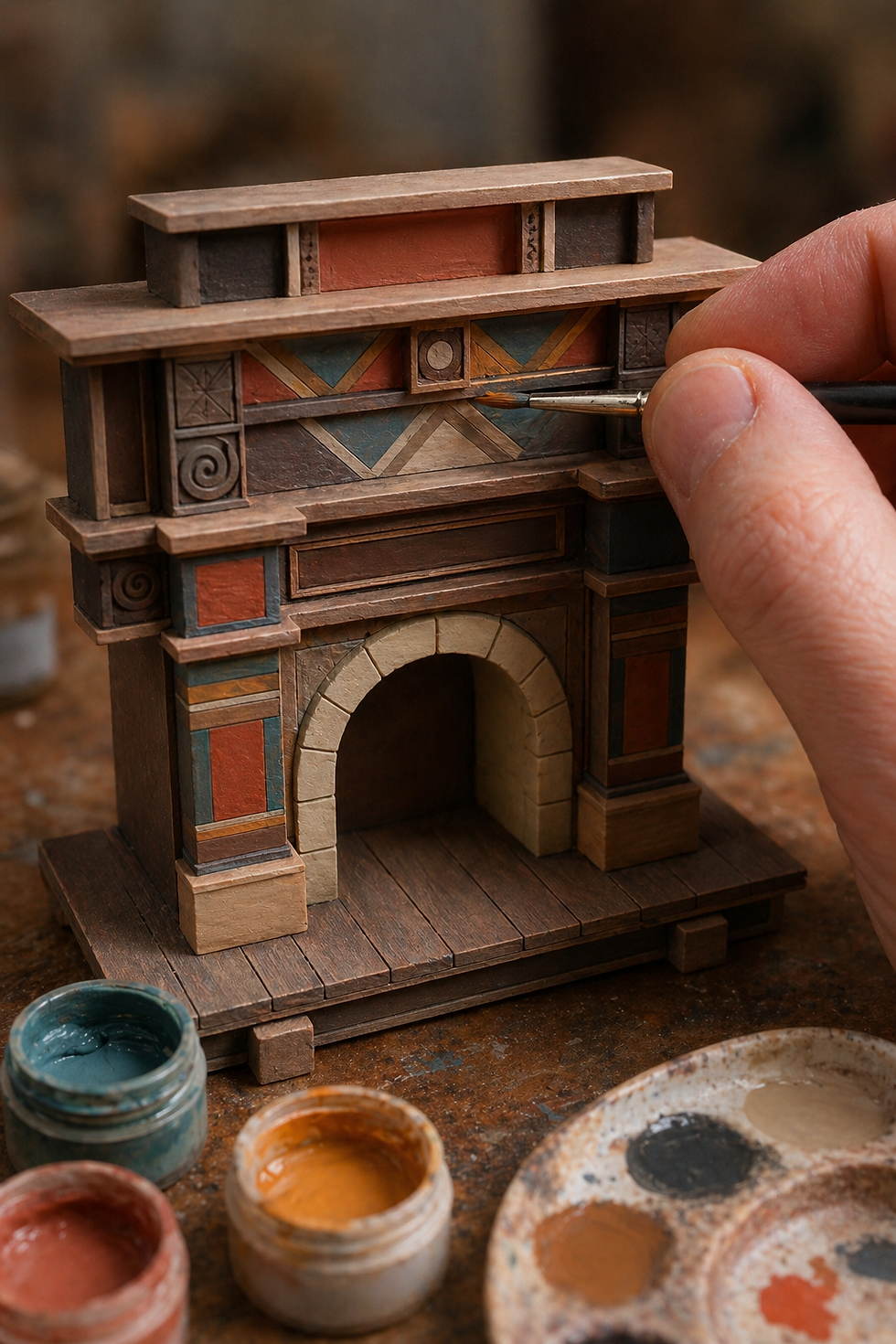
A simple working approach:
Wood base: 2 parts warm brown, 1 part burnt sienna, a touch of black
Stone arch: 3 parts warm ivory, 1 part sand, a tiny touch of gray
Deep shadows: dark brown with a drop of navy instead of pure black
Bright accents: use straight color sparingly over a toned undercoat
7. Paint the ornament in passes, not panic: This is where people either have a wonderful time or begin bargaining with the universe. Work in layers. First block the large shapes. Then add borders. Then outline selectively. Then add dots, petals, and little flashes of contrast. Don’t try to finish a whole panel in one sitting. Miniature ornament loves patience and punishes caffeine. If your pattern starts drifting, stop, let it dry, and correct with the background color. Tiny painting is mostly calm editing.
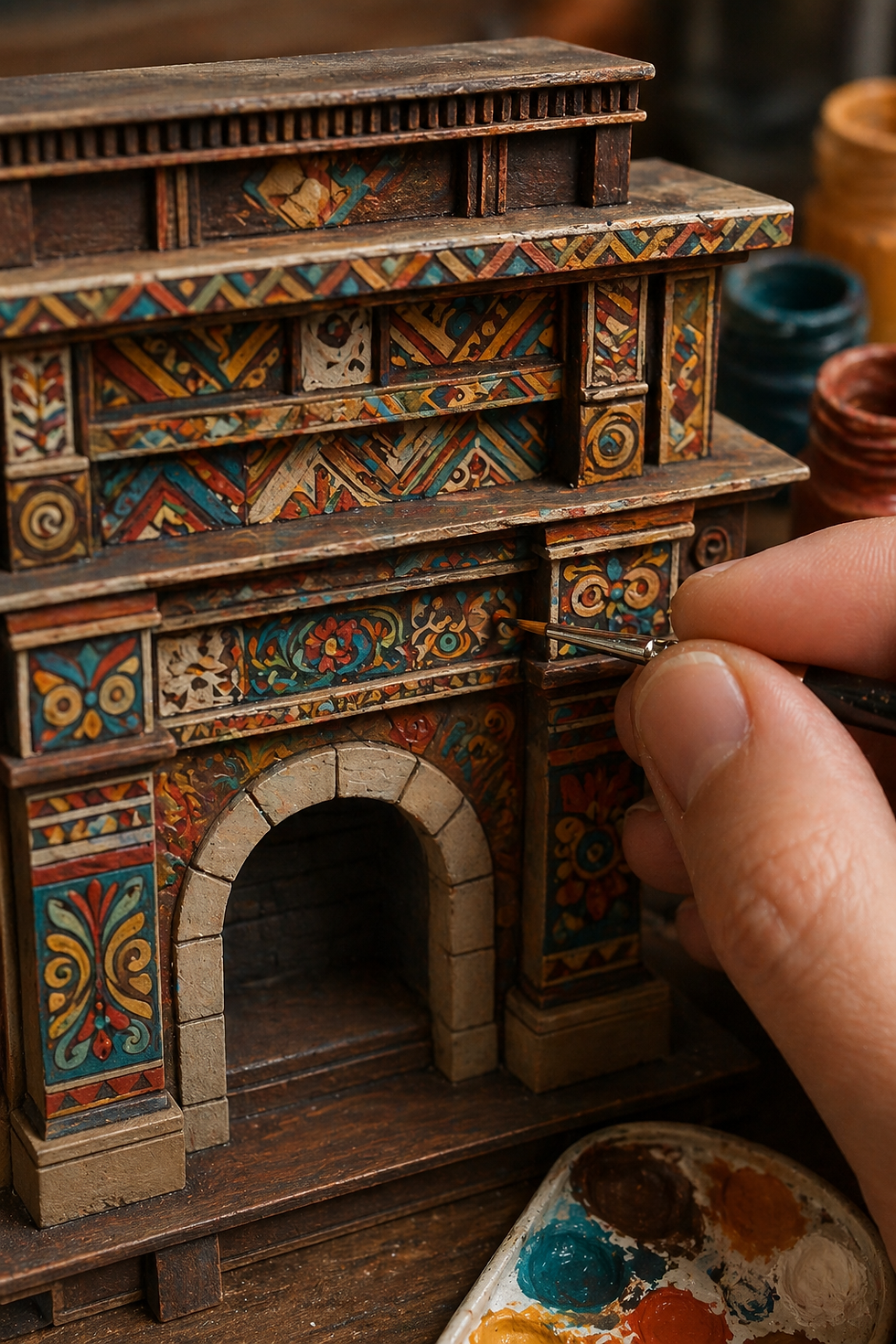
8. Finish the stone, the firebox, and the heat story: The stone surround should be lighter and quieter than the painted panels. Give it soft shading around the joints and a little soot near the opening. Inside the firebox, go very dark at the back, then drybrush subtle warm browns over brick or texture if you’ve added any. The interior should feel deep, not busy. Let the flame do the talking.

9. Build the hero piece: the crown panel: Every successful miniature has one part that pulls the whole composition together. Here, I’d treat the upper central panel like a jewel box lid. Use your most balanced geometric arrangement there — something symmetrical, radiant, and slightly ceremonial. This is where the eye lands after touring the rest of the piece. If you include the tiny guardian animals, frame them so they feel intentional, not randomly parked. They’re your little myth-makers.
10. Add hearth details and greebles: Now for the things that make it feel inhabited. Cut little logs from twigs or dowel and vary the ends so they look natural. Add a few stacked on the floor and a few leaning inward toward the fire. Consider tiny ash dusting, a clay coal bed, a narrow ledge of soot, or one small vessel tucked nearby. This is also the perfect time to sneak in story clutter: a hidden butterfly, a small symbolic rosette, or a painted motif that appears again somewhere else like a visual rhyme.

11. Light it simply: You do not need to wire a tiny hydroelectric plant. A small warm LED or USB-powered mini light is plenty. Aim for a temperature in the warm range — roughly candlelight territory, not refrigerator showroom. Diffuse it with a bit of translucent material, parchment-like plastic, or a hidden layer of frosted tape so you get glow instead of laser-beam doom. Keep the light source invisible from the normal viewing angle if possible.
12. Unify everything with glaze and finish: Once the colors are down, tie them together. A very thin warm brown glaze over selected wood areas can settle the palette. A dusty filter over the base helps the fireplace feel grounded instead of freshly assembled five minutes ago. Seal with matte or satin depending on the effect. I like mostly matte, with perhaps the slightest satin touch on painted ornament so it catches the light without turning toy-like.
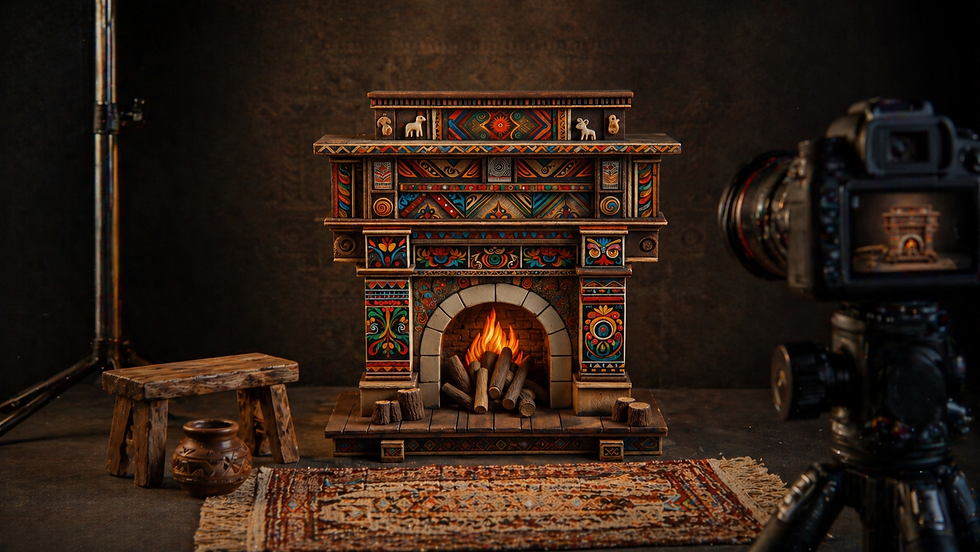
13. Photo it like it deserves: For a piece like this, use a dark backdrop or a warm neutral background so the colors glow forward. Side lighting plus the internal firelight looks wonderful. Keep the camera slightly below center or dead-on frontal to emphasize the symmetry. A folded sheet of charcoal paper, a painted foam board, or even fabric can make a solid backdrop. If you want a story shot, add a tiny bench, woven rug, or vessel nearby without crowding the hearth. Let the fireplace remain the star.
Troubleshooting
Problem: The colors look chaotic.
Fix: Mute the background tones and repeat just two or three accent colors more consistently.
Problem: The ornament looks messy up close.
Fix: Clean the edges with the base color. Tiny painting often becomes crisp in the correction phase.
Problem: The fireplace feels flat.
Fix: Add more shadow under shelves, deepen the firebox, and increase the projection of one or two trim layers.
Problem: The stone arch looks too new.
Fix: Add a thin wash into joints, then drybrush softly with a lighter warm cream.
Problem: The fire doesn’t glow convincingly.
Fix: Darken the back of the firebox, brighten the flame center, and hide the LED so the source isn’t visible.
Problem: It looks decorative, but not lived in.
Fix: Add one or two imperfect details: a slightly crooked log, soot residue, repeated symbolic motif, or a tiny bit of story clutter.
Until Next Time in the Small World
This little Andean-inspired fireplace has exactly the kind of personality I love: warm, ornate, slightly dramatic, and absolutely convinced it deserves the best seat in the room. Truthfully, it’s probably right.
I keep coming back to those colors and that sense of celebration built into the structure. It feels like a hearth designed not just to heat a room, but to gather stories. Which is probably why I can so easily imagine Doña Jacinta serving something delicious nearby while a traveler quietly forgets they were ever in a hurry.
I’d love to know what detail grabs you first. Is it the arch? The painted bands? The tiny guardian animals up top? The butterfly? Drop a comment and tell me your favorite. And if you build something with a similar spirit, share it with #smallworldminiatures so I can see what kind of tiny magic you’re making.
While you’re here, sign up for the newsletter, take a stroll through the online shop.
#smallworldminiatures #miniature #miniatures #miniatureart #miniatureartist #dollhouseminiatures #dollhousefireplace #fireplacedesign #andeaninspired #peruinspired #peruvianart #folkart #miniaturedecor #diorama #dioramaart #scaleart #scalemodel #tinyinteriors #tinyworlds #handcraftedminiatures #architecturalminiature #miniaturepainting #creativehobby #fantasydecor #artisanmade #homedecorart #canvasprint #interiordesigninspiration






Comments