



Sunlit Curves and Secret Vines: A Solar Punk Cottage Miniature That Feels Like Hobbiton Grew Up

First Impressions in Miniature
This miniature strolls up, hands you a cup of herbal tea, and says, “We compost here, obviously.” I love this little solar punk cottage because it feels like Hobbit energy got a sleek modern renovation and then started reading sustainability blogs.
You get that soft, rounded architecture, the warm amber glow, the roofline that rolls like a hillside, and all those happy plants behaving as if they’ve signed a lease. It’s cozy, futuristic, and just smug enough about its energy bill. Stick around, because later in the post I’m walking you through how you can capture this vibe in your own miniature world.

Why This Photo Needs VIP Treatment
A quick tiny-housekeeping note: the image you’re seeing here is optimized for the web, not for giant dramatic wall glory. It looks lovely on a screen, but if you want the full enchanted-greenhouse-meets-future-fairy-burrow experience, this one really deserves a professional high-resolution canvas print. I’ll add the product photo and link later, but yes, there will be FREE U.S. shipping, which feels very on-brand for a house that probably disapproves of unnecessary errands.
The Tiny Tale
This cottage is called Sunburrow No. 7, and according to extremely reliable local gossip, it was founded in 2086 by a retired hydroponics engineer named Elowen Marr and her partner Jun Vale, who had one shared dream: build a home that could grow dinner, collect sunlight, and avoid looking like a sad beige appliance.
They settled in the Verdant Loop Cooperative, a tiny hillside neighborhood known for curved architecture, communal seed swaps, and one very passive-aggressive newsletter about rainwater etiquette. Sunburrow No. 7 quickly became the favorite house on the lane because it somehow managed to feel both wildly futuristic and suspiciously storybook. Children claimed the rounded window glowed brighter when tomatoes were ripe. Adults claimed that was nonsense, then stood outside at dusk to check.

The locals are exactly the sort of people you’d hope would live near a place like this. There’s Mira, who trains bees to ignore nosy tourists. There’s Theo, who repairs wind turbines while wearing linen overalls with too many pockets. And there’s Basil, the neighborhood cat, who has appointed himself Chief Inspector of Potted Herbs and sleeps wherever the sun hits the stone steps at 4:17 p.m.
My favorite rumor is that the vines along the front façade weren’t planted at all. They just showed up, saw good design, and committed. At the end of this post, see if you can spot the unofficial emblem of Sunburrow: a tiny blue vessel tucked among the garden details, said to be Elowen’s first hydroponic test jar.
A Guided Tour of the Build
From the front, the whole cottage feels like it was grown instead of built. The roof rises in one smooth wave, thick with green planting and edged in warm wood tones that make the structure feel sheltered and hand-touched. Ivy spills around the big rounded window as if the house is wearing a leafy collar. That window, by the way, is the star. It turns the whole façade into a lantern.

Step closer and the sensory story gets richer. You can almost smell damp soil, warm wood, and the peppery green scent of clipped stems. The entry steps are simple and clean, which keeps the house from tipping into fantasy-cottage chaos. Pots cluster near the doorway, softening the threshold. Inside, the glow is buttery and domestic, the kind of light that suggests someone has just sat down with soup, a seed catalog, and a very optimistic five-year garden plan.

And then there’s the background: soft, blurred, and full of clean-energy hints. The wind turbines sit beyond the cottage like polite giants, letting the home remain the hero while quietly reinforcing the whole solar punk vision of technology living in harmony with nature rather than stomping all over it.

Inspirations – From the Big World to the Small
This little house belongs to a fascinating design family tree. The curving lines and botanical embrace immediately make me think of Victor Horta and Hector Guimard, where architecture stops acting like a box and starts behaving like a living thing. Their work understood that structure could flow, curl, and bloom. I spent a year living in Belgium, and that experience absolutely sharpened my love of Art Nouveau; Victor Horta remains one of my favorite designers. I also grew up devouring fantasy worlds like The Lord of the Rings, which is probably why this miniature feels to me like Hobbiton after a very successful sustainability grant.
There’s also a little Hundertwasser spirit here in the refusal to stay flat, rigid, or overly obedient. The planted roof, the anti-grid silhouette, the cheerful coexistence of architecture and vegetation all feel spiritually related. Solar punk, at its best, says the future does not have to be sterile. It can be lush, handmade, and just slightly whimsical.

And yes, if you’ve been around here for a while you already know I’m obsessed with proportion, material honesty, and story-first design. That’s why this piece works for me. None of the details feel random. The rounded window is not just pretty; it frames warmth and life. The vines are not clutter; they soften the shell and make the home feel inhabited. The solar elements are not gimmicks; they tell you exactly what kind of future this is.
Artist Tips – Make Your Own Magic
Before you start raiding the recycling bin and talking lovingly to a piece of foam board, a tiny disclaimer: use this guide as inspiration, not as a courtroom sketch. My blog illustrations are AI-assisted concept images, and while they’re wonderful at mood, they can occasionally get a little whimsical with physics and detail. So trust the vibe, trust your eye, and let your version become its own little citizen of the future.
Shopping List
Use what you already have first. Tiny worlds love a budget.
Structure
Cereal box card or chipboard → or buy basswood sheets / model-making card
XPS insulation foam offcuts → or buy hobby foam sheets
Popsicle sticks / coffee stirrers → or buy stripwood
Painter’s tape for templates → or buy flexible drafting tape
Windows and glazing
Clear packaging plastic from toys or bakery containers → or buy acetate sheets
Old plastic lid rings for curved templates → or buy circle cutters / acrylic templates
Thin wire from twist ties → or buy floral wire or soft brass wire
Solar and roof details
Black blister-pack plastic → or buy styrene sheet
Fine mesh from produce bags or tea strainers → or buy model mesh
Cardboard scraps for panel frames → or buy evergreen strip styrene

Garden and vines
Dried roots, moss, seed pods, tea leaves → or buy static grass, flock, foam foliage
Old sponge bits → or buy clump foliage
Thread, embroidery floss, or stripped wire → or buy vine wire and leaf punches
Tiny beads, lentils, peppercorns, or polymer clay → or buy miniature pots, fruit, and planters
Paints and finishing
Matte craft paints for testing → or buy artist acrylics / hobby paints
PVA glue, super glue, tacky glue
Matte varnish
Weathering powders or chalk pastels
I’ll link recommended supplies with Amazon affiliate links, because every time you shop through them, you help keep the tiny lights on in this little universe.
Deep Dive
1. Start with safety and scale:
You’re working small, but the knives are still full-sized and the fumes still mean business. Use a sharp blade, cut away from your hands, wear a mask if you’re sanding foam or using spray products, and ventilate anything stronger than plain PVA. For scale, this design sings at 1:24 or 1:12. At 1:24 it feels elegant and compact. At 1:12 you have more room to sell the interior glow and those delicious planters.
2. Sketch the curve before you build the curve:
The unusual shell is the soul of the model, so don’t freestyle it unless chaos is your preferred medium. Draw a side profile first: think of a low arch that rises over the living space and dips gracefully toward the entry. Make two identical side ribs from card, foam, or thin MDF. Connect them with cross pieces every 1" to 2" depending on scale. This gives you a light “boat hull” skeleton that keeps the form clean instead of lumpy.
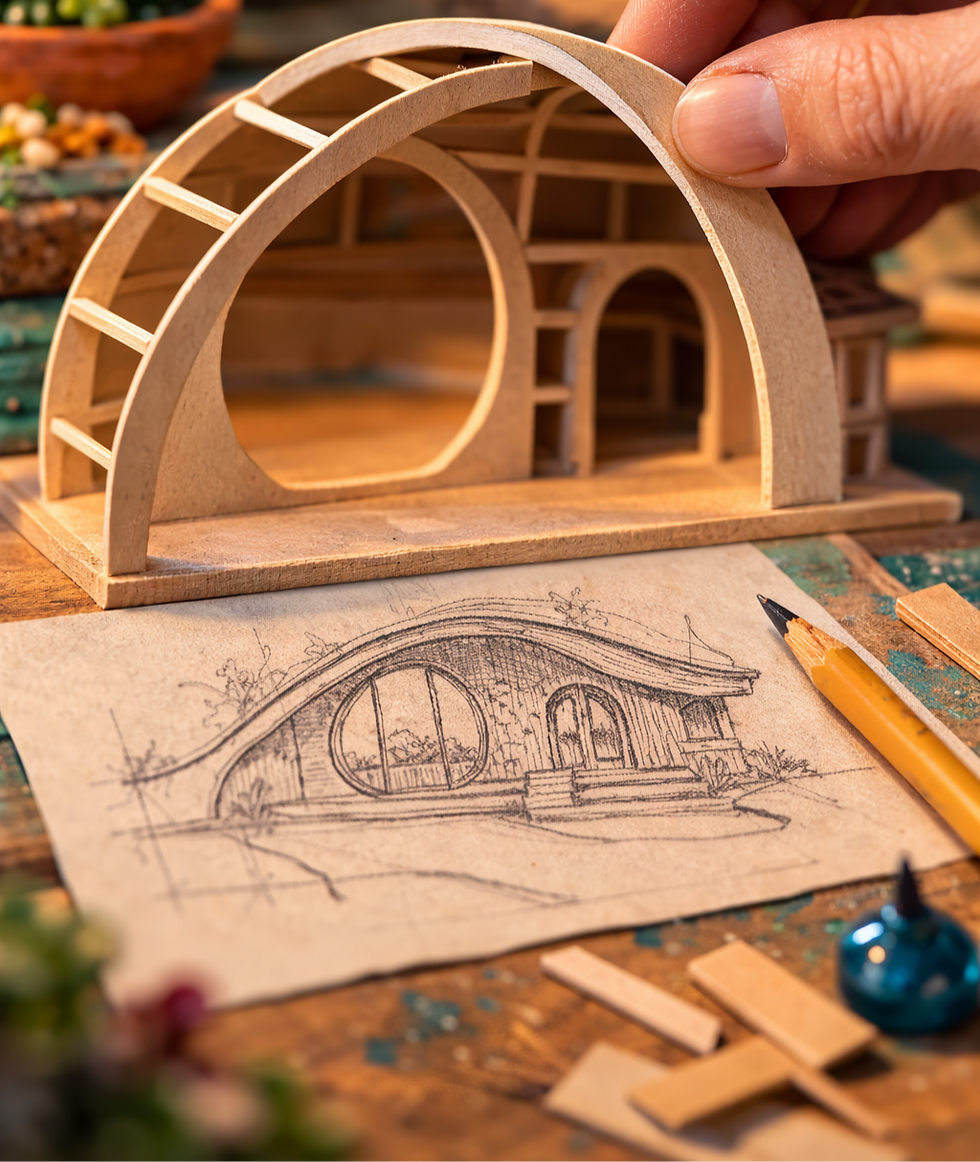
3. Build the bones with flexible skin:
Once the ribs are in place, skin the structure with thin card strips, flexible veneer, or scored styrene. Narrow strips bend better than one giant sheet, especially around compound curves. If you’re using card, lightly mist the back or pre-roll it over a marker barrel. Keep seams staggered. Solar punk likes smooth confidence, not panic folds.

4. Cut in the large rounded window early:
This window is your hero feature, so treat it like royalty. Trace an arch or rounded-rectangle opening using a lid, oval template, or two connected curves. Frame it with thin wood or layered card strips. For glazing, use clear packaging plastic, then polish it with a soft cloth before installation. If you want that luxe modern look, tint the frame a warm walnut or deep bronze. A little interior sill or bench behind the glass makes the house feel instantly inhabited.

5. Add the door and keep the entry simple:
Because the roof and greenery are already doing a lot of visual work, the door should support rather than shout. Use a rounded top if you want stronger Hobbit DNA, or keep it cleaner and more vertical for the modern side of the blend. A good rule is to echo the window curve somewhere in the door or trim so the design language feels intentional.

6. Paint the main finish in warm natural layers:
Start with a base mix of roughly 3 parts warm medium brown, 1 part gray, and a touch of olive for the main shell if you want that rich, sustainable timber-composite feel. Drybrush lighter honey tones along the curve to catch the form. For the steps and hardscape, try 2 parts beige, 1 part gray, tiny touch of moss green. Glaze the recesses with thin burnt umber and olive to settle the miniature into the landscape. Solar punk should look cared for, not abandoned.

7. Build the solar panels like tiny design objects:
The panels matter here, but don’t let them dominate. Cut small clean rectangles from black plastic or painted styrene. Add a fine border in charcoal or bronze and a faint grid with a silver pencil or very thin painted lines. Mount them at a believable sun-catching angle on a slim frame. Think elegant rooftop equipment, not chunky robot waffles.

8. Plant the roof and front garden in layers:
This is the part that makes gardeners feral with joy. Use three foliage scales: tiny ground cover, mid-size leafy plants, and a few upright accents. On the roof, stay lower and tighter so the architecture still reads. Around the entry, loosen up with flowering color and mixed leaf shapes. For vines, twist thin wire or thread, glue it in wandering lines, then add leaf clusters gradually. A mix of glossy dark green, dusty sage, and bright yellow-green keeps it lively. Add a few pink or coral blossoms sparingly so the eye can rest between surprises.

9. Create the interior hero moment:
Since the big window shows so much, give it something worth peeking at. A simple table, pendant lamp, one chair, and a leafy indoor plant are enough. You don’t need to furnish the entire house like you’re opening a tiny IKEA. One warm scene with a believable focal point sells the whole illusion.

10. Add utilities, greebles, and story clutter:
Solar punk loves function with charm. Add a rain barrel, a slim conduit line, a vent, maybe a discreet battery cabinet, or a little hydroponic tray near the side. Then soften all of that with human details: a watering can, stacked pots, a folded apron, seed packets, a bench cushion, or a basket of produce. This is also where you hide your Easter eggs. A tiny blue jar near the steps would be a perfect nod to Sunburrow lore.

11. Light it like sunset, not surgery:
Use warm LEDs in the 2200K–2700K range. A single pendant and one secondary interior glow are usually enough. Diffuse harsh LEDs with tracing paper, frosted tape, or a bead cap used as a shade. USB-powered fairy lights or dollhouse LEDs keep things simple. You want “welcome home,” not “interrogation room for herbs.”
12. Unify, photograph, and make it feel real:
When everything is built, knock back the too-new look with a very thin filter glaze of dusty olive or warm gray, especially near the base and around planters. For photos, shoot low and close so the house feels inhabitable. A soft green garden backdrop works beautifully, and if you want to lean harder into the eco-future story, blur in distant turbines or modern greenhouse forms. Golden-hour style lighting is your best friend here.

Troubleshooting
Curve looks lumpy → Use more ribs and narrower skin strips.
Window glaze looks cloudy → Cut a fresh piece and avoid super glue near visible areas.
Solar panels feel pasted on → Add slim frames and a believable mounting angle.
Plants look like one green blob → Mix leaf sizes, values, and finishes.
Interior light is too harsh → Diffuse it and lower the bulb count.
House reads fantasy but not modern → Simplify the steps, planters, and hardware lines.
Until Next Time in the Small World
Sunburrow No. 7 is exactly the kind of miniature that makes me happy: a little bit fantasy, a little bit future, and completely convinced that basil deserves architectural respect. As an avid gardener, I’m a very easy target for anything with layered planting, warm evening light, and the suggestion that someone inside has both a compost system and excellent taste in lanterns.
Tell me your favorite detail in the comments. Is it the big rounded window? The planted roof? The vines trying to take over in the most charming way possible? And if you build your own take on this idea, share it with #smallworldminiatures so I can admire your tiny eco-utopia. While you’re at it, sign up for the newsletter, take a wander through the online shop, and keep an eye out for the canvas print listing too. Some miniatures belong on a wall just as much as they belong on a workbench.
#smallworldminiatures #miniature #miniatures #miniatureart #miniaturehouse #miniaturecottage #solarpunk #solarpunkart #sustainabledesign #ecoarchitecture #greenroof #dollhouseminiatures #diorama #dioramaart #modelmaking #miniaturegarden #fantasyarchitecture #hobbitinspired #artnouveau #victorhorta #tinyworlds #architecturalminiature #miniaturedesign #makersgonnamake #hobbyartist







Comments