



A Miniature House of Light and Leaves: An Art Nouveau Dollhouse with Balconies, Terraces, and Garden Dreams

First Impressions in Miniature
Some miniatures are cute. Some are clever. And then there are the ones that look like they’ve already judged your paint storage, reorganized your ribbon drawer, and invited you in for tea anyway. This one absolutely got me.
The first thing that hooked me was the style: all that soft, flowing ornament, those grand windows, the layered balconies, the iron cresting, the dreamy roofline, and enough terraces to support a respectable container-gardening obsession. This tiny house has more outdoor planting opportunities than many full-size homes, which is both inspiring and personally offensive. And because I know you’re already wondering how on earth you’d build something in this spirit, keep reading. I’ve got a full how-to guide later on that breaks down the structure, the windows, the decorative molding, and a smart kitbash path so you can chase the vibe without losing your mind.
Why This Photo Needs VIP Treatment
A quick heads-up before we go wandering through the tiny hedges: the image here is optimized for the web, which means it looks lovely on a screen but isn’t the final boss version of sharpness. If this house has already moved into your heart and started paying tiny property taxes, the high-resolution canvas print is the way to go. It’s the proper, wall-worthy version, with richer detail and FREE U.S. shipping. A house this dramatic deserves better than being squinted at between browser tabs.
The Tiny Tale
Locals know it as Maison Bellaflora, though the postman still calls it “that balcony house on the corner” because he refuses to carry four separate sacks of tiny seed catalogs up the steps.
According to neighborhood lore, the house was commissioned in 1899 by Madam Celestine Bellaflora, a widowed botanist, part-time collector of strange orchids, and full-time believer that a house should bloom as enthusiastically as its owner. She wanted sunlight in every room, air on every landing, and enough terrace space to grow things that made her guests ask suspicious questions like, “Is that jasmine, or have I been enchanted?”
So the builder gave her windows that drank in the light, balconies that wrapped and stacked like ribbons, and carved ornament that seemed to sprout from the walls instead of merely sitting on them. By spring, the railings were draped in ivy, the veranda tables were crowded with pots, and Celestine had developed the habit of speaking to her geraniums as if they were boarders behind on rent.

The house changed hands only a few times after that. A music teacher occupied the upper floor and allegedly practiced scales with the windows open so the entire street could enjoy a free concert or complain about it, depending on the hour. A watchmaker used the conservatory-like side room to repair clocks in the afternoon sun. One tenant grew tomatoes in containers on the second-floor terrace and swore they tasted better because the house approved of them.
Even now, Maison Bellaflora is said to reward the observant. People claim that if you stand very still and look from balcony to balcony, you can spot the house’s little private jokes: a runaway watering can, a brass bee worked into the ornament somewhere it shouldn’t be, and a terracotta pot that seems to migrate whenever no one is looking. I won’t spoil where they are. Half the fun is playing detective with your nose practically pressed to the miniature.
A Guided Tour of the Build
From the front, the house rises like a polite little performance. The entry stair lifts you toward that arched central portal, and from there your eye starts climbing—across balustrades, up the carved window crowns, past dormers tucked into the roof, all the way to the ironwork at the top that makes the whole silhouette feel dressed for an evening out.

What I love most is how the façade keeps changing as you look. One moment it reads as elegant and creamy, almost pastry-like with all that molding and trim. Then the green roof cools everything down and the warm interior lights start glowing through the big windows, and suddenly it feels inhabited. Not staged. Inhabited. You can almost smell damp potting soil on the terraces and warm wood from the rooms below.

And then there are the plants. Not just a token pot at the door. Proper plant life. Boxes, planters, terrace clusters, little green interruptions softening all that architecture. They’re exactly what this house needs. Without them, it would still be beautiful. With them, it has a pulse.

Inspirations – From the Big World to the Small
If I had to name the big-world family tree for this miniature, I’d start with Victor Horta’s Brussels town houses, especially Hôtel Tassel and the other major Horta homes. UNESCO describes them as pioneering Art Nouveau works marked by open planning, diffusion of light, and a brilliant decorative line. That matters here, because this miniature is obsessed with light: big windows, glazed openings, warm interior glow, and a façade that seems designed to let sunshine travel as far as possible. That’s very Horta-minded, even if the house itself is more romantic and storybook than strict historical reconstruction.
Next, I’d tip my hat to Hector Guimard—not because this house copies a Paris Métro entrance, but because it shares his love of ornament that feels alive. Guimard’s best-known work includes those plantlike Métro structures, and the broader Art Nouveau idea of architecture, furnishings, and decoration working together as one complete organism fits this miniature beautifully. The trim, cresting, awning, balconies, and windows all feel like they belong to the same sentence. Nothing looks like it was added as an afterthought.

The final branch of the family tree is Queen Anne Victorian, with a side glance at Second Empire. Queen Anne houses are known for asymmetry, steep roofs, dormers, decorative woodwork, and expansive porches, all of which show up here in miniature form. The French-flavored roofline and dressed-up dormers add a faint Second Empire perfume to the mix. So no, this isn’t pure Art Nouveau in a museum-catalog sense. It’s something more playful: an Art Nouveau dream house that flirted outrageously with a Victorian veranda and then bought more flowerpots on the way home.
Artist Tips – Make Your Own Magic
Let’s get one thing out of the way before we start waving glue around like tiny wizards: this is not meant to be an exact reproduction guide. It’s a springboard. A mood. A “go make something dangerously charming” document. Your version will drift a little, your proportions may change, and one of the reference illustrations might occasionally look like it was interpreted by an enthusiastic raccoon with design software. That’s fine. I write these posts myself, but some of the visual helpers can be a little janky around the edges, so take the spirit and run with it.
What matters is capturing the feeling: luminous windows, layered terraces, curving ornament, a grand front entry, and enough planting space to make your miniature residents complain about watering schedules.
Shopping List
Scavenge first, then shop. Also, when I mention Amazon-linked items, those are affiliate links. If you use them, you help fund the tiny world—basically keeping the miniature greenhouse stocked and the imaginary groundskeeper in biscuits.

Structure
Cereal box card or shipping-box chipboard; equivalent: basswood sheets, MDF panels, mat board
Foam packaging scraps; equivalent: XPS foam or insulation foam for sub-bases and terrace build-ups
Coffee stirrers, chopsticks, bamboo skewers; equivalent: scale stripwood and dowels
Clear plastic from food packaging; equivalent: sheet acetate or thin Plexi for glazing
Windows, doors, and trim
Plastic packaging windows, blister packs, old gift card plastic; equivalent: premade dollhouse windows and doors
Toothpicks, stirrers, scrapbook chipboard, cardstock strips; equivalent: milled trim packs, laser-cut fretwork, spindle packs
Thin floral wire or leftover jewelry wire; equivalent: brass wire for railings and cresting
Surface and detail
Sand, baking soda, tissue, fine sawdust, egg carton pulp; equivalent: modeling paste, stucco grit, texture mediums
Tea leaves, dried herbs, sponge foam; equivalent: foliage clusters and static grass
Beads, seed beads, old necklace bits; equivalent: finials, knobs, and decorative hardware
Paint and finish
Acrylic craft paints in warm cream, stone, dusty rose, moss green, weathered bronze, and walnut
Matte medium, PVA glue, clear satin varnish
Brown-black wash mix and a pale ivory drybrush tone
Deep Dive
1. Start with the silhouette, not the wallpaper. Before you cut a single fancy bit, decide what absolutely makes this house this house. For me, it’s five things: the tall central body, layered balconies and terraces, a steep roof full of dormers, oversized windows, and rich decorative trim. Sketch the massing as simple boxes first. If you’re kitbashing, begin with a Victorian shell and plan your add-ons on paper before glue ever enters the room. Model-making guides consistently push planning, scale decisions, and rough mockups first, because it’s much easier to fix cardboard than heartbreak.
2. Pick your path: scratch build or smart kitbash. If you want the closest off-the-shelf spirit, I’d start with Greenleaf Pierce for the grand Victorian footprint and wrap veranda, or Greenleaf Willowcrest for the ornate molding, balcony, dormers, and mansard-style roof energy. For a porch-heavy, easier-to-expand route, Real Good Toys Victoria’s Farmhouse is excellent, and Princess Anne is a good option if you want to add a conservatory-style side volume and extra windows.

3. Safety first, because blood is a terrible wood stain. Use a sturdy work surface, good lighting, and decent ventilation. Keep blades sharp, because dull knives tear material and force mistakes. If you use XPS foam, test anything solvent-based before spraying it—some spray paints can melt it—and a simple PVA-plus-acrylic sealer coat is a safer prep layer.
4. Build the bones. Make a rigid base from MDF, plywood, or doubled-up heavy board. Raise terrace zones in stepped layers so the house immediately gets that luxurious, perched feeling. For the main shell, use 3/16" to 1/4" foam board, MDF, or basswood panels. Think in stacked volumes: central block first, then front veranda, side terrace wing, upper balcony projections, and finally roof masses. Dry-fit everything. When the plain shell already looks handsome, you’re winning.
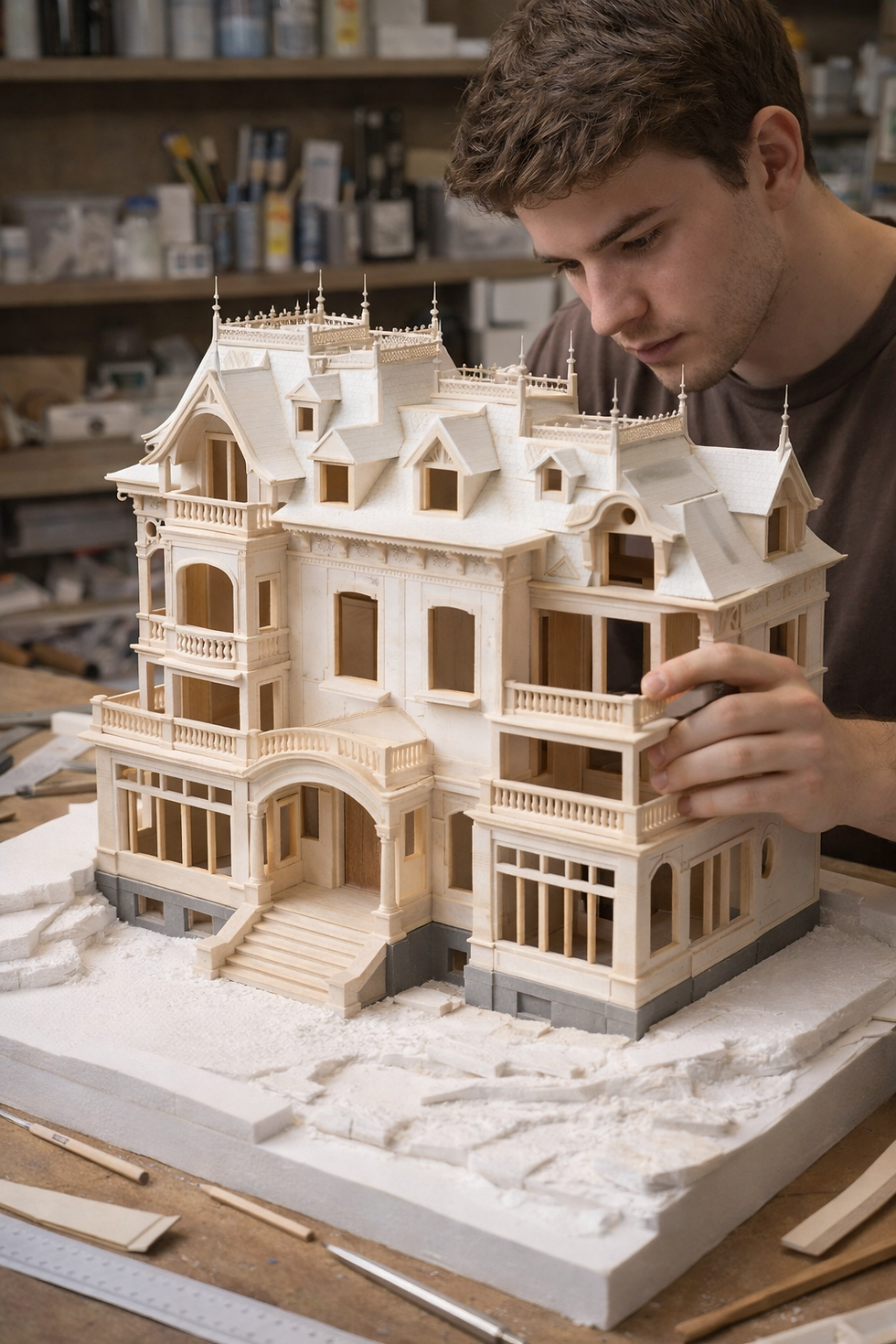
5. Plan your scale so the windows feel gloriously oversized. For 1:12 scale, I’d let the main first-floor windows run a touch taller than strict realism—something in the neighborhood of 5 to 6 inches high on the visible front rooms—because this design wants light. On upper floors, vary the window sizes slightly so the façade feels lived-in rather than machine-stamped. Exact math matters less than rhythm: big public windows below, charming dormers above, and at least one hero opening that makes the whole house feel aspirational.
6. Make the windows and doors. For scratch-built windows, frame each opening with layered card or basswood: outer surround, inner sash grid, then clear acetate behind it. Build the muntins as separate thin strips rather than drawing them on. That little bit of layering does a ridiculous amount of heavy lifting. For curved heads or Art Nouveau-ish arcs, laminate two thin card layers around a paper template instead of forcing one thick strip to behave.For premade options, Real Good Toys currently carries separate window kits, Victorian and Queen Anne windows, dormer windows, French doors, glazed exterior doors, and trim packs. That’s the easiest path if you want clean repetition without hand-building twelve identical windows while muttering at the ceiling.

7. Add decorative molding without losing your mind. This is where the magic happens. Build it in layers. Base trim first. Then crowns above windows. Then balcony brackets, fascia trim, rail details, and gable flourishes. Don’t try to carve every flourish from one heroic chunk. Use paper templates and repeatable units: tiny teardrops, curves, rosettes, half-rounds, and scrolls. Scrapbook chipboard, cereal-card laminations, thin basswood, and even embossed craft paper all work.If you want the faster route, premade alternatives like lace trim, spindle packs, shaped balusters, porch gingerbread, and trim packs are currently available from Real Good Toys. Mix scratch-built hero pieces with premade repeats and nobody will call the trim police.

8. Roof, dormers, and the fancy hat situation. The roof here matters almost as much as the façade. Cut it from thin MDF or layered card over a simple support frame. Let the pitch stay elegant rather than cartoonishly steep. Add dormers after the main planes are locked in. For shingles, individual strips give you the nicest scale texture; tint them in blue-green, soft slate, or weathered copper-green tones. A base mix of muted teal plus gray plus a little ivory works beautifully. Drybrush the ridge lines lighter, then dot in a few darker strips so the roof doesn’t look like a single plastic thought.

9. Finish the walls and terraces. For the creamy exterior, start with a warm ivory base, then glaze in pale taupe and the faintest blush so the house avoids that dead, flat white look. Texture can be subtle: a whisper of stucco on wall panels, crisp trim on edges, and stone-gray on stair bases and terrace paving. My favorite weather stack here is simple: thin raw umber wash into recesses, soft green-brown around planters and water paths, and a pale drybrush on ornamental high points. Enough age to feel loved. Not enough to feel condemned.

10. Choose your hero piece. Every great miniature needs one detail that steals the show. Here, I’d make it the main entry arch and front doors or the upper balcony garden room. Pour extra attention into that zone. Add warmer color, finer trim, maybe a tiny hanging lantern, a sign plaque, or a filigree screen. The rest of the house can be a chorus. Your hero piece gets the solo.
11. Don’t forget the useful nonsense. This house wants greebles, but elegant ones: downspouts, wall lamps, terrace rail caps, tiny planters, a watering can, a rolled rug on the balcony, maybe a little bench under the lower tree. On a build like this, the utilities should feel tucked in, not industrial. Even the practical bits should know they live in a beautiful house.

12. Add furniture, soft goods, and story clutter. A café set on the lower terrace. A chaise or two upstairs. Window boxes. Pot clusters in odd numbers. Sheer curtains behind those giant windows so the rooms glow instead of glare. This is where the house becomes personal. Tuck in the Easter eggs from the story: a brass bee motif, a missing watering can, a pot that “moved,” maybe seed packets on a table. Tiny narrative always beats generic perfection.

13. Light it like somebody is home. Warm LEDs make this style sing. Keep it around warm white territory, diffuse it behind vellum or frosted plastic, and hide the wiring early. USB-powered mini LED strands or dollhouse lighting systems both work. You don’t need a doctoral thesis in electrics. You need soft, believable pools of light that make the windows irresistible. Real Good Toys’ instructions pages also note current wiring documentation for many kits, which is handy if you’re starting from one of their shells.
14. Unify the whole thing. Once everything is painted, glazed, and planted, give the house one final pass with restraint. A very thin dusty filter over terrace stone, a soft satin on windows, matte on walls, slightly richer sheen on doors, and tiny touches of verdigris or warm grime only where water would naturally collect. The goal is one house, not a pile of excellent parts auditioning separately.
15. Photograph it like the tiny diva it is. Use a pale backdrop if you want the architecture to shine, or a soft painted sky panel if you want romance. Side light plus warm interior light is the sweet spot. Drop your camera lower than feels natural so the miniature reads like a real house. Scatter a few loose pots or garden tools in the foreground and suddenly you’ve got atmosphere instead of documentation.

16. Troubleshooting
Windows look flat → Add one more trim layer and recess the glazing farther back.
Trim feels chunky → Split details into thinner stacked layers instead of one thick piece.
House feels toy-like → Tone down color saturation and add a controlled wash into recesses.
Terraces feel empty → Group plants in clusters of three, five, or seven with varied heights.
Roof overpowers the build → Desaturate it slightly and brighten the walls and windows.
The style feels confused → Repeat one motif everywhere: arches, plant curves, or a specific spindle pattern.
Until Next Time in the Small World
Maison Bellaflora may be fictional, but I’m not kidding when I say I’d move in tomorrow. Give me the large windows, the balcony railings, the terrace planters, the warm lamps, the suspiciously thriving geraniums, and one small room dedicated entirely to seed storage and I will ask for nothing more. Well, perhaps one more balcony. Possibly three.
Tell me which detail you love most—the roofline, the windows, the terraces, the garden clutter, the entry arch, the little pockets of light, whatever made you lean in closer. And if you build your own version, I’d love to see it. Share it with #smallworldminiatures so the rest of us can admire your tiny architectural ambition. While you’re at it, take a look around the shop, sign up for the newsletter, and if this house has thoroughly ruined your standards for normal décor, keep an eye out for the canvas print too. It deserves a proper wall.
#smallworldminiatures #miniature #miniatures #dollhouse #dollhouseminiatures #artnouveau #victorianminiature #queenannearchitecture #miniatureart #modelmaking #scalemodel #miniaturehouse #tinyhomeart #architecturalminiature #miniaturegardening #containergardening #miniaturebuilder #diorama #makersgonnamake #fantasyarchitecture #miniaturephotography #interiordesigninminiature #miniaturecollector #handmadeart #tinyterraces #balconygarden #miniatureinspiration






Comments