



Miniature Greenhouse After the Last Tuesday: A Poetic Little Post-Apocalyptic Conservatory

Opening – First Impressions in Miniature
You know a miniature has me in trouble when I start wondering whether I could survive there on canned peaches and suspiciously well-nourished houseplants.
This post-apocalyptic miniature greenhouse has everything I love: a glassy Victorian conservatory shape, creeping vines, cracked panes, mossy chaos, moody survival-garden lighting, and the general feeling that a fern has recently formed a committee. It sits somewhere between Fallout garden club, The Last of Us overgrowth, Independence Day aftermath, and that Will Smith plague movie that made every empty city street feel personally haunted.
Keep reading, because after the tour and the tiny nonsense-lore, I’m getting into a practical build-style guide for making your own abandoned greenhouse scene.

Why This Photo Needs VIP Treatment
A quick note before we wander too far into the weeds, and yes, the weeds are in charge now.
The image you’re seeing here is web-optimized, which means it looks lovely online but is not the same as a print-sharp professional file. For the full “hang this on the wall and let your guests ask why they suddenly care about tiny apocalyptic horticulture” experience, order the high-resolution canvas print from the shop. It comes ready to bring moody greenhouse drama into your room, and U.S. shipping is free. The plants insisted I mention that. They have a clipboard.
Miniature Backstory – The Tiny Tale
Welcome to Saint Sprig’s Conservatory for Questionable Survivors, founded in 1897 by botanist, amateur locksmith, and deeply suspicious jam-maker Euphemia Spriggett.

Euphemia believed that plants were not merely decorative. She believed they were “quiet citizens with excellent memories.” Her greenhouse began as a proper Victorian glasshouse, full of citrus trees, medicinal herbs, orchids, and one fern named Mr. Puddles that, according to local records, “did not care for men in hats.”
Then came the Big Oops.
No one in the town agrees on what the Big Oops actually was. Some say a military experiment went sideways. Some say the power grid sneezed. Some say a traveling magician tried to teach a tomato plant card tricks and nature finally snapped. Whatever happened, humans became scarce, the town went silent, and Saint Sprig’s Conservatory did what every stubborn old greenhouse dreams of doing: it kept growing.
The current locals include:
Mabel the Moss, who lives on the roofline and considers herself senior management.
The Triplets, three identical terracotta pots near the door that gossip loudly during rainstorms.
Old Clank, a dented watering can with the emotional range of a retired security guard.
The Night Nasturtium, which blooms only when someone lies about how many cookies they ate.
And somewhere in all that green, tucked near the front steps, is Euphemia’s last painted sign: “DO NOT TRUST THE BASIL.” That’s your Easter egg. If you spot a basil pot in your own version, give it a tiny label and let it look innocent. Basil always looks innocent.

A Guided Tour of the Build
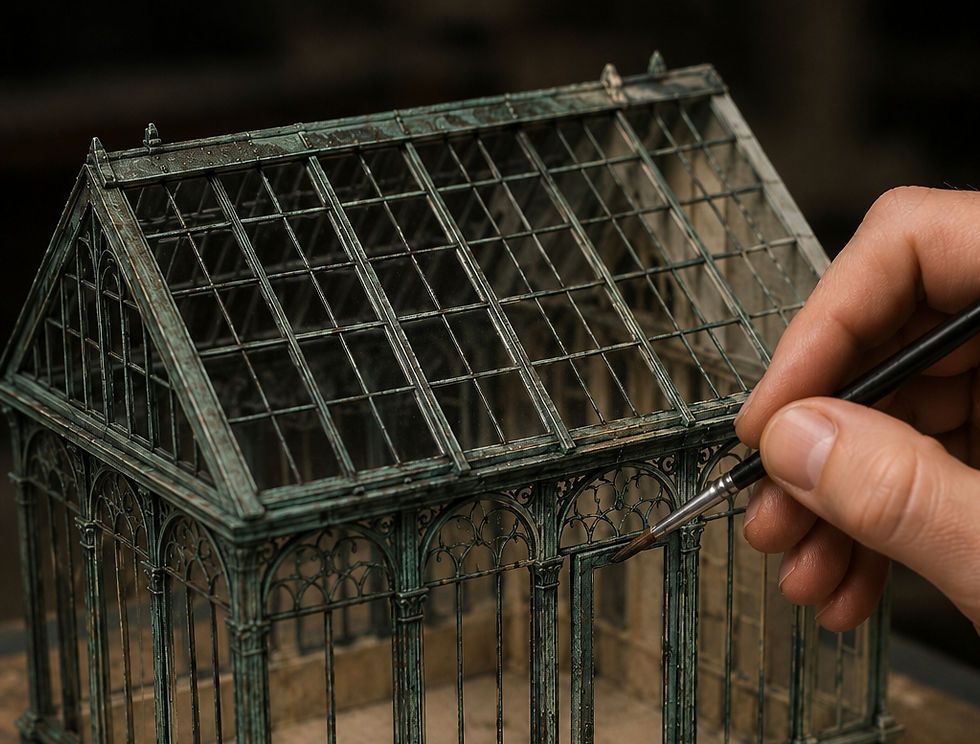
The roof catches you first. That slanted glass canopy rises like an old botanical cathedral, but it’s wounded in all the best miniature ways: missing panes, tilted frames, moss clumps, trailing vines, and that lovely “weather has been negotiating here for decades” texture.
The metalwork below is wonderfully fussy. There are arches, columns, scrolls, grilles, and narrow panes stacked like tiny memories. It has the bones of a refined conservatory, but the manners of a place that now hosts raccoons with opinions.

Inside, the warm light glows through the jungle. Leaves press against the glass. Pots crowd the floor. The door, worn and blue-green, feels like it has survived storms, weeds, looters, and at least one person named Greg who said, “I know a shortcut.”

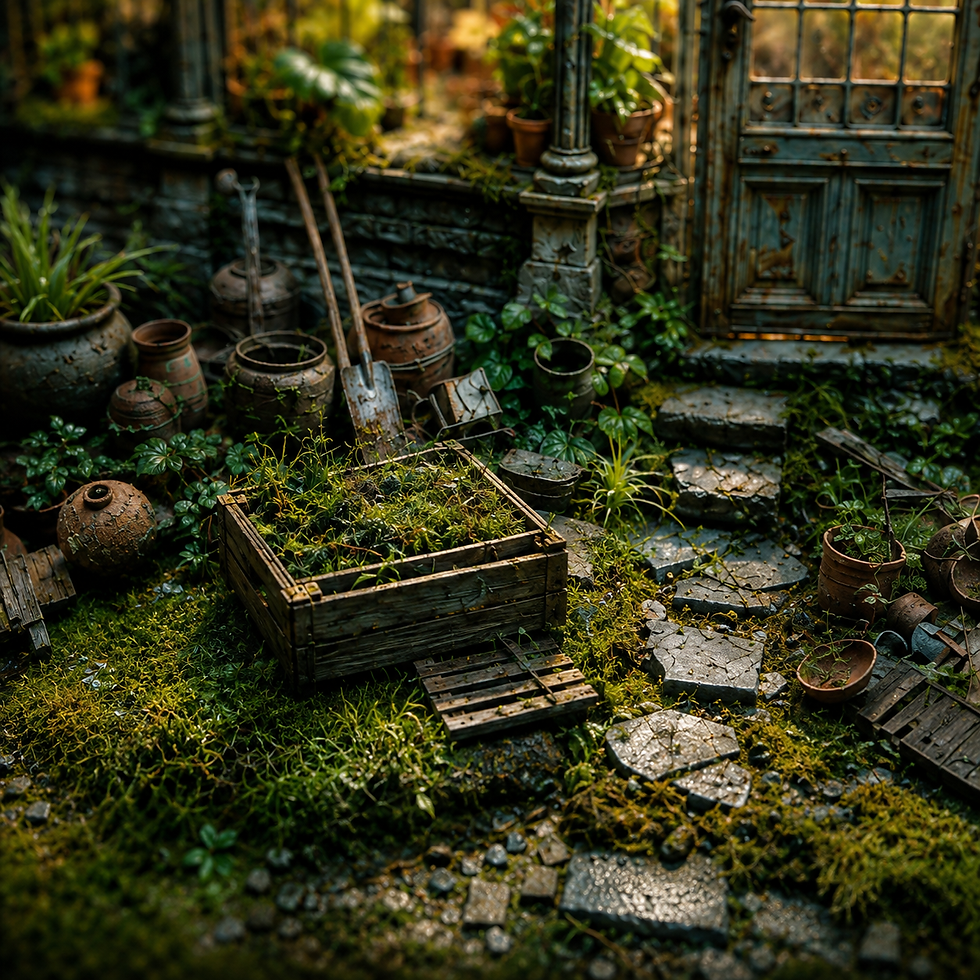
Outside, the ground is deliciously cluttered. Crates, boards, broken stone, tools, terracotta pots, grass, moss, and little paths all point toward a world where humans left in a hurry and plants immediately said, “Great. Open floor plan.”
Inspirations – From the Big World to the Small
This miniature sits in a real design family with roots in Victorian glasshouses, iron conservatories, and the romantic ruin.
The first obvious cousin is the great Victorian greenhouse tradition, especially places like the Palm House at Kew Gardens. That kind of structure is all about glass, repetition, thin ribs, and the fantasy of bringing wild plant life into a controlled architectural shell. In miniature, that idea gets flipped beautifully. The shell is still there, but control has packed a suitcase.
There’s also a whisper of The Crystal Palace, that grand 19th-century dream of iron and glass. Even though this tiny greenhouse is much smaller and far more feral, it shares that same obsession with transparency, rhythm, and structure as spectacle. The miniature version turns spectacle into intimacy. Instead of a palace of progress, we get a greenhouse of “well, progress got eaten by vines.”
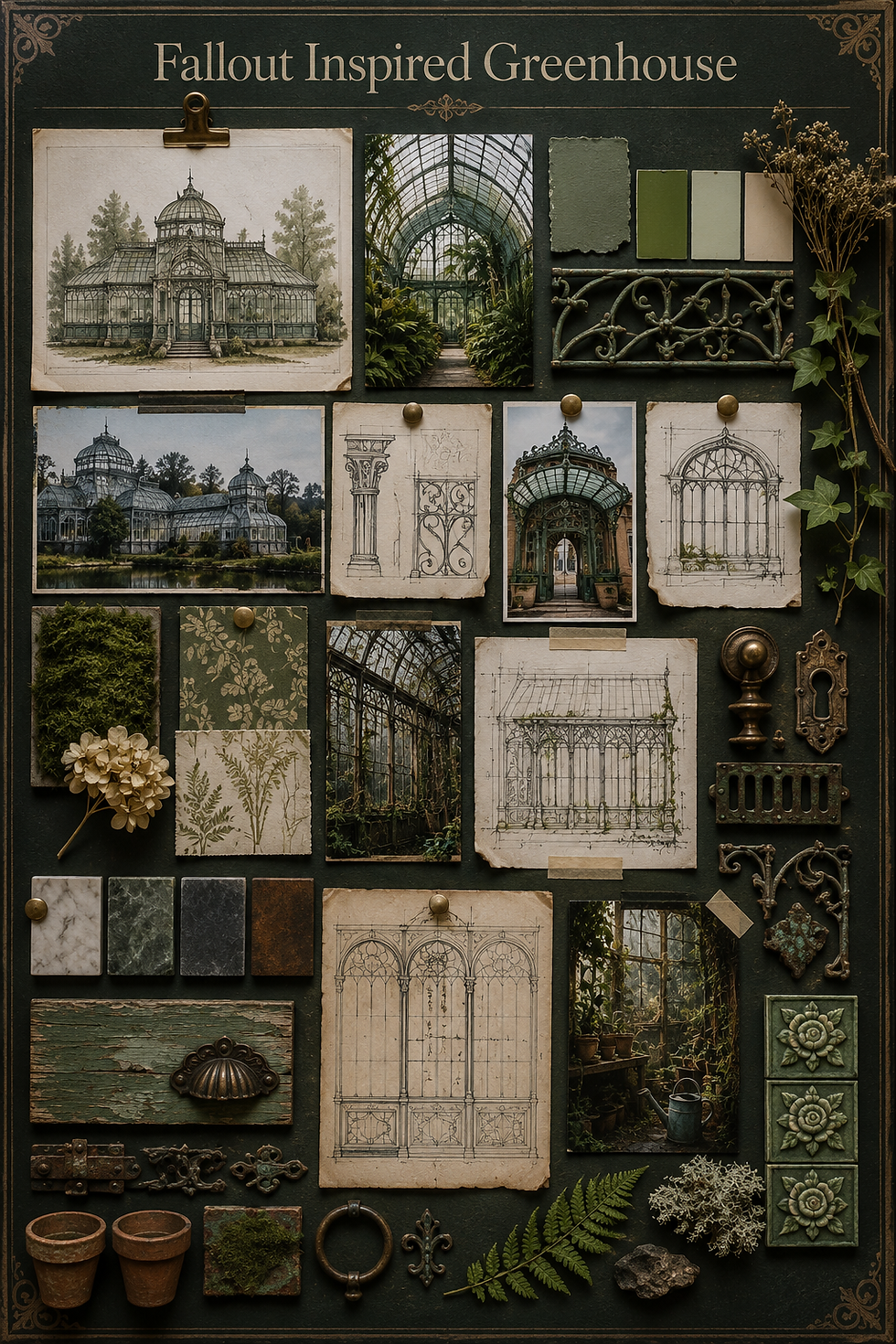
The ornamentation also brushes up against Art Nouveau, especially the plantlike curves of designers such as Victor Horta and Hector Guimard (I know... I know... I talk about those two WAY too much. Deal with it. I’ve always loved how Art Nouveau makes architecture feel like it grew rather than got built. Here, the curling metalwork and vines start speaking the same language. You can’t always tell where the iron ends and the plant mutiny begins.
That shared design DNA matters. A post-apocalyptic miniature doesn’t have to be just rust, rubble, and gray dust. This one has elegance. It says, “Yes, civilization collapsed, but the door still has great proportions.”

Artist Tips – Make Your Own Magic
You are not making a carbon copy. You are building your own little overgrown survival poem with a door, a roof, and probably too many pots. Results will vary, and they should. This guide is inspiration, not a blueprint with a tiny building inspector hiding behind the moss. I write the blogs, and I use AI image generation to help create the illustrations, which means sometimes the tiny world gets a little janky. A window may forget how geometry works. A vine may develop ambition. We bless it and keep crafting.
Shopping List
Household finds first
Save clear plastic packaging from berries, pastries, toy boxes, or electronics for greenhouse panes. Use cereal box cardboard for templates, coffee stirrers for trim, toothpicks for thin rails, twist ties for vines, bottle caps for planters, old tea leaves for soil texture, and bits of broken dried plant matter for dead branches.
Useful purchasable equivalents
Look for clear acetate sheets, basswood strips, chipboard, foam board, XPS foam, miniature terracotta pots, static grass, preserved moss, floral wire, UV resin, craft acrylics, weathering powders, matte Mod Podge, tacky glue, super glue gel, and USB-powered warm white LED strands.

The supply links on the blog are Amazon affiliate links, which means if you buy through them, you help fund the tiny world. Somewhere, a miniature fern gets a better education. Caring is sharing.

Deep Dive: Building an Abandoned Miniature Greenhouse
Safety first, because fingers are useful
Use a sharp blade, cut away from yourself, and change blades before they start chewing the material instead of slicing it. Ventilate when painting, sealing, or using glue. Wear eye protection when snapping plastic or cutting wire. Keep LEDs low-heat, and never bury battery packs where you can’t reach them.
Planning and scale notes
Pick a scale before you start. For dollhouse-style drama, 1:12 works beautifully. For a compact shelf scene, 1:24 gives you the feeling without requiring your dining table to become a national park.
A good footprint for a small greenhouse scene is about 10 by 14 inches in 1:24 or 18 by 24 inches in 1:12. Keep the greenhouse tall enough to feel airy. In 1:24, a front wall around 5 to 7 inches high with a roof peak around 8 to 10 inches feels generous.
Sketch the front elevation first. Count your window bays. Odd numbers often look pleasing: three, five, or seven. Then plan where the door interrupts the rhythm.
Bones: base structure
Start with a rigid base: MDF, foam board laminated in layers, or a wood plaque. Build a low stone foundation from XPS foam, cork chunks, or egg carton pieces. Keep it uneven but believable.
For the greenhouse frame, use basswood strips, coffee stirrers, or styrene rods. Make the front wall as a flat panel first: vertical posts, top rail, bottom rail, then arch shapes or crossbars. Build side walls separately, then join them into a box.

The roof can be two slanted panels meeting at a ridge. Make a simple cardboard template first. If the angle looks too steep, your greenhouse becomes a tiny church. Not bad, but the tomatoes may feel judged.

Windows and doors
For glass, use acetate or clear plastic packaging. Scuff a few panes with fine sandpaper. Crack others with a white paint pen or a tiny scratch from a blade. Leave some panes missing entirely.
For the door, cut a rectangle from chipboard or thin basswood. Add vertical strips, a tiny handle, and a small lower panel. Paint it faded blue-green, then sand the edges lightly after drying. A door should look like it has opened for gardeners, scavengers, and one possum who refuses to leave a forwarding address.

Victorian decorative filigree
For that fancy greenhouse lacework, use thin cardstock, painted lace scraps, jewelry findings, bent floral wire, or tiny curls of black paper quilling strips. Keep the pattern repeating: little arches, loops, and scrolls make the frame feel Victorian without needing a magnifying glass and a nervous breakdown.
For buyable options, search for miniature wrought-iron fencing, dollhouse balcony railings, laser-cut chipboard trim, decorative nail-art decals, photo-etched brass railings, or 1:12 scale garden gates. Paint them dark teal-black, then dry-brush with pale green-gray so the details pop like the greenhouse is still trying to be elegant while actively being swallowed by vines.

Finishes, base color, and weather stack
Start with dark primer or a black-brown base coat. For old metal, layer deep green, blue-black, and rusty brown. A good mix is roughly 2 parts dark teal, 1 part black, 1 part burnt umber. Dry-brush with pale gray-green on edges.

For glass grime, thin tan or gray acrylic with water, about 1 part paint to 5 parts water, and drag it downward in streaks. Add green algae washes along lower panes and roof seams.
For stone, use charcoal gray, warm gray, and moss green. Sponge the colors instead of brushing everything smooth. Real decay has freckles.
The main focal piece
The front door is the emotional anchor. Give it contrast. Let the surrounding greenhouse go dark and leafy, then make the door just bright enough to catch the eye. Add one broken step, one fallen pot, and a little path leading toward it. The viewer should feel invited and slightly warned.
A sign helps too. Try “Saint Sprig’s,” “Seed Vault 7,” “No Refunds After Collapse,” or “Do Not Trust the Basil.”
Vines, plants, and leafy takeover
For vines, twist together thin floral wire, bread-bag twist ties, embroidery floss, or unraveled jute twine. Brush them with a mix of tacky glue and dark green-brown paint, then press on tiny leaf shapes cut from painted paper, dried herbs, preserved moss crumbs, or miniature leaf scatter. Keep the vines uneven. Nature does not use a ruler, and after the apocalypse, she definitely fired the intern who owned one.
For big leafy greenhouse plants, cut simple heart, oval, and spear-shaped leaves from green paper, painted masking tape, or thin craft foam. Bend each leaf slightly with tweezers so it catches the light. Glue them to fine wire stems, then cluster them into pots with coffee grounds, tea leaves, or fine dirt-colored ballast on top.

For purchasable shortcuts, look for miniature ivy, model railroad foliage, preserved moss, laser-cut paper leaves, static grass tufts, aquarium plant trimmings, dollhouse plants, or 1:12 and 1:24 scale potted plants. Mix handmade and store-bought pieces together so the scene feels wild instead of freshly unpacked from the Tiny Garden Center, where Mabel the Moss is absolutely the manager and absolutely has opinions about your coupon.
Utilities and greebles
This is where the world starts talking. Add a rain barrel from a bottle cap or bead container. Use thin wire for broken conduit. Make a tiny hose from green embroidery floss stiffened with glue. Add old tools, a ladder, seed trays, a cracked lantern, and a suspicious crate labeled “NOT MUTANT CORN.”

Keep the clutter clustered. Random everywhere becomes visual oatmeal. Put little stories in pockets.
Furniture and plant benches
Inside, add narrow benches along the walls. Coffee stirrers work well. Make shelves crowded with pots, trays, jars, books, and seed packets. A tiny stool near the door adds human scale.
For plant pots, mix purchased mini pots with handmade ones from air-dry clay, beads, paper cones, or painted bottle caps. Not every pot should stand upright. The apocalypse has poor shelf discipline.

Lighting
Use warm white USB-powered LED strands or fairy lights. Aim for 2700K to 3000K if you want that golden greenhouse glow. Hide the lights behind plants, under benches, or along the back wall.
Diffuse bright bulbs with parchment paper, frosted plastic, or a dab of matte medium over the LED cover. Keep wiring accessible. Future You deserves kindness.
Story clutter and Easter eggs
Add one odd detail that rewards a closer look: a tiny child’s toy, a hand-painted seed packet, a clipboard of plant crimes, a cracked mug, or Euphemia Spriggett’s “Do Not Trust the Basil” warning.
The best miniature scenes feel like someone left five minutes ago, even if that someone was a squirrel with a medical degree.
Photo tips
Use a dark background to make the glass glow. A black foam board backdrop works. Add a warm light inside the greenhouse and a cooler light from above or the side. Mist the scene lightly nearby, not directly on delicate materials, if you want atmosphere.
Shoot low, near door height. Miniatures look more real when you photograph them like a place, not an object.

Troubleshooting
Problem: The greenhouse looks too clean.Fix: Add layered grime. Use thin washes, speckled sponge paint, dust-colored dry-brushing, and uneven moss.
Problem: The windows look flat.Fix: Vary the panes. Crack a few, fog some, remove one, and add highlights along edges.
Problem: The plants look toy-like.Fix: Mix leaf sizes and greens. Add brown dead bits. Real plants are messy little drama queens.
Problem: The structure feels crooked in a bad way.Fix: Choose where it leans. Intentional sagging looks charming. Accidental wobble looks like a sneeze.
Problem: The lighting is harsh.Fix: Diffuse it and bounce it off the back wall. Hide bulbs behind foliage.
Problem: The scene feels crowded.Fix: Clear a path to the door. The eye needs somewhere to walk.
Closing – Until Next Time in the Small World
Saint Sprig’s Conservatory has survived disaster, weather, neglect, and one basil plant with extremely questionable motives. That’s the kind of miniature I love most: pretty at first glance, strange at second glance, and absolutely packed with little stories if you lean in.
Tell me your favorite detail in the comments. Is it the glowing glass? The roof moss? The battered door? The tiny pots staging a group intervention?
And if you make your own abandoned greenhouse, tag it with #smallworldminiatures so I can come admire the weeds. Sign up for the newsletter for more tiny tours, wander through the online shop, and don’t forget the canvas print if this little post-apocalyptic greenhouse needs to haunt your wall in the nicest possible way.
#smallworldminiatures #miniature #miniatureart #miniaturediorama #dioramaart #greenhouseminiature #postapocalypticart #abandonedgreenhouse #miniaturegreenhouse #scale模型 #scalemodel #dollhouseminiatures #miniatureartist #tinyworlds #miniaturephotography #fantasyminiature #apocalypticdiorama #weatheringtechniques #modelmaking #crafttutorial #miniaturecollector #architectureminiature #victoriangreenhouse #artnouveauinspired #tinygarden #mossart #overgrownminiature #canvaswallart







Comments