



The Blooming Steamship in Miniature: Victorian Pastel Ship Kit-Bash on a Sea of Roses

Opening – First Impressions in Miniature
I have a soft spot for miniatures that look like they sailed out of a cake box, robbed a Victorian conservatory, and then politely apologized with flowers. This pastel ship miniature has everything I love: creamy white architecture, minty sea-glass hull color, gold accents, glowing interiors, balconies everywhere, and enough tiny blossoms to make a garden club faint into its lace gloves.
Does it look seaworthy? Absolutely not. There is a grand open section near the bottom of the hull that suggests the ship’s flotation plan is mostly “good manners and optimism.” But that is exactly why I love it. It is less “practical ocean vessel” and more “floating Victorian hotel that believes physics is a rude suggestion.”
Keep reading, because farther down I’ll walk through a build-inspired guide for turning a thrifted or eBay ship model into your own floating Victorian fantasy.

Why This Photo Needs VIP Treatment
This image is web-optimized, which means it looks lovely on your screen but was not dressed for the grand ballroom of print. For wall art, order the professional high-resolution canvas print instead. It gives the details room to breathe, the warm windows room to glow, and the flowers room to gossip. FREE U.S. shipping, because even tiny steamships deserve favorable trade routes.
Miniature Backstory – The Tiny Tale
This is The S.S. Petunia Persnickety, launched in 1894 by the Very Serious Floral Navigation Society, an organization founded after one captain declared, “Why should only gardens have gazebos?” The ship was designed as a floating hotel, tearoom, botanical research station, and emergency hat-storage facility for traveling aunties of means.
Its first captain, Admiral Beatrice “Buttonhook” Bellwether, refused to sail unless every deck had at least one topiary sphere and three varieties of hydrangea. Her crew included a pastry chef who navigated by cinnamon smell, a gardener who spoke fluent begonia, and a ship’s cat named Marmalade, who held the unpaid but deeply respected title of Assistant Inspector of Sunbeams.

Local legend says the Petunia Persnickety never docks in the same port twice. Instead, it appears wherever someone has left a tiny chair empty beside a tiny table. There is always tea. There is usually cake. There is occasionally a heated disagreement over whether a fern counts as a passenger.
Easter egg for you: somewhere in this design, imagine a little compass rose that never points north. It points toward dessert.

A Guided Tour of the Build
The first thing your eye catches is the dreamy contrast: a soft aqua hull below and a wedding-cake stack of white Victorian architecture above. The ship feels like a mansion decided land was overrated.

Look at the long rows of arched windows, the layered porches, the railings, the gold trim, the glowing rooms tucked inside the lower hull. The whole thing feels warm, busy, and slightly nosy, like every window contains someone saying, “I’m not spying, I’m appreciating the harbor.”
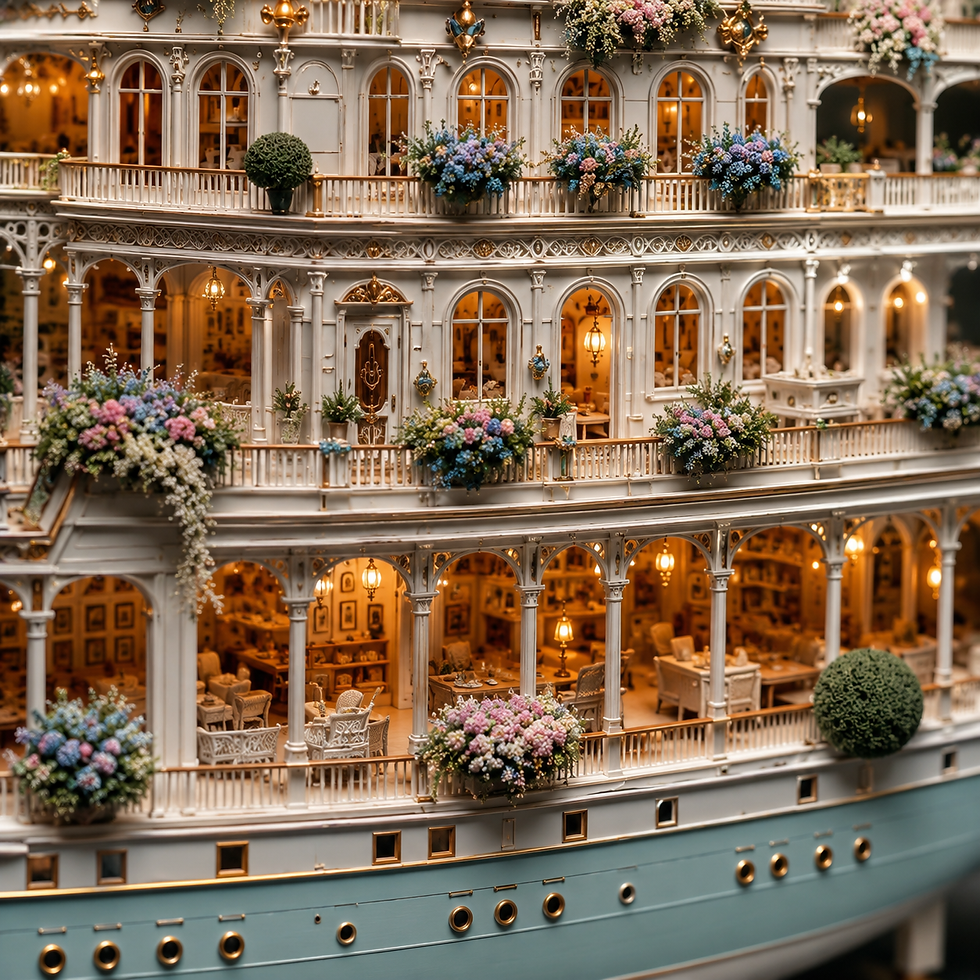
Flowers spill over balconies in pinks, blues, creams, and lavender. Round topiary trees perch on decks like tiny green aristocrats. The masts and rigging add a nautical skeleton, while the ornate doors, columns, moulding, and carved-looking panels make it feel like a Victorian hotel got politely welded to a steamboat.

Inspirations – From the Big World to the Small
This miniature belongs to a delightful style family: Victorian Queen Anne exuberance, riverboat charm, Gilded Age ornament, and a tiny kiss of Art Nouveau. Queen Anne architecture often plays with asymmetry, porches, turrets, brackets, and layered exterior materials, which is exactly the kind of “more is more, but make it charming” thinking that works beautifully in miniature.
For ship DNA, look toward historic American steamboats like the Belle of Louisville, built in 1914 and described by its official site as an authentic surviving steamboat from the packet boat era. That layered-deck silhouette, railing rhythm, and ceremonial riverfront presence all rhyme with this fantasy build.

For the floral curves and botanical attitude, I think of Victor Horta’s Hôtel Tassel in Brussels, built between 1892 and 1893, with steel, glass, flowing structure, and organic Art Nouveau detailing. The Petunia Persnickety is not copying Horta, but it shares that same belief that architecture can grow like a plant if you let it misbehave a little.
You can also borrow a pinch of The Breakers in Newport, built in 1895, for the grand Gilded Age feeling: arches, columns, social drama, and spaces that announce, “Someone here owns too many spoons.” In miniature scale, those influences become simplified silhouettes: repeated arches, strong deck lines, creamy colors, and ornament placed where shadows will show it off.
Artist Tips – Make Your Own Magic
You are not building an exact reproduction here. You are catching the mood, bottling the perfume, and convincing a ship model to put on a fancy hat. Results will vary, and that is part of the fun. I write these posts from my own tiny-world brain, and I use AI image generation for some illustration concepts, which means it occasionally invents a window that would confuse a building inspector and possibly a priest. Treat this guide as inspiration, not a naval engineering document.
Shopping List
Raid the house first: cereal-box card, toothpicks, bamboo skewers, coffee stirrers, paper doilies, jewelry bits, lace scraps, clear packaging plastic, old greeting cards, beads, faux plant clippings, thread, wire, bottle caps, and thin cardboard.
Ship base: thrift-store ship model, old plastic boat kit, wooden display ship, toy yacht, or eBay fixer-upper. Look for a hull with good length and decks you can modify.
Architectural pieces: basswood strips, styrene strips, dollhouse windows, model railroad windows, 1:64 or 1:72 doors, laser-cut trim, paper quilling strips, nail-art decals, silicone moulds, UV resin, polymer clay, filigree jewelry findings.

Flowers and plants: preserved moss, foam foliage, paper flower punches, flocking, tiny beads, polymer clay, floral wire, model railroad shrubs, dollhouse flower boxes, premade miniature hydrangeas, roses, vines, and topiary balls.
Interior bits: scrapbook paper, printable wallpaper, bead lamps, 1:64 furniture, 1:72 furniture, train-layout benches, matchstick tables, micro books, warm LED strands, vellum, acetate, gold paint pens.
Many supply links in the finished post can be Amazon affiliate links. When you shop through them, you help fund the tiny world, which is excellent because Marmalade the ship’s cat has expensive sunbeam standards.

Deep Dive: Build-Inspired Guide
1. Safety first, captain. Work with good lighting, ventilation, and a sturdy surface. Wear a dust mask when sanding, and use a respirator for spray painting or airbrushing. Sharp blades, solvents, sealers, and glues deserve respect, not panic. Read labels, take breaks, and keep supplies sealed and labeled.
2. Let the donor ship decide the scale. A model’s scale is a fraction of the full-size subject, so start by measuring something predictable: a door, railing, deck chair, or figure. If a real door is about 80 inches tall and your miniature door opening is 1.25 inches, you are around 1:64. If your donor ship is closer to 1:72 or 1:96, follow that. This design visually reads around 1:60 to 1:72, but your thrift-store ship is the bossy admiral.
3. Build the bones. Keep the hull, then add stacked deck structures from foam board, basswood, or styrene sheet. Think wedding cake: wide lower deck, narrower middle deck, tiny upper deck. Dry-fit everything with painter’s tape before gluing. Use cardboard templates first so you can test the silhouette without committing emotional damage.


4. Add Victorian trim, moulding, doors, and windows. For arched windows, use premade model railroad or dollhouse windows when the scale works. For DIY versions, cut thin frames from cardstock or styrene, then add clear acetate behind them. Use paper quilling strips for curved arches. Toothpicks make columns. Beads make capitals. Lace, nail decals, and filigree jewelry bits can become carved panels, brackets, and cresting. For raised moulding, layer thin strips: one wide strip, one skinny strip, one tiny bead of glue or dimensional paint. Paint hides many sins. Gold paint distracts from the rest.

5. Paint the pastel ship palette. Try a hull mix of 4 parts pale mint, 1 part blue-gray, and 1 part warm white. For the white upper decks, use 6 parts warm white, 1 part ivory, and a tiny touch of blush so it does not look refrigerator-cold. Gold trim works best when softened: 3 parts antique gold to 1 part raw umber wash. Keep weathering gentle. This ship has drama, but it still moisturizes.

6. Create the floral explosion. For handmade hydrangea clusters, dab tiny balls of foam, sponge crumbs, or flocking onto glue mounds, then tint with diluted pink, blue, lavender, and cream paint. For roses, roll tiny spirals of paper or polymer clay. For vines, twist fine wire with green flocking or use thread brushed with matte medium. Topiary balls can be foam beads covered in fine turf. Premade options are your friend: model railroad foliage, dollhouse flower kits, and miniature floral sprays save time and sanity.

7. Build the lower-hull interiors. Those glowing open sections are where the ship becomes irresistible. Do not build full rooms unless you want to. Make shallow room boxes behind the hull openings. Add a back wall, floor, side returns, wallpaper, tiny shelves, and a few furniture silhouettes. Use warm LEDs behind vellum or parchment paper for soft light. Place a chair near a window, a tiny table with a cup, a bookshelf, or a plant. The viewer’s brain fills in the rest, which is cheaper than buying sixteen tiny sofas.

8. Create the main focal detail. Pick one moment that gets extra love: the central staircase, the grand doorway, the glowing dining room, or the flower-draped balcony. Give it contrast, light, and texture. This keeps the whole model from becoming visual soup, even though “Victorian soup boat” does sound like something Beatrice Bellwether would commission.
9. Add utilities and greebles. Use beads for portholes, wire for rigging, jewelry chain for deck ropes, watch parts for medallions, and small eyelets for vents. Keep nautical details in metallic gold, cream, and dark bronze so they feel fancy instead of industrial.

10. Light it simply. USB-powered warm white mini LED strands are the easiest route. Aim for 2700K to 3000K warmth. Tape lights behind walls, bounce them off white card, or diffuse with vellum. Avoid bare bulbs blasting straight through windows unless you want your parlor to look like a lighthouse having a medical episode.
11. Plant story clutter and Easter eggs. Add a crooked “Tea Served at All Tides” sign, a tiny cake box, a misplaced captain’s hat, the compass rose that points toward dessert, and one orange cat silhouette in a sunny window. Little jokes reward slow looking.

12. Unify the finish. A very thin glaze of warm ivory over the white areas can tie the decks together. A pale gray-blue filter on the hull settles the color. For panel lines and carved details, use a gentle wash. A common model technique is a soapy acrylic wash that settles into recesses and wipes away from glossy surfaces, leaving definition behind.
13. Photograph the tiny cruise. Use a matte gray, blue-gray, or painted cloudy backdrop. Place the ship three feet from the background so shadows fall softly. Light from the front-left with a large diffused lamp, then add a dim warm light inside the model. Shoot slightly below deck level so the ship feels grand.

Troubleshooting
Trim looks too chunky → use thinner cardstock layers and paint them the wall color before adding gold.
Flowers look like cereal crumbs → vary color, add darker centers, and mix fine turf with a few larger blossoms.
Windows look flat → add acetate, curtains, and a dark interior gap behind the frame.
LEDs are too harsh → diffuse with vellum, parchment, or frosted plastic.
The scale feels confused → repeat one consistent clue everywhere, like door height, railing height, or chair size.
Gold details look loud → glaze with diluted raw umber and wipe the raised edges.

Closing – Until Next Time in the Small World
The S.S. Petunia Persnickety has officially ruined ordinary boats for me. How am I supposed to look at a sensible tugboat now without wondering where it keeps its hydrangeas?
Tell me your favorite detail: the pastel hull, the glowing lower rooms, the topiary trees, the gold trim, or Marmalade’s imaginary sunbeam inspection route. Share your own creations with #smallworldminiatures, sign up for the newsletter for more tiny mischief, and take a little tour through the online shop. And yes, if this floating floral mansion has already stolen your heart, the high-resolution canvas print is waiting with FREE U.S. shipping.
#smallworldminiatures #miniatureart #miniaturemodel #shipminiature #victorianminiature #pastelminiature #kitbash #kitbashing #dollhouseminiatures #modelmaking #scalemodel #scalemodeling #miniatureflowers #miniatureplants #miniaturearchitecture #victorianstyle #fantasyminiature #miniaturephotography #miniatureinteriors #tinyworld #miniaturecollector #architecturalminiature #floralart #handmadeinspiration #modelship #miniaturedesign




Such an exquisite display of unique, extraordinary talent! What an incredible masterpiece, and so inspirational! Thank you so much for sharing. Even though smaller scale (1:72 or 1:96 I think you mentioned), about how many hours did a build of this magnitude take? Thanks, Noreen