



Where the Green Window Glows: A Dark Fantasy Miniature Kitchen Diorama with Burton-Style Kitchen Witchery
Updated: Oct 12
Opening – First Impressions in Miniature
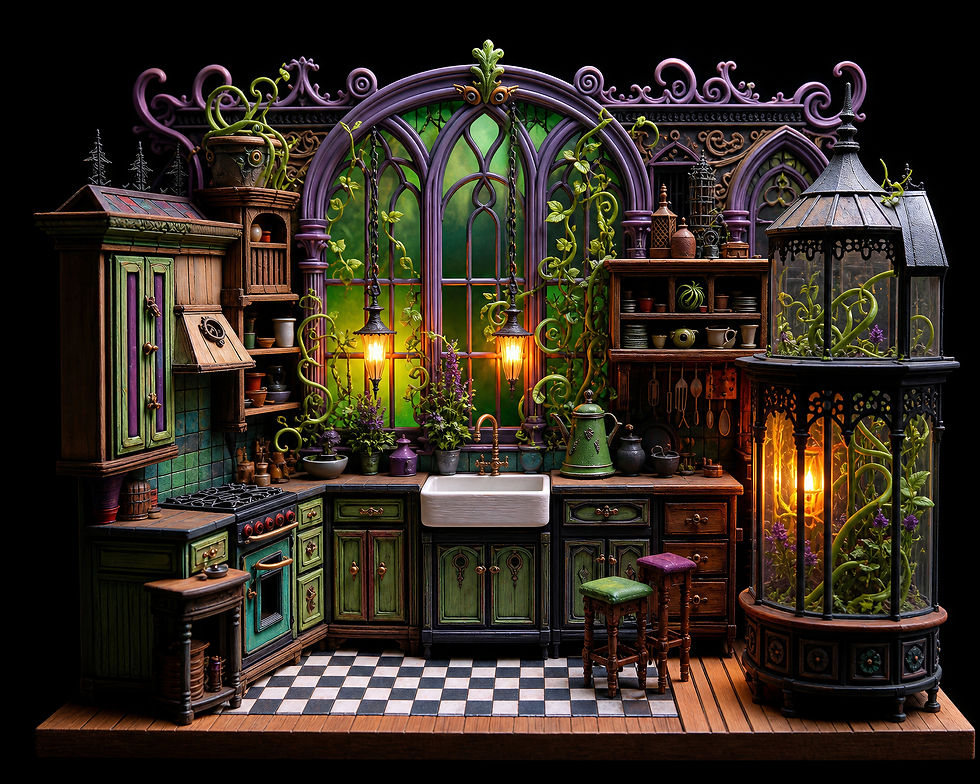
This miniature kitchen has everything I want in a tiny room: gothic arches, curly purple trim, a suspiciously alive greenhouse, and enough glowing green atmosphere to make a soup ladle nervous.
I’ve loved Tim Burton’s visual style since I first watched Beetlejuice, Batman Returns, and The Nightmare Before Christmas. That crooked, theatrical, not-quite-safe charm is baked right into this dark fantasy miniature kitchen diorama. The giant arched window, the drooping lanterns, the black-and-white floor, the moody cabinets, the crawling vines—it feels like a place where dinner is served at midnight and the basil is NOT to be trusted.

Keep reading, because later in the post I’ll walk through a practical build guide for getting this look by modifying existing dollhouse pieces, painting plain objects into strange little treasures, sculpting purple tracery with polymer clay, growing creepy vines, and making that green glowing window hum like it knows your secrets.

Miniature Backstory – The Tiny Tale
Welcome to The Moonvine Scullery, founded in 1893 after the town council of Bramblewick Hollow accidentally outlawed “ordinary kitchens.” The law was meant to stop a runaway pudding incident, but as usual, bureaucracy opened the door for weirdness.
The Scullery was first run by Edwina Bracklepot, a cook, amateur botanist, and part-time thunderstorm enthusiast. She believed every meal needed three things: salt, scandal, and one ingredient that had to be politely asked not to bite. Her kitchen became famous for nettle dumplings, glowing pear jam, and tea so strong it could remember your childhood.

The locals are a mixed bunch. There’s Mr. Thistleby, who claims he only stopped by for parsley in 1912 and has been trapped in conversation with a fern ever since. There’s Mina Spoon, the cabinet sprite, who rearranges drawers based on emotional weather. And then there’s Keith, the vine in the right-side conservatory, who is technically a plant but has the social confidence of a theater director.
The purple arch over the window is said to be the Scullery’s “thinking bone.” When the cook is making stew, the arch leans left. When someone lies about liking turnips, it leans right. When a guest asks for ketchup, the lanterns flicker and every spoon turns face down.
A tiny Easter egg for you: look for the watchful little face perched above the central arch. The locals say those eyes blink once when the kitchen approves of you, twice when you used too much garlic, and three times when Keith has already eaten your hat.

A Guided Tour of the Build
The first thing that grabs me is the window: tall, gothic, green, and glowing like a swamp sunrise that went to finishing school. Purple tracery loops through the panes in soft, handmade curves, giving the whole back wall that stop-motion, clay-molded personality I love.

Below it, the white farmhouse sink sits right in the middle like the only sane object in the room, which of course makes it suspicious. Around it are green cabinets with worn edges, little drawers, brass hardware, coppery fixtures, pots, bowls, bottles, and the kind of clutter that says, “Yes, dinner is coming, but first we must negotiate with the ivy.”

The left side has a crooked cupboard and stove area full of weathered wood, teal tile, and deep shadows. The right side leans more botanical laboratory: shelves, jars, tools, kettles, and that marvelous glassy conservatory glowing with plant life and warm orange light. The floor gives us a checkerboard stage, the counters give us cozy witch kitchen energy, and the vines tie everything together like nature showed up with a glue gun and boundary issues.


Inspirations – From the Big World to the Small
This miniature lives in the family tree of gothic fantasy, Art Nouveau, and theatrical dark whimsy. Tim Burton’s influence is obvious in the twisted silhouettes, exaggerated curves, moody palette, and playful creepiness. Nothing here is flatly spooky. It is spooky with manners. Spooky with cabinet knobs.
There’s also a strong Art Nouveau flavor. Victor Horta’s interiors, especially the way ironwork and architecture flow like stems and tendrils, feel related to the curling vines and the organic lines around the window. Hector Guimard’s Paris Métro entrances have that same plantlike metalwork energy: elegant, strange, and just a bit insect-adjacent if you stare too long. Antoni Gaudí’s Casa Batlló also comes to mind with its dreamy curves, fantastical surfaces, and refusal to let a straight line boss everyone around.

In miniature scale, those ideas become even more theatrical. A real building can whisper with a curved railing or a stained-glass panel. A miniature needs to speak up. The arch gets a little more purple. The vines curl harder. The lanterns glow warmer. The cabinets age faster. The trick is not copying a famous building piece by piece; it is borrowing the design DNA: botanical curves, gothic verticals, handmade asymmetry, moody contrast, and a sense that the room might start singing when you leave.
For a street-sized take on those curves and vines, wander through Crooked Bloom Row.
Artist Tips – Make Your Own Magic
You are not building a perfect duplicate of this model. You are borrowing the mood, raiding the pantry, and making your own tiny kitchen misbehave beautifully. Results will vary, and honestly, that is half the charm. I write these posts, and I use AI image generation for the illustrations, which means sometimes the tiny spoons look perfect and sometimes one of them appears to be applying for citizenship. Use this as inspiration, not a sacred blueprint.
Shopping List
Many of these pieces can start as things you already have. The purchasable options are linked through Amazon affiliate links. When you use those links, you help fund the tiny world, which keeps the lights on and the miniature vines only mildly threatening.
Base and structure: Scrap plywood, foam board, sturdy cardboard, old picture frame backing, or a premade dollhouse room box. Buyable option: basswood sheets, MDF bases, foam core boards.
Windows and trim: Plain dollhouse windows, picture frame scraps, coffee stirrers, toothpicks, thin chipboard, acetate from packaging. Buyable option: 1:12 dollhouse windows, basswood strips, clear acetate sheets.
Purple tracery: Polymer clay, air-dry clay, or flexible craft foam. Buyable option: Sculpey, Fimo, clay sculpting tools, silicone clay shapers.

Vines and plants: Floral wire, twist ties, paper scraps, dried tea leaves, yarn fibers, faux moss, tiny silk flower bits. Buyable option: green floral wire, preserved moss, miniature leaf punches, model railroad foliage.
Paints and finishes: Acrylic craft paint in black, deep brown, moss green, olive, teal, plum, violet, cream, copper, brass, warm yellow, and fluorescent green. Add matte varnish and gloss varnish.
Lighting: USB-powered mini LED strands, warm white fairy lights, green LEDs, vellum, parchment paper, tracing paper, or frosted plastic for diffusion.
Kitchen objects: Existing dollhouse cabinets, chairs, shelves, pots, beads, jewelry findings, bottle caps, pen parts, tiny charms, old buttons, broken earrings. Buyable option: unfinished dollhouse kitchen furniture and miniature cookware.

Deep Dive
1. Safety first, because haunted kitchens still need eyebrows: Work in a ventilated space, especially when painting, sealing, sanding, or using glue. Keep sharp blades sharp and capped. Cut away from your fingers. Wear eye protection when clipping wire. Polymer clay should be baked according to package directions, and do not bake plastic dollhouse windows unless you know they are oven-safe. LEDs stay outside the oven. Keith the vine may object, but Keith does not get a vote.
2. Plan the scale and silhouette: A 1:12 scale room box is a friendly starting point. Try a base around 12–16 inches wide and 8–10 inches deep if you want a compact scene. Sketch the back wall first: large arched window in the center, cabinets below, darker clutter to the sides. Keep the center vertical and dramatic, then let everything else lean, curl, sag, and wander.
3. Build the bones: Use foam board, MDF, or a premade room box for the walls and floor. Add a back panel tall enough to hold the oversized window. For the floor, glue down a printed checkerboard, individual cardstock tiles, or painted squares. Add a strip of wood-look flooring at the front for warmth. This gives you the stage: gothic in back, cozy chaos in front.

4. Modify plain dollhouse windows: Start with a plain arched dollhouse window, or fake one using chipboard and acetate. Paint the frame deep plum mixed with black, about three parts purple to one part black. Dry-brush lavender on raised edges. For a Burton-like shape, exaggerate the curves: add extra arches, loops, and teardrop shapes over the panes.

5. Sculpt the purple tracery: Roll polymer clay into thin snakes, roughly 1/16 inch thick for 1:12 scale. Taper the ends and press them gently onto a ceramic tile in the shape of gothic arches, curls, and loops. Let the lines be slightly uneven. That handmade wobble is your friend. Bake the clay separately, then glue it over acetate or the window frame. Paint it plum, shade the creases with black-purple, then kiss the edges with pale lilac.

6. Make the green glowing window: Layer clear acetate with frosted vellum or tracing paper behind it. Tint the acetate with transparent green paint, alcohol ink, or thin acrylic glaze. Place green LEDs behind the window, but diffuse them with vellum so the glow spreads instead of turning into laser dots. Add a warm amber light low behind the sink or lanterns so the green feels magical rather than radioactive salad.


7. Repaint existing furniture into strange treasures: Plain dollhouse cabinets are perfect victims. Prime them dark brown or black. Paint the doors moss green, teal, or muddy olive. Mix a weathering wash with one part dark brown paint to five or six parts water, then brush it into corners. Dry-brush cream or pale green over edges. Add brass dots for knobs using beads, nail art studs, or tiny drops of metallic paint.

8. Create creepy vines and plants: Twist floral wire into curling stems. Wrap thinner wire around thicker wire for tendrils. Coat with tacky glue if you want organic lumps. Paint the stems dark olive, then dry-brush lime and yellow-green. Leaves can be cut from painted paper, shaped from polymer clay, punched with a leaf punch, or stolen from faux floral scraps. Make some vines curl around the window, some creep toward the lanterns, and one or two act like they are absolutely listening.

9. Add kitchen clutter and odd little tools: Use jewelry findings for lantern cages, beads for jars, pen tips for bottles, wire loops for hanging utensils, and toothpicks for tool handles. Paint metal pieces with copper, brass, or blackened iron. Add little bowls, kettles, pots, plates, and jars on shelves. The trick is layering: large shapes first, then medium clutter, then tiny sparkles of detail.

10. Build the conservatory corner: On one side, add a glasshouse or terrarium shape using acetate panels and black cardstock strips. Paint the frame black with a little bronze dry-brushing. Fill it with vines, moss, and one strong amber LED at the base. This side should feel warmer, like the plants have started a secret fireplace club.

11. Lighting without panic: Use simple USB-powered mini LED strands if wiring makes your eye twitch. Warm white LEDs around 2700K–3000K work beautifully for lanterns and under-shelf glow. Use green LEDs only behind the window, and hide the wires behind cabinets, shelves, or foam board channels. A little black paint or foil tape behind walls helps block light leaks.

12. Add story clutter and Easter eggs: Give the scene a private joke. A tiny recipe card labeled “Soup for People Who Asked Too Many Questions.” A crooked kettle named Edwina. A cabinet door with a painted eye. A single purple stool for guests who may not remain human. Add one hidden detail that viewers have to hunt for. That is how a miniature becomes a place instead of a display.

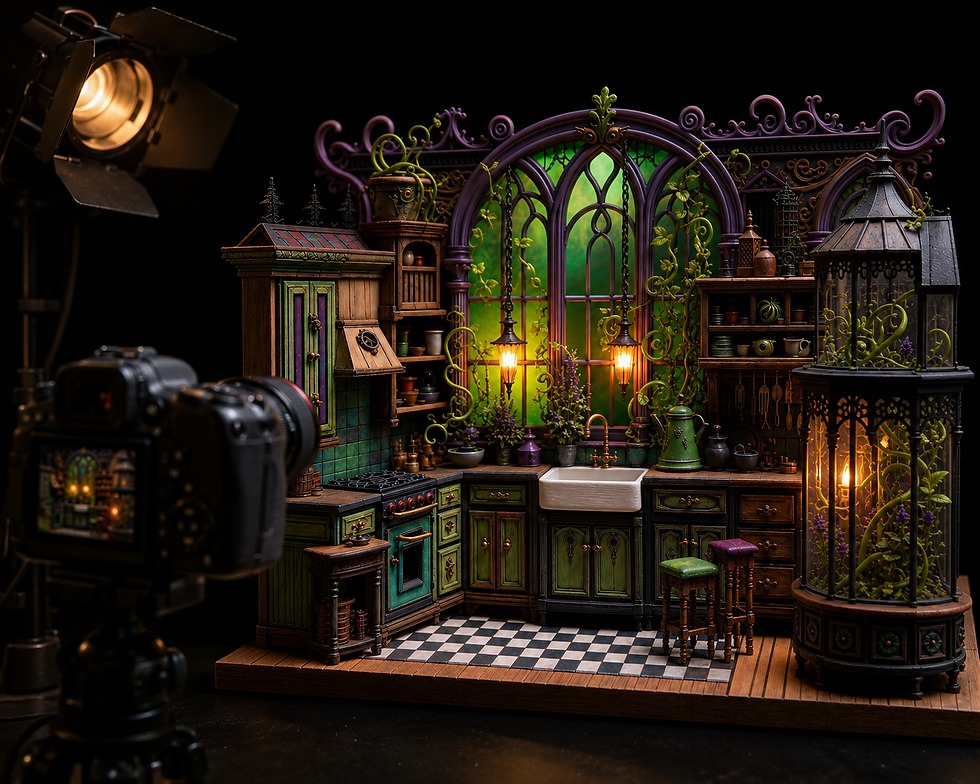
13. Photograph it like a tiny movie set: Use a black backdrop to make the colors pop. Place one warm light low on the side and let the green window glow from behind. Shoot from slightly below counter height so the window feels grand. A phone camera works fine; tap to focus on the sink or central arch, lower the exposure a little, and let the shadows stay moody.
Troubleshooting
Problem: The vines look like green spaghetti. Fix: Add thicker main stems, smaller curling tendrils, and varied leaf sizes. Paint darker shadows near the base.
Problem: The green window is too bright. Fix: Add another layer of vellum or move the LED farther back.
Problem: Polymer clay tracery breaks. Fix: Make pieces slightly thicker, bake fully, and glue them onto a firm backing before handling.
Problem: The room looks cluttered instead of magical. Fix: Remove a few items from the center. Keep the busiest details on the sides and let the window breathe.
Problem: Paint looks too clean. Fix: Add a thin brown-black wash, then dry-brush raised edges with a lighter tone.
Problem: The scene feels flat in photos. Fix: Add one warm side light, one green back glow, and a dark backdrop. Shadows are doing half the storytelling.

Closing – Until Next Time in the Small World
The Moonvine Scullery is exactly the kind of miniature scene that makes me want to lean in and ask questions I probably should not ask. Who lit the lanterns? Why is the vine in the conservatory reaching for the stove? Why does that little face above the arch look like it knows what happened to the last dinner guest?
That is the fun of a dark fantasy miniature kitchen diorama like this. It is not just a room. It is a tiny stage with cabinets, vines, glowing glass, oddball cookware, and enough personality to make a full-size kitchen feel underdressed.
Tell me your favorite detail in the comments. I want to know whether you are Team Green Window, Team Purple Tracery, or Team “That Plant Is Definitely Up To Something.” Share your own miniature creations with #smallworldminiatures, sign up for the newsletter, and take a little tour through the online shop.
May your glue dry clear, your LEDs behave, and your vines remain mostly polite.
#smallworldminiatures #miniature #miniatures #miniatureart #miniatureartist #miniaturediorama #dioramaart #dollhouseminiatures #dollhousekitchen #darkfantasyart #darkfantasyminiature #timBurtonInspired #burtonesque #gothicminiature #fantasyminiatures #miniaturekitchen #polymerclayminiatures #miniatureplants #creepyvines #miniaturelighting #modelmaking #scalemodeling #kitbash #miniaturephotography #fantasydecor #tinyworlds #artnouveauinspired #gothicdecor







Comments