


An Iris Apfel-Inspired Maximalist Miniature Closet

My Vision for This Small World
I love Iris Apfel’s maximalism, and minimalism has never been my thing. My maximalist miniature closet brings that enthusiasm into a room full of color, pattern and interesting objects. An ochre sofa and patterned chaise gather around an ornate illuminated mirror, with clothes and accessories adding more to explore. This is my Iris Apfel-inspired fantasy, not her actual closet or an endorsed design. Even the ceiling joins in, giving the room’s abundance one more place to flourish.
Some links earn me a commission from qualifying purchases and help keep this tiny world growing. As an Amazon Associate I earn from qualifying purchases.
A bold little sofa can give an entire room its personality. iLAND Turquoise Sofa brings a delicious splash of color to a dollhouse sitting room or a growing furniture collection.

Miniature Backstory — The Tiny Tale
Mara is a retired costume cutter with a very practical rule: if an outfit makes you stand awkwardly, something needs changing. She has spent enough years fitting clothes to know that discomfort can announce itself before anybody says a word.
Her adult grandson Eli arrives before his first gallery opening wearing a carefully chosen black shirt. It is perfectly fine. He has said so four times, which is how Mara knows he is worried about it.
He has been studying photographs of other people at gallery openings and trying to work out the correct way to look. Mara asks whether he likes his shirt. He does. She asks whether he likes the severe expression he has apparently selected to accompany it. He does not.

She offers him a seat while she looks through a small tray of accessories. Eli expects her to produce something extraordinary, perhaps an object large enough to need its own ticket. Instead, she asks him to choose.
He picks up a bright scarf, puts it down, and picks it up again. “Is this too much?”
“For a scarf?” Mara asks. “It seems the usual amount.”
They try it loosely at his neck. Eli looks at the mirror, then at the scarf, and finally smiles without preparing to do so. Mara decides that is the useful part. She shows him one simple fold so he will not spend the evening adjusting it, then leaves the rest alone.
Before he goes, he asks what she would wear. Mara points to the comfortable slippers already on her feet. Her evening involves tea and a book. She has dressed for it with considerable accuracy.
The scarf and the visit are fictional, but the room’s seating and accessory-filled surfaces make them easy to imagine. In your own miniature, a folded bright scarf on the chaise could be a small reminder of Eli’s decision.
If you love arranging miniature displays, the iLAND Retail Roombox Kit offers a place to let those ideas grow. Imagine dressing a little shop with your favorite colors and carefully chosen details.

A Guided Tour of the Build
A mirror with a theatrical setting
The large mirror sits within a gold-colored frame full of curling ornament. Round lights trace its inner edge, while red and deep teal curtains gather around it. Below, pale drawers and a crowded dressing surface provide a quieter base for all that decoration. The reflected clothing rail gives the room another layer without requiring another visible room.
I like the contrast in scale between the broad arch and the tiny objects beneath it. Bottles, framed pieces, jewelry-like shapes, and flowers create a close-up world around an instantly recognizable form. The mirror organizes this corner, so the surrounding detail has somewhere to gather.

A clothing rail that becomes a color palette
Along the right wall, clothes hang in a bright sequence of pink, teal, orange, red, cream, and patterned fabric. Above them, a shelf holds accessories, while framed artwork fills the wall higher up. The rail reads as one long horizontal band, and the individual garments provide its rhythm.
The variety works because colors reappear elsewhere. Teal turns up in the curtain and seating; warm reds and golds return in the rugs and ceiling. It is a good reminder that maximalism can have structure. Repeating a color gives the eye something familiar to recognize while it explores a new pattern.

Seating worthy of staying a while
The ochre sofa is piled with cushions in saturated colors and mixed patterns. Opposite it, the chaise carries a turquoise-and-red patterned surface and a long pale throw. A round, pale-topped coffee table sits between them with books and flowers. A smaller metallic-looking side table holds two little cups.
Underneath is a richly patterned rug, framed by a geometric border at the edge of the floor. Overhead, a decorative ceiling panel brings the same appetite for detail to the final surface. The dark edges of the room box contain the whole arrangement. I enjoy that visible boundary: all this personality has somehow agreed to fit inside one small square.

Inspirations — From the Big World to the Small
Finding structure in a maximalist miniature closet
The Metropolitan Museum of Art’s exhibition Rara Avis described Iris Apfel’s style through her inventive mixing of high and low fashion. The useful lesson for this miniature is that an interesting combination does not need every element to come from the same category. A plain little drawer unit can support a gloriously elaborate mirror. A small paper book can sit comfortably beside a gold-colored table.
The Peabody Essex Museum’s Rare Bird of Fashion exhibition presented her ensembles with playful staging, emphasizing unexpected combinations and accessories. I see a related pleasure in this room’s rail, pictures, and decorative objects. They invite you to look from one thing to another and notice how the choices interact.

Her example gives me permission to enjoy the arrangement, while the actual miniature suggests its own practical lessons: repeat colors, vary pattern size, and keep a few larger shapes easy to read. You can have an extravagant room with a very sensible floor plan.
My earlier Iris Apfel-inspired miniature sofa diorama concentrates that feeling around one upholstered piece. Here, the whole room takes part. The ceiling and clothing rail widen the conversation, while the seating gives it somewhere comfortable to settle.
If arranging tiny rooms is your favorite part of the hobby, these furniture sets and room kits offer plenty to enjoy. I would start with a piece that catches my eye, then build the room’s colors and personality around it.
Settle into the cozy details of Catherine’s Living Room Kit. Its inviting room is a lovely project for anyone who enjoys bringing tiny interiors to life.

Artist Tips — Make Your Own Magic
AI-assisted imagination filled this little room with color. Use its arrangement and atmosphere as a springboard for your own closet, trying paper templates before committing your favorite fabric.
For an approachable version, build an open-front room with a mirror wall, a clothes rail, and two small seats. Begin with the largest forms. The pleasure of this scene comes from how its colors and textures relate, so you can reduce the amount of ornament without losing its spirit. You can always add another cushion after the furniture fits.
Supplies
For the shell and furniture, begin with clean packaging card, small boxes, and thin wooden stirrers. Mount board, basswood sheet, and stripwood offer purchased alternatives. Use a stable base and choose a planning scale before combining ready-made furniture with pieces you make yourself.
For upholstery and garments, gather fine fabric scraps from unwanted clothing, ribbon, and a small amount of clean padding. Thin cotton and closely woven fabrics are often easier to fold at miniature size than bulky material. Fine upholstery fabric and suitable batting are alternatives. Compare the pattern with a paper cushion before cutting a larger piece.

For wall finishes and rugs, reuse attractive paper, small printed patterns, and flat decorative packaging. Scrapbook paper or miniature wallpaper can provide alternatives. A rug can be printed paper for a first version, or a fine fabric piece with a neat edge if you want more softness.
For mirrors and ornament, use smooth reflective card and layered card shapes. Mirrored card, suitable miniature trim, and metallic acrylic paint are purchased options. Reflective plastic and true mirror pieces need their own handling and cutting instructions; a paper-based reflective surface keeps this version simpler.
For small accessories, collect clean beads, card offcuts, and short ribbon lengths. Purchased miniature books, flowers, and vases are optional finishing pieces. Keep loose beads and sharp tools away from children and pets. Use adhesives suited to paper, fabric, or wood as appropriate rather than assuming one glue will behave well on every surface.
You will also need scissors, tweezers, a pencil, brushes, and a protected cutting surface. Cut away from your supporting hand and make several controlled passes through thicker card. Follow finish and adhesive labels for ventilation, compatibility, and drying before assembling neighboring materials.
Create a restful little retreat with iLAND Classical Bedroom Furniture. Its traditional character makes a lovely addition to a dollhouse or a collection of favorite miniature rooms.

1. Give the room a layout and a few repeating colors
Set out a base and two walls, then use small boxes to stand in for the sofa, chaise, and dressing table. Leave a clear place in front of the mirror and a visible route to the rail. Look from the open front before deciding how deep the room should be.
Choose a small group of colors to repeat across the scene. Teal, warm red, and ochre are one possible starting point from this image. Place paper swatches where those colors might appear: on a curtain, cushion, garment, or rug. The repeats will help connect the room when you add more patterns.

Keep the large furniture shapes simple at this stage. If both seats compete for the center, reduce one or turn it slightly. Take a photograph of the mockup and check the spaces between objects. Those gaps are useful parts of the design, even in a room that enthusiastically welcomes decoration.
2. Make the wardrobe area and mirror wall
Build shallow storage boxes and a clothes-rail framework from card or suitable wooden strips. Match the rail height to your planned garments and leave enough space beneath them to see the floor. Assemble the supports squarely and allow the joints to set before hanging anything from the rail.
Cover the walls with your chosen paper or paint, keeping the mirror wall readable. Cut a simple arch or rectangle for the mirror backing and attach reflective card. Layer card curls or suitable miniature trim around the edge, then paint the frame with a restrained metallic finish. Let it dry before attaching nearby fabric.

For an easier interpretation of the lights, add small pale circles around the mirror edge. They can suggest the rhythm of bulbs without introducing wiring. If you choose a ready-made miniature lighting product instead, follow its instructions and plan access to the power source before closing the wall. Keep any electrical work to suitable low-voltage systems.
The right finishing details make a tiny room feel beautifully dressed. Dollhouse Trim brings architectural character to doors, wall panels and the little spaces you want to make special.

3. Upholster two simple seats
Start with a box-like sofa base and a separate back. Test the fabric around each piece before gluing, keeping seams toward the underside or rear. Use only enough padding to soften the shape; thick layers can make a miniature seat look swollen and hide its proportions.
Apply an adhesive labeled for the materials and keep it away from the visible fabric face. Pull the fabric just taut enough to remove wrinkles, then let it set before adding arms or legs. A simple straight-backed sofa is a good first version. You can suggest the reference’s richer form with cushions and narrow trim.

Make the chaise as a small bench with one raised end, or use a suitable ready-made seat. Give the two pieces different fabrics connected by a repeated color. Fold a light fabric scrap over the chaise to suggest the pale throw. Check its thickness from the front; a thinner fold often looks more convincing than a heavy drape.
4. Build a wardrobe from folded fabric
Cut a few basic garment shapes from fine fabric and fold them around narrow card supports. You only need the visible outline to suggest a coat, dress, or jacket. Keep some pieces plain and others patterned so the rail has variation rather than becoming one continuous print.
Arrange them loose on the work surface in the order you want to hang them. Repeat one or two room colors, then introduce a contrasting piece where the sequence needs a little energy. Small folded fabric tabs can suggest collars without adding difficult seams.
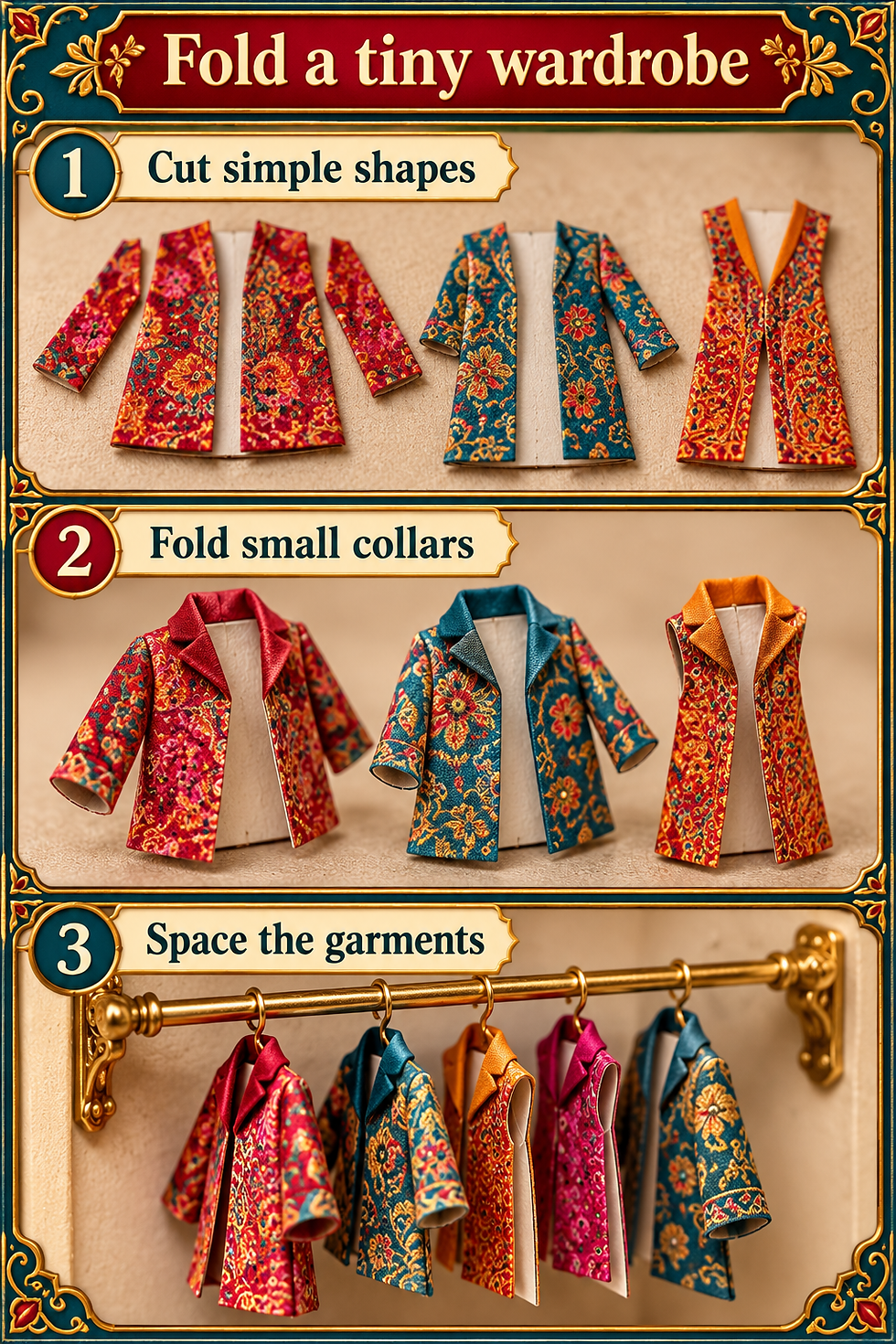
Use simple miniature hangers or paper-supported hanging shapes appropriate to your scale. Attach them after the rail has set firmly. Leave a little separation between selected garments so their silhouettes remain visible. If the clothes are too bulky, reduce the number and use thinner fabric rather than squeezing them harder together.
A small touch of gold can make a tiny detail feel like a treasure. AMACO Rub ’n Buff Antique Gold is a lovely finishing choice for raised ornament, picture frames and decorative accents.

5. Layer rugs, pictures, and metallic detail
Place the largest rug first and check that its pattern supports the furniture arrangement. If you add another patterned surface, vary the size of its motifs. A fine rug pattern can sit comfortably beneath a larger cushion design, while several equally strong patterns may compete from the same viewing distance.
Make a gallery wall from small printed or drawn pieces in simple card frames. Arrange them on scrap paper before moving them to the wall. Keep the images and frames varied, but repeat a little of the room’s color palette. A few larger frames are easier to read than dozens of indistinct specks.

Apply metallic color selectively to frame edges, table legs, or trim. Metallic acrylic paint is a straightforward option. If you choose a gilding wax, follow its manufacturer’s surface and handling guidance and test it on an offcut first. Let finishes dry or cure as directed before placing textiles against them.
A small bouquet can make a room feel ready for a guest. Miniature Flowers and Vases brings color and personality to a table, mantel or favorite dollhouse corner.

6. Add accessories, then photograph the room
Build small books from folded card, make a few flower shapes from paper, and place them in simple containers. Group accessories around an activity: dressing at the mirror, reading by the sofa, or having tea at the small table. Those groups give the abundance a human purpose.
Keep the center of the coffee table partly visible and leave a few clear areas on the dressing surface. Add the imaginary bright scarf from Eli’s story if you like, placing it where its color is easy to notice. Then pause before adding anything else. A photograph can tell you whether the room needs another detail or a little space.
Light the open front softly from one side and use a pale card reflector to lift shadows. Move the camera until the mirror reflects part of the room instead of your phone or a bright lamp. Take a wider view showing the room-box edges, then close views of the mirror, clothes rail, and upholstery. Check that metallic details retain texture rather than turning into bright white spots.

When more needs a little arranging
If every pattern competes, add a plain cushion or a quieter wall area near the busiest section. You are giving the eye somewhere to pause before it continues exploring.
If the garments look thick, remove internal layers and use fewer folds. A suggestion of a coat can be more convincing than a tiny coat made from full-size fabric thickness.
If metallic trim overwhelms the furniture, limit it to selected edges. A small amount of shine is easier to appreciate when the surrounding surfaces stay soft.
If the mirror reveals the workbench, change the camera angle or place a simple backdrop outside the reflected view. Check reflections before moving delicate furniture around.
A few Miniature Books can give a room an entire history. Stack them beside a chair, fill a shelf or leave one on the desk to suggest a story still being read.

Closing — Until Next Time in the Small World
This is the kind of miniature room I can look at for ages. Every surface offers another choice: a color repeated, a pattern paired with something unexpected, a little object given a place where it can be enjoyed. My taste will always lean toward a room with this much personality.
I also like Mara’s approach to dressing. Choose the thing you love, make yourself comfortable, and leave enough time for tea. Eli can manage the gallery opening from there.
Which part would you bring into your own miniature: the extravagant mirror, the colorful rail, the patterned ceiling, or that wonderfully inviting sofa? Tell me in the comments and share your own joyful little rooms with #smallworldminiatures. Explore the Small World Miniatures shop for more inspiration, and join the newsletter to see where we go next.







Comments