



A Riot of Rugs and Rhinestones: An Iris Apfel–Inspired Miniature Sofa Diorama That Refuses to Whisper
Updated: Oct 12

Opening – First Impressions in Miniature
You know that feeling when you walk into a room and your eyeballs do a tiny happy dance? That’s what this miniature did to me. The star is a gloriously maximalist sofa—tufted, patchworked, and unapologetically loud—like it’s been personally blessed by the spirit of Iris Apfel and then sprinkled with confetti. Between the rainbow pillows, the punchy wall art, and that bold blue door sitting back there like a cool bouncer at a velvet-rope club, this little scene is pure “more is more” in dollhouse scale.

And yes—if you stick with me, I’ve got a full, practical mini build guide later in this post. Not a rigid blueprint, more like a treasure map with a few silly doodles in the margins. Keep reading. The sofa demands it.

Miniature Backstory – The Tiny Tale
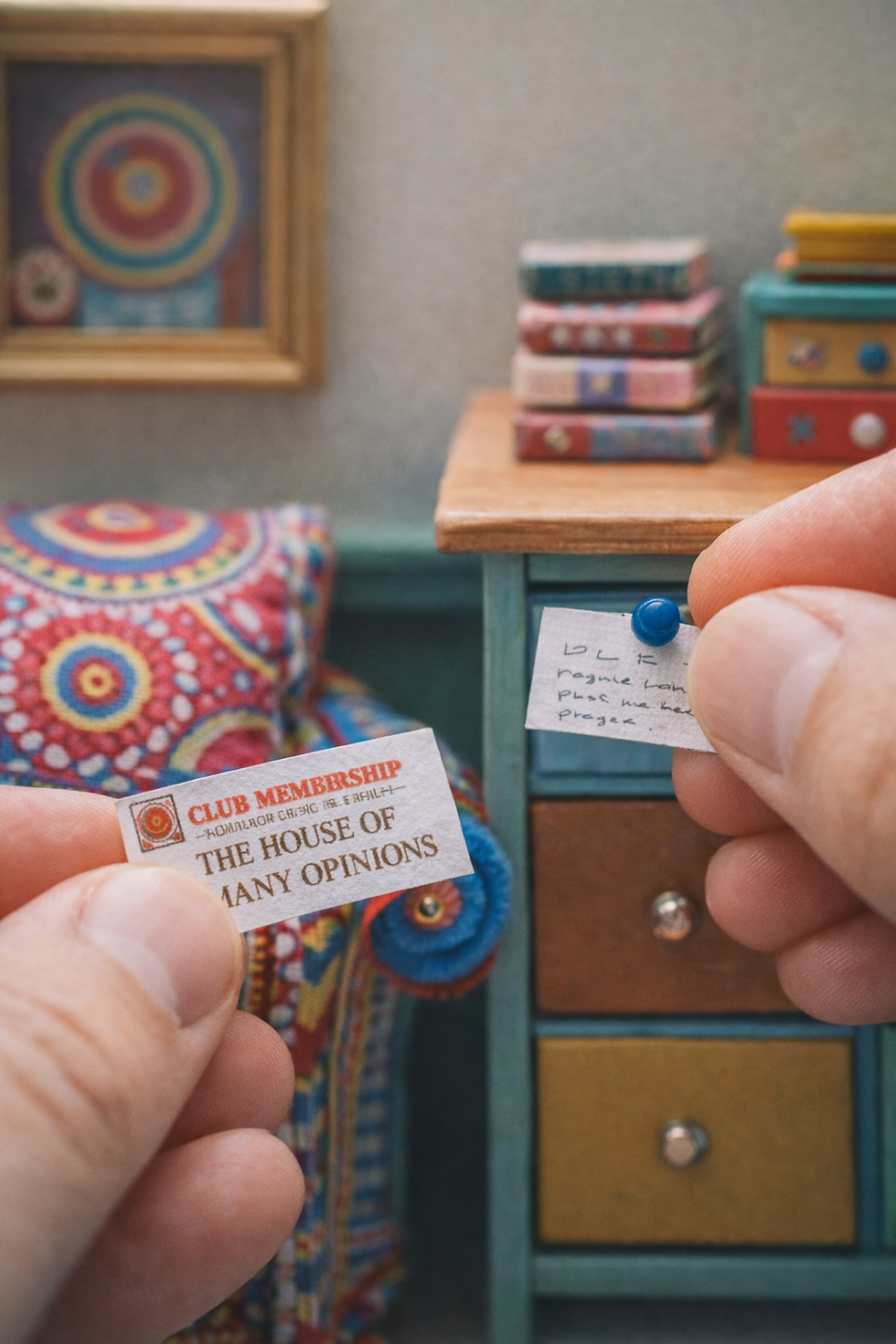
Locals call this place The House of Many Opinions, because every object inside has a strong belief about color theory and isn’t afraid to share it.
It began in 1979, when a traveling textile peddler named Maribel “Merry” Glimmerwool rolled into town with two suitcases: one full of fabric swatches, the other full of costume jewelry that clinked like a tiny wind chime with attitude. Merry bought a narrow little row home and renovated the parlor into what she described as “a sitting room for dramatic pauses.” The sofa arrived first—delivered in three parts because it was “too confident” to fit through the door in one piece.

Soon, the room became a social hub for the neighborhood’s most legendary residents:
Captain Peabody, a retired sea captain who insists the blue door is “nautical, not trendy.”
Professor Nibbs, an academic mouse who gives unsolicited lectures about pattern scale while stealing cookie crumbs.
Duchess Dot, a small dog with a large wardrobe and a personal vendetta against beige.
The rules of the room are posted (in very tiny lettering) somewhere nearby: No whispering. No neutral tones. Compliments required.
And here’s your Easter egg: somewhere in this scene, Merry hid a tiny “lucky charm” motif—a little circle-within-a-circle pattern that shows up more than once. Spot it in at least two places, and you’re officially part of the household.

A Guided Tour of the Build
Let’s step into the room like we’ve been invited to tea—except the tea is probably served in a cup that looks like a watermelon and the spoon is wearing a hat.
First, your eyes hit the sofa: a candy-coated throne with tufting that looks pillowy-soft even at miniature scale. The upholstery is a joyful riot—patchwork panels, bold trims, tiny bead-like details, and piping that feels like it should have its own fan club. The pillows are stacked like a cozy, colorful argument: jewel tones, stripes, florals, geometric prints—each one trying to outshine the next, and somehow they all win.

Then you notice the gallery wall: framed art pieces in bright, saturated colors, with a mix of ornate and simple frames that makes the whole wall feel curated but not fussy. It’s the kind of wall that says, “I traveled,” even if the farthest it’s ever gone is from the craft table to the shelf.

The blue door anchors the back of the room like a bold exclamation point. The lower walls are trimmed in green wainscoting, giving the space structure so the patterns don’t float away into chaos (lovely chaos, but still). Off to the side, a sideboard with multicolored drawers looks like it’s storing secrets, craft supplies, and maybe one tiny emergency disco ball. There’s also warm lighting—soft, inviting—like the room is perpetually in “golden hour.”
The overall mood? Cozy maximalism. A hug, but make it fashion.

Inspirations – From the Big World to the Small
This miniature feels like it belongs in the family tree of bold, joyful design—where personality is the main structural beam.
Iris Apfel is the obvious guiding constellation here: fearless color, textile layering, and the “why choose one pattern when you can adopt twelve” philosophy. The sofa’s patchwork energy and accessory-heavy styling mirrors that unapologetic, curated chaos—where every piece looks like it has a story, even if that story is “I was fabulous at a flea market.”

For architectural and design cousins, I can’t not mention Antoni Gaudí, especially spaces like Casa Batlló in Barcelona. Gaudí’s work embraces curves, color, ornament, and the idea that a building can feel alive. This diorama echoes that spirit through its rounded sofa arms, playful palette, and whimsical surface detail—like the room itself is grinning.

And then there’s the Memphis Group—think Ettore Sottsass and that 1980s pop of geometry, color blocks, and pattern-as-structure. The multicolored drawer cabinet in the back gives serious Memphis vibes: bright, segmented, and cheerfully rebellious, like it’s daring you to reorganize your life with primary colors.
The magic here is how those big-world influences translate to miniature scale: you still get the punch of color and the rhythm of pattern, but now it’s condensed into tiny, tactile moments—stitches, trims, little frame edges—details that reward you the closer you look.

Artist Tips – Make Your Own Magic
You stand at your workbench like a director on opening night: the set is small, but the drama can be huge. And before you start measuring anything with the intensity of a NASA engineer, let’s set expectations the fun way—this is not a step-by-step clone recipe. It’s inspiration, a roadmap, a handful of “try this” ideas, and a few questionable little illustration moments (I do my best, but sometimes my digital helpers get… overexcited about symmetry). Your version will vary, and that’s the point: maximalism is personal.
Shopping List (Click the affiliate links to purchase from Amazon)
Base and structure
Around the house: cereal box cardboard, shipping box chipboard, coffee stirrers, toothpicks, leftover foam packaging
Buy option: foam board sheets, basswood strips, styrene strips, pre-made dollhouse trim
Upholstery and soft goods
Around the house: fabric scraps from old shirts, bandanas, scrap ribbon, gift wrap, tea bag paper (great texture!), thread
Buy option: dollhouse upholstery fabric, miniature trims, micro-cording, tiny buttons, embroidery floss
Detail bits and “sparkle logic”
Around the house: broken jewelry, beads, sequins, paper clips (wire), bottle caps (templates), sandpaper bits (texture)
Buy option: jewelry findings, micro beads, decal paper, miniature hardware pulls
Paint, glue, and finishes
Around the house: matte acrylic craft paint, clear nail polish (tiny “glass” shine), baking soda (texture), PVA glue
Buy option: miniature-specific acrylics, glazing medium, matte varnish, tacky glue, contact cement (careful!)
Lighting
Around the house: old USB cable (for routing), translucent plastic packaging (diffuser)
Buy option: USB-powered mini LED strands, warm white pico LEDs, coin-cell fairy lights
Tools


Deep Dive
Safety tips and reminders: You’re working small, but the risks are full-size. Use fresh blades (dull knives slip), cut away from your hands, and ventilate when using strong glue, sprays, or sanding dust. If you’re texturing foam or sanding anything fine, follow the material’s safety data sheet for dust control and properly fitting respiratory protection. Don’t assume a simple mask is enough; save the Victorian-ghost impression for Halloween.
Planning and scale notes:
Pick a scale first (common choices: 1:12 or 1:24). Sketch the room box and anchor points: door on the back wall, window to the side, sofa centered. For a 1:12 vibe, a sofa might land around 6–7 inches wide; for 1:24, think 3–4 inches. Keep a “pattern rule”: if a motif would be the size of a dinner plate in real life, it should not become a beach ball in miniature. Shrink patterns accordingly.
Bones and layout:
Build a sturdy room shell with foam board or chipboard. Use a simple three-wall “stage set” (left wall, back wall, right wall) plus a floor. Add a slightly raised platform if you want that clean, gallery-like base. Dry fit everything before glue—maximalism loves confidence, not crooked corners.

Windows and doors:
The bold blue door is a visual anchor—keep it crisp. You can cut a door from layered card, then add trim strips around the edges for depth. For the window, clear acetate makes quick “glass.” If you want that clean mullion look, thin painted stripwood or even sliced plastic packaging works. Paint the frames a bright, clean color so they read as architectural structure against all the pattern chaos.


Finishes, base color, and wall treatments:
That green wainscoting effect is a cheat code: it gives the room a “designed” backbone. Add vertical panel lines with thin strips or scribed foam board. Paint walls in two zones:
Upper wall: warm off-white (mix roughly 4 parts white : 1 part cream)
Lower wall: saturated green (add a touch of black or deep blue to keep it rich)Lightly dry-brush edges with a paler tone to pop panel detail without making it look distressed.

The star and focal point sofa:
This is your star, so build it like you’re making a tiny celebrity outfit.
Shape: carve the sofa base from dense foam or stack card layers into a block, then sand smooth.
Tufting: mark a grid, then press shallow dimples. Add tiny “buttons” with micro beads or pinheads.
Upholstery: patchwork is forgiving and fabulous. Cut small fabric panels, keeping seams tight. Use a thin tacky glue layer (too much will soak and stiffen).
Piping: twist embroidery floss or thin cord, glue along edges.
Beaded trim: use micro beads or sliced jewelry chain—apply in short runs so it stays neat.


Utilities and greebles:
These are the little “believability boosters.” Cabinet knobs can be tiny beads or pinheads. Frame edges can be painted stir sticks. Stack a few mini books (folded paper blocks) on the sideboard. Add a plant using floral wire + green paper scraps, then dry-brush lighter tips.

Furniture and soft goods:
Pillows sell comfort fast. Mix sizes: a couple “hero pillows” with bold patterns, then a few quieter solids to give the eye a rest. Stuff with tiny bits of cotton or rolled tissue. Curtains can be fabric strips stiffened with a watered PVA mix (1 part glue : 2 parts water) so they hang with believable folds.

Lighting made easy:
Warm light makes this scene feel like home. Use warm white LEDs (look for “2700K-ish” descriptions). Hide the strand behind the back wall or under the floor lip. Diffuse harsh points by taping translucent plastic over the LED or bouncing light off a white foam board “ceiling.”

Story clutter and Easter eggs:
This is where you pay off the Tiny Tale. Add a tiny charm motif (circle-within-a-circle) as a repeating “lucky symbol”—maybe on a pillow pattern and again in a framed print. Toss in one absurd micro detail: a miniature “club membership card” for The House of Many Opinions, or a teeny note from Captain Peabody complaining about modern art.
Unifying glaze and finish:
Maximalist scenes can look “busy” if everything is equally loud. Unify with a gentle filter: a super-thin warm glaze (like 1 drop burnt umber + 10–12 drops water + a dab of glazing medium) brushed lightly over walls and furniture edges—just enough to harmonize. Seal with matte varnish so fabrics and paint sit in the same visual world.

Photo tips and backdrop ideas:
To sell scale, keep your camera low—so the sofa feels life-sized. Use side lighting for texture. For backdrops, a soft gradient paper (sky blue to warm cream) works beautifully, or a simple “out-of-focus” printed cityscape. If your phone has portrait mode, use it gently—too much blur can make minis look like toys instead of worlds.

Troubleshooting:
Problem: Fabric looks bulky at seams → Fix: Trim seam allowances aggressively; switch to thinner fabric or tissue-based “fabric.”
Problem: Patterns look gigantic → Fix: Use smaller-print scraps; print your own micro patterns on thin paper.
Problem: Glue stains on fabric → Fix: Apply glue to the base, not the fabric; use a toothpick, not a brush.
Problem: Paint feels chalky → Fix: Add a tiny drop of satin medium, then matte coat afterward.
Problem: Scene feels chaotic, not curated → Fix: Repeat 2–3 colors (like the blue door + green wainscoting + warm accents) across the room.
Problem: Lighting looks harsh → Fix: Diffuse the LED and bounce it off white surfaces.
Closing – Until Next Time in the Small World
If this miniature room had a motto, it would be: “Make it bold, make it cozy, make it slightly ridiculous.” The sofa is the kind of tiny throne that makes you want to sit down, drink tea, and let the gallery wall critique your outfit with love.
Now I want to hear from you: what’s your favorite detail—the rainbow tufting, the pillow pile-up, the cabinet of colorful secrets, or the “spot-the-lucky-charm” Easter egg? Drop it in the comments.
And if you build your own maximalist mini moment, share it with #smallworldminiatures so I can cheer wildly from my corner of the internet. If you want more tiny tours, build guides, and behind-the-scenes chaos, sign up for the newsletter—then take a stroll through the online shop while you’re at it.
#miniature #miniatures #miniaturediorama #diorama #miniaturesofinstagram #dollhouseminiatures #dollhouse #miniaturefurniture #miniaturescene #scale_model #scalemodeling #modelmaking #miniatureart #tinyworld #handmade #crafting #mixedmediaart #maximalism #colorfuldecor #textileart #interiordesign #IrisApfelInspired #miniaturesofa #tinyhome #smallworldminiatures #miniaturephotography #diycrafts #makersgonnamake






Comments