



Where Glass Learns to Bloom: A Fantasy Art Nouveau Conservatory Miniature in Mint, Gold, and Garden Light

First Impressions in Miniature
Some miniatures whisper. This one absolutely glides into the room wearing perfume and a gold crown.
What hit me first wasn’t just the pastel mint framing, the warm glow, or those dreamy domes—it was the feeling. As a kid, I still remember the first time I saw the Crystal Palace on Main Street in Disney World and completely fell in love with conservatories. Especially that Victorian, classical kind of design where glass, ironwork, and light all seem determined to be more romantic than strictly necessary. I’m pretty sure I decided on the spot that I wanted to live in one. Honestly, I have not ruled it out.

That’s exactly what this miniature brings rushing back. It has that same elegant, airy magic—like architecture decided to become a daydream. The curving lines, the jewel-box glow, the way the whole thing feels both refined and a little enchanted—it all reminds me why conservatories have had such a grip on my imagination for so long. And later in the post, I’ll walk you through how I’d approach creating that same kind of miniature magic for yourself, from the structure and glazing to the filigree, frames, and domes that make a piece like this feel truly alive.
Why This Photo Needs VIP Treatment
A quick tiny-world public service announcement: the image you’re seeing here is optimized for the web, which means it looks lovely on your screen but it is not the final boss version.
For that, you’ll want the professional high-resolution canvas print, where the soft garden haze, glowing windows, and gilded details can really stretch their legs and be glamorous in peace. The product link and photo can be added later, but yes, the good news remains delightfully unchanged: FREE U.S. shipping. Your walls deserve a little greenhouse drama too.
Miniature Backstory – The Tiny Tale
This little marvel is known as The Conservatory of Saint Marigold, founded in 1897 by Lady Elsinore Vale, amateur botanist, professional collector of impossible plants, and alleged winner of at least three arguments with weather.
According to local legend, Lady Vale commissioned the conservatory after declaring that ordinary greenhouses were “far too sensible” and that any proper glasshouse should feel like a cross between a jewel box, a winter garden, and a place where one might accidentally receive prophetic gardening advice from a talking fern. The builders, being practical people, ignored the talking fern part. History suggests they did not entirely succeed.

Over the years, Saint Marigold became the social center of the surrounding tiny estate. Dawn tea was served under the eastern dome. Midnight citrus tastings were held beneath the gilded lantern roof. Visiting artists came to sketch the curling metalwork, while local children insisted the place was guarded by moths wearing powdered wigs. The official records do not confirm this. The unofficial records are much more entertaining.
The most beloved caretakers were the Bell siblings, Juniper and Theo, who specialized in coaxing roses up impossible curves and persuading vines to behave just enough to look romantic. Juniper swore the conservatory bloomed best when spoken to kindly. Theo maintained that it bloomed best when the orchestra played waltzes near the south doors. The orange trees, as usual, declined to comment.
If you look closely, the locals still say you can spot Saint Marigold’s lucky emblem hidden somewhere in the ornament: a tiny golden bee tucked into the decorative scrollwork.
A Guided Tour of the Build
From the garden path, the whole miniature feels like a breath held between rain and sunlight. The exterior is pale mint and cream, soft as sugared almonds, with warm gold accents that catch the eye like jewelry at just the right angle. Nothing is harsh. Everything curves.

The central entry arch pulls you inward first, framed by delicate relief and tall glazed doors that promise warmth, perfume, and expensive taste. On either side, the rounded glass bays feel almost weightless, like elegant cages for light. The dome ribs rise upward in gentle, repeating lines, giving the whole structure rhythm—something Art Nouveau always understood so well. Repetition, but with grace. Structure, but make it flirt.

Then there’s the garden itself, half disciplined, half enchanted. The flowers tumble rather than sit. Vines climb as if they’ve chosen beauty over obedience. That soft interior lighting glows through the panes in a way that makes the conservatory feel inhabited, even if no tiny person ever appears. You can almost smell damp leaves, warm stone, and a teacup just set down somewhere out of sight.

Inspirations – From the Big World to the Small
This is exactly the kind of miniature that reminds me why I fell so hard for Art Nouveau in the first place. I spent a year in Belgium and a year in France, and that absolutely rewired my eye. You start noticing how a single curving facade can out-sing a whole row of sensible buildings. If you’ve read my “Meet Brandon — The Mind Behind Small World Miniatures” post, you already know I’m a sucker for the moment when glass catches light and suddenly a model stops being an object and starts becoming a place.
The clearest family resemblance here is to Victor Horta. His interiors and facades have that flowing, botanical line quality that feels alive rather than merely decorated. In this miniature, you can see that spirit in the organic framing, the floral scrollwork, and the way ornament seems to grow out of structure instead of being glued on as an afterthought. That’s a huge lesson for miniature artists: trim should feel born from the architecture, not taped to it after a panic.

Then there’s a wink toward Hector Guimard, especially in the elegant iron-and-glass theatricality. Guimard understood that an entrance could behave like a living thing, all tendrils and movement and invitation. This conservatory borrows that mood beautifully. The arches, the repeated verticals, and the sense of a graceful metal skeleton all echo that idea.
And because fantasy is happily meddling in the lineage here, I’d also nod to the Royal Pavilion in Brighton for those dreamy onion-like domes. They push the piece beyond strict historic Art Nouveau and into storybook territory, which is exactly why it works. In miniature scale, that adaptation is magic: you can borrow from history, exaggerate silhouette, soften palette, and suddenly create a building that feels familiar and impossible at the same time.
Make Your Own Magic
Think of this less as a blueprint and more as a beautifully opinionated nudge in the right direction. Tiny architecture has a way of wandering off and becoming its own thing, which is part of the fun. Also, my concept illustrations occasionally make choices that are very poetic and not always entirely lawful in the realm of physics. So take the mood, the shapes, the palette, and the spirit—and let your build become your build.
Shopping List
Start by raiding the house before you raid the hobby budget.

For structure
Cereal box card, packaging chipboard, foam packaging, clear plastic from bakery lids
Or buy: basswood sheets, mat board, foam board, styrene sheet
For windows and frames
Plastic packaging, acetate from old report covers, clear ornament packaging
Or buy: clear acetate, PET sheet, dollhouse greenhouse windows, styrene strip, basswood strip
For decorative filigree
Thick paper, cardstock, jewelry packaging scraps, floral wire, twist ties with paper removed
Or buy: laser-cut chipboard scrollwork, resin appliqués, photo-etched brass, nail-art metal filigree, paper punch lace trims
For domes
Clear Christmas ornaments, plastic bath bomb shells, dessert dome lids, sections of smooth soda bottle
Or buy: acrylic fillable ornaments, clear half-spheres, vacuum-formed domes, miniature gazebo tops, brass finials
For surface detail
Air-dry clay, lightweight spackle, old gift card plastic, bead caps, buttons, seed beads
Or buy: epoxy putty, modelling paste, mouldings, pearl pins, dollhouse finials
For paint and finish
Acrylic craft paints in soft mint, ivory, warm white, pale sage, champagne gold, soft brown
Or buy: hobby acrylics, metallic wax, satin varnish, gloss varnish, glass cleaner polish
And yes, when you see Amazon links on the real post, those are affiliate links. If you shop through them, a little bit of that purchase goes back into funding the tiny world—more glue, more LEDs, fewer tragic moments of realizing we’re out of gold paint again.
Deep Dive
Safety first, because we’d like our greenhouse to be magical, not hazardous. Use a sharp blade, cut on a proper mat, ventilate if you’re using spray adhesives or solvent glues, and dry-fit clear parts before committing. Clear plastic loves fingerprints the way ivy loves a trellis, so handle it gently and keep a soft cloth nearby.
Plan your scale and your silhouette:
This style sings in 1:12, 1:24, or 1:48, but the larger you go, the more ornament you can enjoy without muttering at your tweezers. Sketch the front elevation first: central entry, two side bays, then the dome hierarchy. Make the middle dome tallest, the flanking domes slightly lower, and keep the side conservatory wings broader than they are deep. You want elegance, not squash.
Build the bones of the structure:
Start with a sturdy base and wall openings, then create simple boxy forms under the pretty stuff. Think of the conservatory as a central hall with rounded projection rooms attached. Foam board or layered card works for mockups; basswood or styrene is better for a cleaner finished build. Keep your corners square early so your curves can be dramatic later without turning into chaos.

Windows and doors: buy them or build them:
If you want speed, buy laser-cut greenhouse frames, dollhouse French doors, or even pre-made arched windows and adapt them. If you want full control, cut the main frame from styrene strip or basswood strip, building each sash like a tiny grid. For the rounded bays, use thin styrene or cardstock ribs over clear plastic. For the delicate Art Nouveau feeling, make the muntins slimmer than you think, then add just a little arching movement at the tops. Too chunky and the whole thing starts looking more municipal than magical.

Filigree: the jewelry of the build:
This is where the fantasy really arrives. To buy it, look for laser-cut scroll trim, resin corner flourishes, photo-etched brass embellishments, jewelry connectors, or even fancy scrapbook chipboard. To craft it, draw your pattern first, then cut it from heavy cardstock sealed with thin super glue, or from thin styrene sheet using a fresh blade.
You can also bend floral wire into whiplash curves and back it with tiny paper leaves. If you want repeated motifs, make one master piece and cast a few copies in resin or press-mould them with air-dry clay. The secret is restraint: repeat a motif across doors, cornices, and dome bases so the ornament feels like a language.
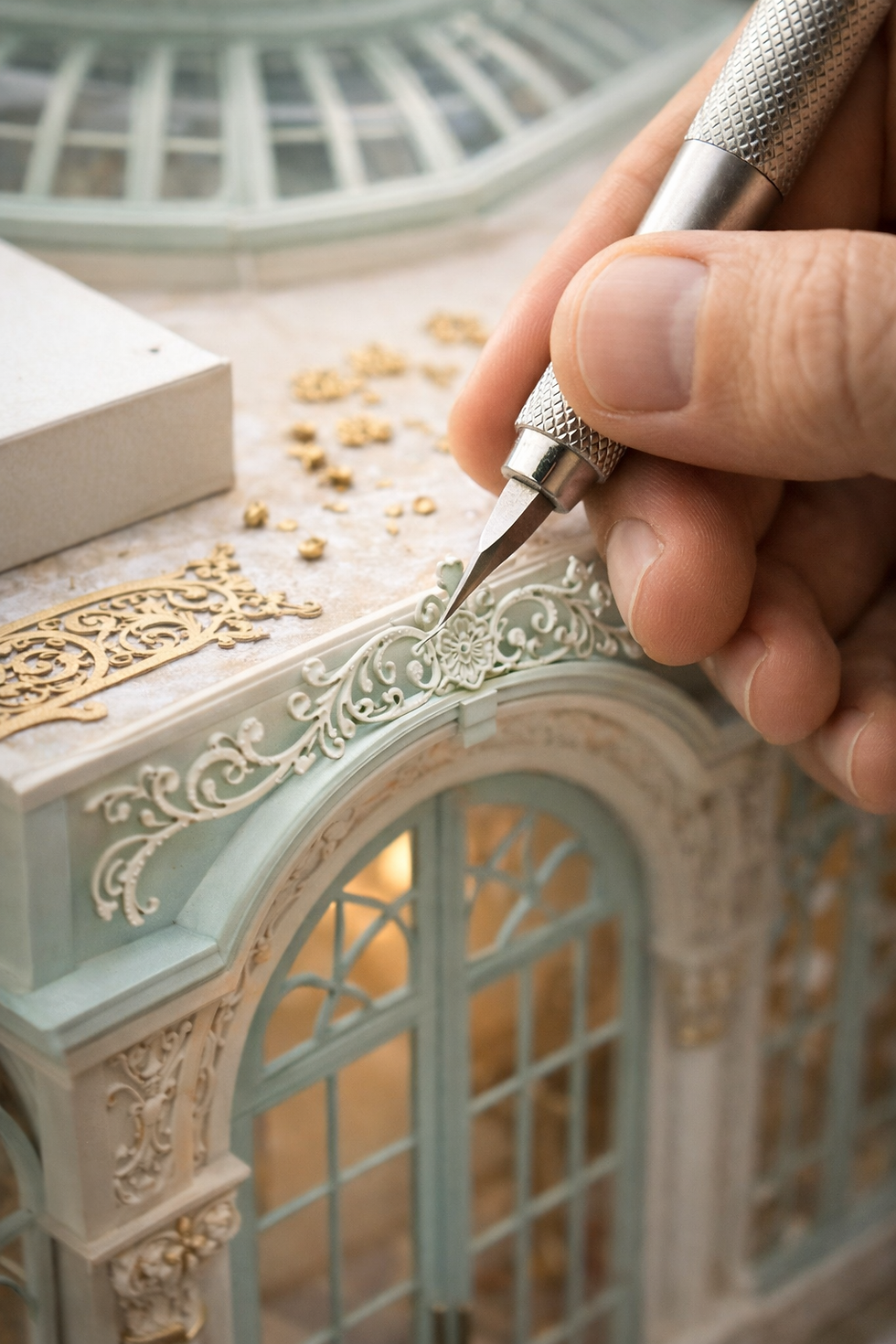
Domes: the crown jewels:
The easiest dome method is clear fillable ornaments or acrylic half-spheres with vertical ribs added from thin strip styrene, paper strips hardened with glue, or fine brass wire. For a more handcrafted route, build a rib cage from evenly spaced strips around a circular ring, then glaze between them with clear plastic panels. Top each dome with stacked beads or a turned finial for that regal greenhouse finish. Paint the ribs a soft mint or ivory, then kiss the cresting and finials with champagne gold. That contrast does a lot of heavy lifting.

Base color and materials:
For this palette, mix roughly three parts warm white with one part mint and a touch of sage for the main framing. Keep the walls creamy rather than stark white.
Gold should be antique and soft, not casino-lobby bright. Stone steps can be a pale beige-gray with subtle warm dry-brushing. Glass should stay mostly clear, but a whisper of satin frost in selected upper panes can add dreamy depth.

Make the hero piece earn its paycheck:
Here, the hero is the central entry arch and tallest dome. Give that area your richest detailing: the most refined filigree, the cleanest glazing, the prettiest handles, maybe a fanlight motif over the door. When someone looks at the miniature from across the room, that should be the first place their eye lands.

Add utilities, greebles, and believable extras:
Conservatories love tiny hinges, pull handles, ridge caps, planter rims, vents, finials, and maybe a discreet rain chain or downspout.
These little functional bits keep the build from floating off into pure fantasy frosting. Even the fanciest miniature needs a few sensible details to convince the viewer it could exist.


Furniture and garden life:
Keep the interior airy. A fainting sofa, delicate table, potting bench, or pair of wicker chairs is enough. Too much furniture and you lose the glasshouse feeling. Add clustered pots, citrus trees, climbing roses, or a giant fern with main-character energy. Soft goods should be pale and restrained so the architecture stays in charge.

Lighting without the headache:
Warm white USB mini LEDs are your friend. Aim for something around candle-warm rather than icy white. Diffuse the lights behind upper cornices, under dome rings, or behind interior planting so you get glow, not interrogation-room glare. Hide wiring in wall thickness, base channels, or planters. Tiny miracles are still allowed to use extension cords.
Story clutter and Easter eggs:
This is where Saint Marigold becomes yours. Add a lost trowel, seed packets, a tiny bee emblem, a forgotten teacup, a labeled orchid, or a miniature gardening ledger. Just one or two narrative clues can make the whole scene feel inhabited.

Unifying glaze and finish:
Once everything is assembled, lightly unify the piece with a very thin warm glaze in creases and around ornament so the structure doesn’t feel sticker-clean. Use satin on the frame, gloss on selected glass, and matte on stone and foliage. Too much uniform sheen can flatten the romance.

Photo tips and backdrop ideas:
Photograph this style with soft side light and a garden-y blurred backdrop if you want it to feel dreamy.
For a studio look, use pale gray, sage, or cream behind it. A few out-of-focus flowers in the foreground instantly sell scale and mood.
Avoid overhead light unless your goal is “tiny conservatory being questioned by the authorities.”

Troubleshooting
Filigree looks bulky → Scale the pattern down and thin the material. Fine repeated curves always beat thick chunky swirls.
Domes look lopsided → Make a center guide and mark equal rib spacing before gluing. Dome symmetry is worth the extra five minutes.
Window glazing looks cloudy → Use less glue, switch to clear-drying canopy glue or double-sided film, and peel protective film at the very end.
Gold looks too loud → Knock it back with a thin beige or umber wash, then re-highlight just the top edges.
The whole piece feels toy-like → Add tonal variation. Slight shadowing around frames, steps, and ornament instantly improves realism.
Until Next Time in the Small World
That’s the charm of a miniature like this: it is delicate, theatrical, and just believable enough to make you wonder whether Lady Vale’s impossible conservatory is still quietly glowing somewhere after dusk.
If you make your own version, I’d love to know what detail you fall for first—the domes, the filigree, the vine work, the warm interior glow, or the tiny golden bee if you spotted it. Share your work with #smallworldminiatures, sign up for the newsletter so you don’t miss the next build guide, and take a wander through the shop while you’re at it. And if this little glass palace has already moved into your heart, keep an eye out for the printed canvas too. Some miniatures are happiest on the workbench. Others also want wall space and compliments.
#smallworldminiatures #miniature #miniatures #miniatureart #miniaturebuilding #dollhouseminiatures #artnouveau #fantasyart #fantasyarchitecture #conservatory #greenhouse #miniaturegarden #miniaturearchitecture #diorama #dioramaart #makersgonnamake #scalemodel #modelmaking #tinyworlds #miniatureobsession #architecturelovers #victorhorta #hectorguimard #whimsicaldecor #creativehobby #handmadeart #interiordesigninspiration #fairytaleaesthetic






Comments