



The Curious Curiosities Cart: A Tim Burton–Style Miniature Halloween Market You Can Practically Smell
Updated: 10 hours ago

Step right up, tiny travelers! Today on Small World Miniatures I’m showcasing an exotic plant vendor stand that looks like it wheeled right out of a claymation Halloween special and parked itself under a crescent moon. We’re talking twisted trees, candy-colored gourds, a plank floor that creaks with personality, and a lanky, top-hatted shopkeeper who’s equal parts charming and “did he just wink or was that a draft?” It’s a Tim Burton–style miniature with big stop-motion energy: swirled branches, spindly legs, and produce bins brimming with spiky succulents and pumpkin-esque flora. This is your miniature Halloween market stall meets miniature exotic plant shop diorama, complete with miniature twisted vines and a miniature pumpkin flower garden that’s somehow adorable and ominous at the same time.
The mood hits first: cool teal atmosphere in the background, warm oranges and mossy greens up front. Then the textures: flaky wood grain, wrinkled gourd skins, and those wiry tendrils curling like punctuation marks from a poem about compost. If you lean in (yes, your screen won’t mind), you’ll notice soft lichen clumps, seedpod lanterns, and air-plant-like tentacles performing jazz hands. It smells like cinnamon brooms and slightly illegal fertilizer.
The Tiny Tale: “Oddroot & Daughters, Purveyors of Photosynthetic Peculiarities”
Founded on the 13th of Smarch, 1888 (a calendar exclusively observed in the Weirder District), Oddroot & Daughters started as a pushcart peddled by Bartholomew Oddroot, a gentleman scientist who discovered two things: plants do, in fact, like being complimented, and pumpkins will gossip if given a trellis and a slow afternoon. The cart prospered in the nook between the crooked clock tower and the bakery that sells crescent rolls shaped like actual crescents (lunar licensing fees included).

Bartholomew eventually adopted a trio of assistants—Penny, Pip, and Pox—all “daughters” in the found-family sense. Penny can prune a carnivorous calla without losing a fingertip, Pip catalogs seeds by the sound they make when shaken, and Pox negotiates with vines that like to wander. Their best-selling specimens? Whisper gourds (they hum if you overwater), Starlace tulips (petals that snap shut at compliments), and Mopeweed (pure décor, zero motivation).
Easter egg for the lore-hungry: legend says a rare Thirteen-O’Clock Bloom opens only when a lantern swings precisely seven times. If you spot a seven-ribbed pumpkin in the scene, you’ve found the nod. (And yes, seven ribs is very fashion-forward in the gourd world.)
As you browse the bins, imagine Bartholomew’s long shadow leaning in, offering a sample sprig in exchange for a promise: “Don’t feed it after midnight unless you’ve signed the waiver.” His price chalkboard always reads, “Ask about the return policy (you can’t).” The neighborhood adores Oddroot & Daughters because the storefront doubles as a tiny conservatory for sentient vines and because the stools are surprisingly comfy for being fabricated by ghosts.
Composition & Materials – A Guided Tour of the Build
Let’s take a left-to-right walk:
Left side: A squat teal pumpkin anchors the scene near a three-leg stool whose rungs feel hand-lathed. Behind it, a tall orange flower with lime-green octopus roots stretches like it’s late for rehearsal. Twisted tree trunks ribbon upward with scroll-like curls, dotted by pastel gourds hanging from tendrils. This side sets the rhythm with big shapes and contrasting temperatures—cool blues in the pumpkins, warm oranges in the flowers.
Center stage: The vendor stand—weathered wood with two shelves—packs trays of micro-greens, clusters of berry-colored bulbs, and turquoise moss beds that look delicious but please don’t. The back wall is a tapestry of spiraling vines and oversized starbursts: a pink sunburst flower spreads like a secret. You’ll notice the grain of the planks on the floor guiding your eye into the composition, while small crates and stacks of “maybe-later” supplies create narrative clutter. This is where the story lives: the bins say commerce; the tendrils say chaos.
Right side: Our shopkeeper, a rail-thin silhouette with a top hat and a long, bird-beak mask (don’t worry, it’s more whimsical than plaguey), gestures toward the produce like a magician revealing rabbits made of begonias. Behind them, more serpentine trees frame the negative space. A cluster of orange-and-pink star flowers pops against the teal haze, and a hanging seedpod lantern echoes the left-side gourds for visual symmetry.
Top to bottom: From misty teal sky to the knotty floorboards, the palette drifts from cool atmospheric depth to warm tactile foreground. Material cues suggest polymer clay for the fruits and flowers, epoxy or wire armatures for vines, basswood for structures, and acrylic paints layered with dry-brushing and washes. Add in tufts of model railroad foliage, static grass, and faint pastel chalk dusting for that velvety bloom on the gourds.

Inspirations – From the Big World to the Small
This piece lives at the crossroads of Tim Burton’s curlicue Gothic, Laika Studios’ tactile stop-motion (think Coraline’s Other Garden), and a dash of Antoni Gaudí’s organic, bone-like architecture. Burton gives the silhouettes and the playful macabre; Laika inspires the handmade textures and slightly oversized features that read beautifully on camera; Gaudí reminds us that nature’s geometry (ribs, spirals, sinuous trunks) can be whimsical without losing structure. In miniature, that style DNA translates to exaggerated curves, rhythmically repeating ridges, and tactile paint that reads from a distance but rewards a close look. If you love Hector Guimard’s Art Nouveau metro entrances, you’ll see distant cousins in those whiplash vines.

Artist Tips – Make Your Own Magic
The featured scene is an AI-generated concept illustration. Use this guide as inspiration for interpreting it with real materials; your results will vary.
You’re about to turn your desk into a haunted farmer’s market. Keep the coffee close and the superglue cap closer.
Mini Shopping List (clever reuse first)
Coffee stir sticks / popsicle sticks (floorboards) — Alt: 1/16" basswood strips.
Floral wire (22–26 ga.) — vines & hooks — Alt: paperclips.
Polymer clay (orange, teal, magenta, white) — Alt: air-dry clay + sealer.
Epoxy putty for trees — Alt: aluminum foil bulk with wood filler.
USB micro LED string (warm/cool) — Alt: battery tea lights.
Acrylics: Raw Umber, Burnt Sienna, Sap Green, Payne’s Gray, Phthalo Blue, Yellow Ochre, Titanium White.
Matte medium & matte varnish — Alt: PVA for sealing non-painted bits (test first).
Soft pastels (gray, olive) for dusting — Alt: eyeshadow you no longer wear (ask first).
Model foliage/static grass — Alt: dried herb flakes (oregano = tiny leaves; seal well).
Toothpicks & old toothbrush — texturing + speckling.
Tiny magnets (hide panels, attach lanterns) — Alt: poster tack.
Brass rod / paperclip pins for figures and stools.
Safety: Ventilation on when sanding/priming, gloves for epoxy, eye protection for wire + rotary tools. Your fingers are not sacrificial offerings to the miniature gods.

Quick Wins (grab-and-go)
Twist wire → vine: Wrap 22–26-gauge floral wire around a pencil, bend loose spirals, coat with a thin roll of polymer clay, and carve bark lines with a toothpick.
Instant wood grain: Drag a stiff, nearly dry fan brush loaded with a 2:1 mix of Raw Umber:Payne’s Gray across basswood. Knock back with a diluted black wash (about 1:8 paint:water).
Gourd glow: Base in Pumpkin Orange, glaze with Burnt Sienna (1:6), then hit ridges with Yellow Ochre + a dot of Titanium White for bloom.
Depth in a dash: Mist a cool teal (Phthalo Blue + a hint of black) into the back wall/sky to push it away; keep foreground warms saturated.
Story clutter: Add one crate, one stray tool, and one “whoops, the plant moved” tendril. Odd beats are more believable than perfect symmetry.

Deep Dive (step-by-step)
Planning & Scale Notes: Choose 1:12 or 1:24 scale. Sketch a five-box layout: left anchor, central stand, right figure, top canopy, floor texture. Decide your hero: vendor or oversized star flower. Palette anchor: teal + pumpkin orange + moss green, with magenta as spice.

Bones (Base Structure): Build the floor from coffee-stir sticks or basswood strips (~7–10 mm wide for 1:12). Distress edges with a craft knife and a small wire brush. The tree trunks are twisted armature wire covered in aluminum foil and epoxy putty; carve rings and spiral grooves while soft.

Hero Piece (Focal Point): Make one starburst flower: cut eight tapered petals from thin polymer clay, texture with the back of a knife, and seat them into a pea-sized clay center. Bake, then glaze with Magenta:White 3:1, shading tips with Quinacridone Violet. Dot the center with sap green and tiny chartreuse highlights.

Utilities / Greebles: Bins, crates, hooks, and lanterns sell the “shop” story. Repurpose matchboxes for drawers, ball-end headpins for lantern finials, and paperclips for hanging hooks. Add coiled wire “sprinkler hose” or a tiny chalkboard sign (cardstock + acrylic).

Furniture & Soft Goods: Sculpt a three-leg stool with dowels; angle the legs slightly outward. For cloth, coat tissue with watered-down PVA, drape over a toothpick “rod,” and stipple paint once dry for a burlap look. A single string-wrapped bundle reads “recent delivery.”

Base Colors & Materials
Wood: Raw Umber:Payne’s Gray 2:1, dry-brush Neutral Gray, then Buff Titanium on edges.
Gourds: Pumpkin Orange, Teal (Phthalo Blue + Yellow Ochre), Pale Lavender (Dioxazine + White).
Greens: Sap Green, knock back with Burnt Umber for shadow; pop with Lime (Hansa Yellow + Sap).
Metal hooks: Graphite + a whisper of Blue; touch with silver pencil on edges.
Weathering Stack (primer → varnish, 10 steps)
Prime black or dark gray (rattle can or brush-on).
Stipple Raw Umber into corners.
Dry-brush Buff Titanium across high points.
Wash: Black Ink:Water 1:10; flow into creases.
Speckle Burnt Sienna + Payne’s Gray with a stiff toothbrush for micro-grime.
Add green algae edge stains (Sap + a dot of black).
Dust pastel cool gray on floorboards; seal with light fixative.
Edge highlight with off-white (don’t overdo—less is haunted-homey).
Satin glaze (matte medium + a drop of gloss) on gourds for that waxy peel.
Final matte varnish overall; spot-gloss on lantern glass or wet leaves.

Lighting: Use USB-powered micro LED strings (warm white for cozy market, cool white for foggy cemetery). Run wires down the back of tree trunks. Diffuse hot spots with a dab of hot glue over the LED to make a frosted bulb. Hide the power bank in a crate. Optional: one teal gel (a scrap of candy wrapper!) behind the stand for atmospheric depth.

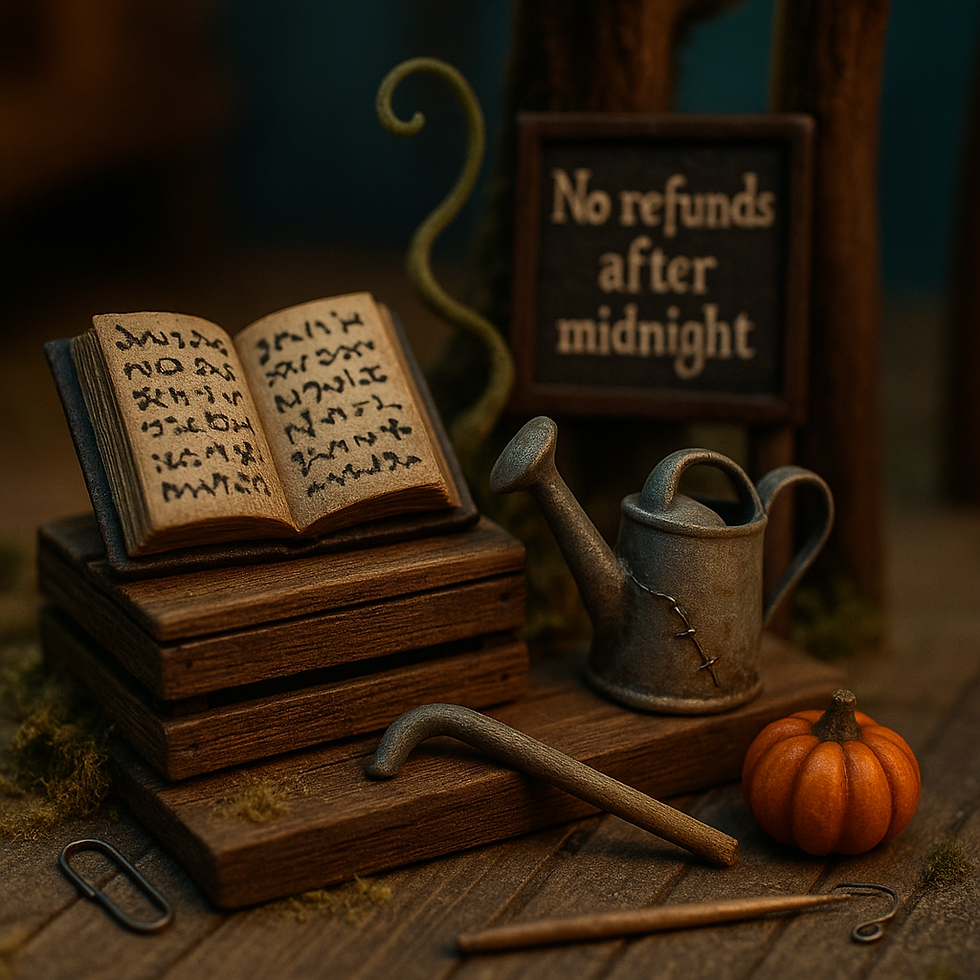
Story Clutter & Easter Eggs: Toss in a tiny ledger with undecipherable plant names, a broken watering can repaired with wire, and a “No refunds after midnight” sign the size of a fingernail. Easter egg idea: a pumpkin with seven ribs tucked near the stool—our Thirteen-O’Clock nod.
Unifying Glaze / Filter + Finish: To harmonize the palette, mist or brush a very thin teal filter across background elements (Phthalo Blue + matte medium, ultra dilute). Then warm the immediate foreground with a transparent Burnt Sienna glaze. Finish with a soft vignette by darkening outermost edges.
Photo Tips: Shoot slightly below eye level of the figure to keep the world feeling big. Backlight with a cool source for rim highlights on tendrils. Foreground bokeh? Hold a sprig of dried moss in front of the lens edge. Final edit: lift blacks a hair, cool shadows, push orange/green saturation gently, and keep whites modest so texture survives.


Troubleshooting (Problem → Fix)
Clay cracks on vines → Wrap a thin paper or foil sleeve around wire; apply softer clay layer; cure in shorter intervals.
Wood looks flat → Add two more tonal breaks: a warm glaze and a cool wash, perpendicular dry-brush to pop grain.
Gourds read cartoonish → Introduce a desaturation pass (Neutral Gray glaze) and micro-speckles; add sun-bleach on ridges.
LEDs glare → Diffuse with hot-glue domes or trace paper lantern shades; back the brightness off with a USB dimmer.
Scene feels clutter-confused → Group props in odd numbers and leave at least one clean negative space (the aisle).
Figure tilts/leans → Pin feet with 1–2 cm brass rod into drilled floor and secure with PVA + CA “kicker.”
Until Next Time in the Small World
If Oddroot & Daughters ever rolls into your town, remember: haggle politely, don’t tap the carnivores, and bring a tote bag rated for “mildly opinionated pumpkins.” I’d love to hear your favorite detail—the teal gourds, the pink starburst, or the vendor’s impossibly polite menace? Drop a comment, tag your own market-stall builds with #smallworldminiatures, and if you want more behind-the-scenes mischief, hop on the newsletter. It’s like a field trip permission slip for your inner goblin.
Hashtags
#miniature #miniatureart #miniaturediorama #miniaturephotography #dollhouseminiatures #tabletopterrain #modelmaking #scratchbuilt #polymerclayart #halloweendecor #timburtonstyle #stopmotionvibes #artdoll #fantasyart #gothicart #whimsicalart #kitbashing #weathering #acrylicpainting #foamsmith #laikastyle #gaudiinspired #dioramabuilders #tinyworld #artistsoninstagram #handmade #scaleodels #spookyseason #smallworldminiatures







Comments