



Under Glass in Miniature: My LEGO Ideas Botanical Garden Build, Brick by Bloom

First Impressions in Miniature
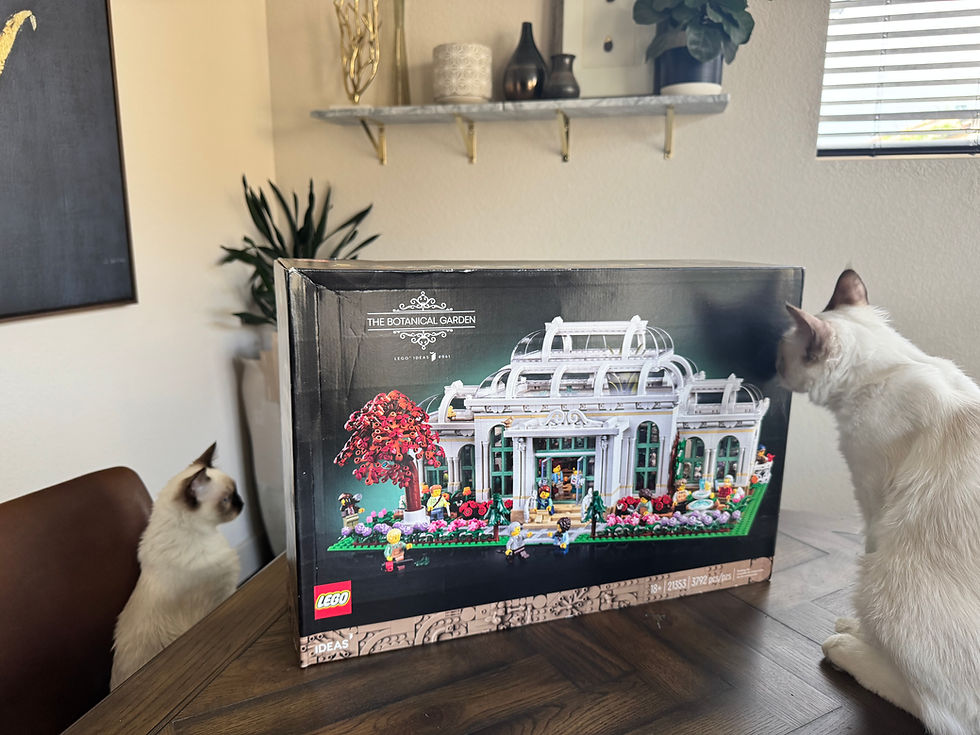
There are LEGO sets I enjoy building, and then there are LEGO sets that immediately start rearranging imaginary real estate in my house. The LEGO Ideas Botanical Garden, set 21353, landed firmly in the second category.
I love gardening, miniature architecture, glasshouses, tiny public spaces, and anything containing enough plants to make watering day slightly intimidating. This set manages to gather all of those interests beneath one very elegant transparent roof.

At 3,792 pieces, the Botanical Garden is a substantial build. The finished model has a Victorian-style conservatory, three atriums, a café, an observation balcony, landscaped beds, 12 minifigures, wildlife, and more than 35 represented plant species. LEGO currently lists the finished model at about 20 inches wide, so this little garden arrives with surprisingly big elbows.
Keep reading, because farther down I’ll explain why I think this is one of LEGO’s most satisfying sets for gardeners and miniature lovers. And yes, my cat Chuckie supervised part of the construction by sleeping near the project. Quality control was rigorous.
The Tiny Tale: Opening Day at Fernwick Conservatory
While I was building, the place gradually acquired a completely unofficial history in my head.
Welcome to Fernwick Conservatory, founded in 1897 after eccentric horticulturist Adelaide Fernwick returned from a decade of collecting seeds, pressed flowers, and increasingly implausible stories about parrots.

Fernwick insisted that every respectable city required three things: a public garden, a decent cup of coffee, and somewhere people could stand under a palm tree during winter and pretend the weather outside had reconsidered its behavior.
The conservatory became famous for its tropical hall, its exceptionally polite gardeners, and a café whose pastries mysteriously disappeared whenever the local rabbit was seen near the premises.
Visitors eventually learned to keep one eye on the botanical labels and the other on the shrubbery.
The gardeners insist the rabbit is innocent.
The rabbit has declined comment.
One little Easter egg to watch for in my photos: find the white bunny lurking beside the garden edge. I have decided he is the Fernwick Conservatory's unofficial director of tulip inspection.
There are genuine Easter eggs in the official set too. One Bird of Paradise plant serves as a nod to model designer Chris McVeigh, who previously designed LEGO's Bird of Paradise set, and to fan designer Valentina Bima, who counts the plant among her favorites.
A Guided Tour of the Build
The floor was the first moment the garden began feeling like a place. Cream and warm terracotta tiles create a patterned interior that immediately suggests an old conservatory rather than a generic LEGO room. In my early build photo, the pathways are already visible before much of the architecture exists. Curving tan planting beds snake across the floor, waiting for their greenery.

Then come the tall sand-green windows. This is where the scale suddenly changes. The repeated vertical glazing, white wall panels, slender columns, and tan masonry base give the structure real architectural rhythm. Even half-built, it starts resembling a civic glasshouse that has occupied the same park for a century.

Inside, the planting beds turn wonderfully unruly. Broad leaves overlap small flowers. Trees climb in front of windows. Tiny identification signs appear beside specimens. A pair of binoculars waits among the greenery. The plants feel collected rather than arranged, which is exactly what I want from a botanical garden.

The spiral staircase and observation balcony are especially good miniature storytelling. The curved white stair rises through the foliage toward an ornate balustrade. From that level, a minifigure can peer into the canopy instead of observing everything from ankle height. It adds vertical life to the interior.
Near the entrance, the reception area gives the garden a public face. A little terminal, ticket, desk, and nearby viewing equipment transform the building from a greenhouse into an institution. Suddenly there are employees, admission, guided tours, and presumably at least one person asking where the restroom is every seven minutes.

Outside, the formal beds and pathways soften the white architecture. Red, orange, purple, and pink flowers sit against green lawn plates and brown soil. In one of my favorite progress photos, the little white rabbit is sitting beside the planting bed looking remarkably pleased with himself.

Finally, the transparent roof sections bring the whole composition together. The completed conservatory becomes light and airy even though it contains thousands of pieces. Clear curved glazing floats over the white and sand-green structure while palms and trees remain visible through it. That final roof stage is the point where the build goes from “very nice LEGO building” to “I would like a season pass, please.”

What Makes the LEGO Botanical Garden So Unusual?
Transparency changes everything here.
A lot of architectural LEGO models reward you primarily from the exterior. The Botanical Garden keeps its interior visible through walls and roof, so the plants remain part of the architecture from almost every angle. Fan designer Valentina Bima specifically loved transparent LEGO elements because they dissolve the visual boundary between exterior and interior. That idea survived beautifully into the finished set.
The building itself also has an unusually open character. Three atriums create distinct environments: the main tropical space, an arid garden, and a café wing. Roof and wall sections can be removed for access, which helps enormously because there is a great deal happening inside.
Then there is the plant diversity. The model contains more than 35 species. Among the specifically identified plants are Coffea arabica, Japanese maple, snow eucalyptus, Ice Cream tulips, and date palm. Elsewhere you find cacti, bamboo, peonies, hydrangeas, pitcher plants, mushrooms, and plenty of leafy oddities.

The building techniques get wonderfully strange. Broom pieces become pitcher plants. Familiar decorative elements suddenly read as petals or foliage. One of my favorite pleasures with LEGO botanicals is reaching a step, staring at the pieces, and thinking, “There is absolutely no plant here,” followed three minutes later by, “Oh. Of course that’s a plant.”
The set also launched with 12 minifigures, more than any previous LEGO Ideas set at the time. They include staff, visitors, gardeners, a barista, and a minifigure based on Valentina herself. The population gives the glasshouse the feeling of an actual destination instead of an empty architectural model.
From the Big World to the Small
Valentina Bima is an architect, and her original LEGO Ideas proposal grew from her affection for botanical gardens, travel, and historic glasshouses. She has described looking toward iron-and-glass conservatories constructed from the mid-1800s through the early twentieth century.
That puts this miniature building into a wonderful architectural family.
The Palm House at Kew Gardens in London is an obvious relative in spirit. Designed by Decimus Burton and constructed by Richard Turner beginning in 1844, its curving iron-and-glass structure used ideas borrowed from shipbuilding. The great glazed shell almost resembles an overturned hull. The LEGO Botanical Garden uses a much smaller vocabulary, yet the same basic magic is there: a delicate-looking transparent envelope supporting an astonishing amount of plant life.

Then there are the Royal Greenhouses of Laeken in Belgium. Architect Alphonse Balat began designing the complex in 1873, creating domes, galleries, and monumental pavilions in metal and glass. Belgium's monarchy describes the result as a “glass city,” which may be the best two-word description of why these buildings are so enchanting. The complex also helped point Belgian architecture toward Art Nouveau.
Across the Atlantic, San Francisco's Conservatory of Flowers opened in 1879. Its white Victorian structure, tall central volume, repeating arched bays, and surrounding formal gardens share another branch of the same visual language. The conservatory remains the oldest building in Golden Gate Park and houses roughly 1,700 aquatic and tropical plant species.
I wouldn't claim any of those buildings as direct blueprints for this LEGO set. Together, they explain the tradition it belongs to: architecture acting as a frame for living collections, with glass allowing the plants and structure to share equal billing.
Where the LEGO Botanicals Series Fits In
Here is an important little piece of LEGO taxonomy.
The Botanical Garden 21353 belongs to LEGO Ideas. LEGO Botanicals is a separate theme. They share a very leafy family resemblance, and the Botanical Garden feels like a place where half the Botanicals catalog might go on vacation.
LEGO launched its Botanical Collection in 2021 with the Flower Bouquet and Bonsai Tree. Those sets helped establish a different kind of adult LEGO experience: slower, decorative, and heavily focused on interpreting organic shapes with existing bricks.

The idea clearly took root. In late 2024 LEGO announced that Botanicals would become its own dedicated theme beginning in 2025. The range has since expanded through orchids, bouquets, succulents, tiny plants, bamboo, flower arrangements, bonsai designs, and more.
That development makes the Botanical Garden especially interesting to me. It combines the organic puzzle-solving of LEGO flowers with an architectural environment and minifigure scale.
You get to build the plant.
Then you get to build where the plant lives.
Then somebody opens a café beside it.
That is a pretty good afternoon.
Would I Recommend Buying the LEGO Ideas Botanical Garden?
Very much so, with two practical checks first: budget and display space. At the time I'm writing this, LEGO's U.S. store lists set 21353 at $329.99 and shows it as available. Prices and availability can change, so check the current listing before ordering.
For gardeners, the appeal is obvious. You spend hours watching little ecosystems appear beneath your hands. For architecture fans, the glasshouse has enough structural repetition and period detail to remain interesting long after the last brick clicks into place. For miniature collectors, the interior tells stories from almost every viewing angle.
The completed model also feels unusually alive. You can move minifigures, adjust plants, remove roof sections, photograph through the glazing, add lighting, and create new scenes over time.
And that lighting upgrade made me love mine even more. A conservatory already revolves around light in real life. Once the miniature version starts glowing through those clear roof panels after dark, the whole purpose of the architecture suddenly makes sense.

Mine went from LEGO set to tiny destination.
Fernwick Conservatory is apparently open late now.
The rabbit remains on the premises.
Until Next Time in the Small World
This build hit a very particular sweet spot for me. I got architecture, gardening, miniature storytelling, slightly obsessive plant arranging, and a glass roof all in one enormous box.
I also enjoyed seeing the garden develop in stages. Those progress photos capture something the finished model tends to hide: underneath all the foliage and transparent glazing is a carefully planned sequence of floors, beds, structural bays, circulation routes, and little public spaces. Watching those layers accumulate was half the fun.
If you've built the LEGO Ideas Botanical Garden, tell me your favorite detail in the comments. I especially want to know which plant caught your eye first and whether you added lighting.
And if you customize yours, rearrange the grounds, expand the gardens, or create an entire brick-built park around it, share your creation with #smallworldminiatures so I can see what you've grown.
You can also join the Small World Miniatures newsletter for more builds, miniature design stories, practical tutorials, and occasional reports concerning suspicious rabbits. Then take a wander through the online shop and see what else is waiting in the tiny world.
Until next time, keep building. Preferably somewhere with good light and several plants.
Hashtags
#SmallWorldMiniatures #LEGOBotanicalGarden #LEGOBotanicals #LEGOIdeas #LEGO21353 #LEGOFlowers #LEGOGarden #LEGOArchitecture #LEGOBuild #AFOL #AdultLEGO #LEGOPhotography #LEGODisplay #MiniatureArt #MiniatureArchitecture #MiniatureGarden #BotanicalArt #BotanicalDesign #GreenhouseDesign #VictorianArchitecture #ConservatoryDesign #GardenInspiration #PlantLovers #GardeningLife #BrickBuilt #ModelMaking #MiniaturePhotography #CreativeBuilding







Comments