



Miniature Molding Magic: How to Cast Tiny Wood-Like Trim, Rosettes, Crown Moulding, and Dollhouse Details

Today we are skipping the grand tour, the moody doorway, and the suspiciously charming tiny bakery that may or may not be run by a mouse with a zoning problem. This time, we are getting straight to the good stuff: details.
Tiny crown moulding. Chair rails. Rosettes. Wall panels. Fireplace trim. Ornate door toppers. Little decorative bits that make a dollhouse look like someone wealthy, dramatic, and possibly wearing a velvet smoking jacket had opinions about architecture.
This guide is all about making your own silicone molds and using them to cast miniature embellishments with a wood-like paste similar to WoodCast. WoodCast is a moldable wood pulp product for creating appliqués, trims, and decorative castings that can be sanded, carved, painted, stained, and shaped before or after drying.

Just a quick note before anyone starts side-eyeing the wood paste: this is not a sponsored post, and I haven’t received anything from the company. No secret crate of tiny trim goo arrived at Small World headquarters. I just think WoodCast looks genuinely interesting, it seems to have some happy makers talking about it online, and it feels worth testing in the tiny-detail laboratory.
We’ll also talk about a homemade version, but with one tiny caveat wearing a safety vest: commercial products have formulas we can imitate in spirit, not perfectly duplicate on a kitchen counter next to the cereal.

Why Cast Your Own Miniature Details?
Because buying every tiny decorative piece separately is how a person goes from “I have a hobby” to “I have a drawer labeled possibly useful cornice fragments.”
Casting lets you repeat one beautiful detail over and over. One chair rail becomes a whole parlor. One rosette becomes a ceiling, a cabinet, a picture frame, a bed crown, a door accent, and possibly a very fancy hat for a 1:12 goose. I do not judge the goose.

The big advantage is consistency. If you want matching trim around a room, repeated appliqués on a staircase, or identical corner blocks for wall panels, a silicone mold turns one good master into a small army of decorative pieces.
And in miniature work, repetition is what makes a scene feel intentional rather than “I found twelve unrelated scraps and threatened them with glue.”

Shopping List
Some of these items are things you may already have around the house. Others are the “buy it once and suddenly feel like a tiny factory owner” items. Product links are Amazon affiliate links, which means your purchase may help fund the small world without requiring me to open a tiny toll booth at the edge of town.

For Making the Master Detail
Household options:Cardstock, mat board, toothpicks, coffee stirrers, bamboo skewers, plastic packaging, old jewelry findings, buttons, lace, embossed scrapbook paper, picture frame scraps, dried pasta shapes if you are feeling brave and mildly unhinged.
Purchasable equivalents:Basswood strips, styrene strips, dollhouse trim, 3D printed moulding, laser-cut embellishments, polymer clay texture sheets, miniature architectural details.
For the Mold
Household options:Foam board, LEGO bricks, tape, plastic food container lids, scrap acrylic, disposable cups, popsicle sticks, petroleum jelly.
Purchasable equivalents:Two-part RTV silicone mold rubber, silicone measuring cups, digital scale, mold release spray, sulfur-free clay, plastic mold boxes.
A quick note on silicone: cure inhibition can happen when contaminants prevent silicone from curing properly against a surface. Smooth-On explains that the mold may look fine outside but stay sticky where it touched the model, and Polytek recommends small test cures when using platinum silicone with uncertain materials.

For Casting
Household options:Fine sawdust, wood flour, PVA glue, wood glue, lightweight spackle, cornstarch, talc, acrylic medium, toothpicks, old gift cards for scraping.
Purchasable equivalents:WoodCast or similar moldable wood pulp, fine wood flour, cellulose powder, flexible modeling paste, premade decorative casting compound.
WoodCast’s own usage instructions call for acetone, gloves, a dust mask, a fan or well-ventilated workspace, and careful storage to keep the product workable. Acetone is highly flammable and should be handled with ventilation, sealed containers, and no ignition sources nearby.
For Finishing
Household options:Acrylic craft paint, tea or coffee stain, makeup sponge, old toothbrush, sandpaper, brown ink pad.
Purchasable equivalents:Wood stain pens, miniature paint washes, primer, matte varnish, gilding wax, detail brushes, sanding sticks.

Safety First, Because Eyebrows Are Nice
Work in a well-ventilated area. Wear nitrile gloves when handling silicone, solvents, or commercial wood-casting products. Keep acetone away from flames, sparks, heaters, hot tools, candles, and that one questionable extension cord we both know you should replace.
Also: label everything. The modeling safety guides I keep on my own mental workbench are very clear about good lighting, ventilation, careful storage, dust protection while sanding, and actually reading chemical labels before charging into battle like a glue-scented raccoon.
Step One: Choose a Master Detail
Your “master” is the original piece you want to copy.
For crown moulding, use a short section of dollhouse trim, carved basswood, layered styrene, or a 3D printed profile. For a rosette, use a jewelry finding, carved button, polymer clay stamp, or premade decorative applique.
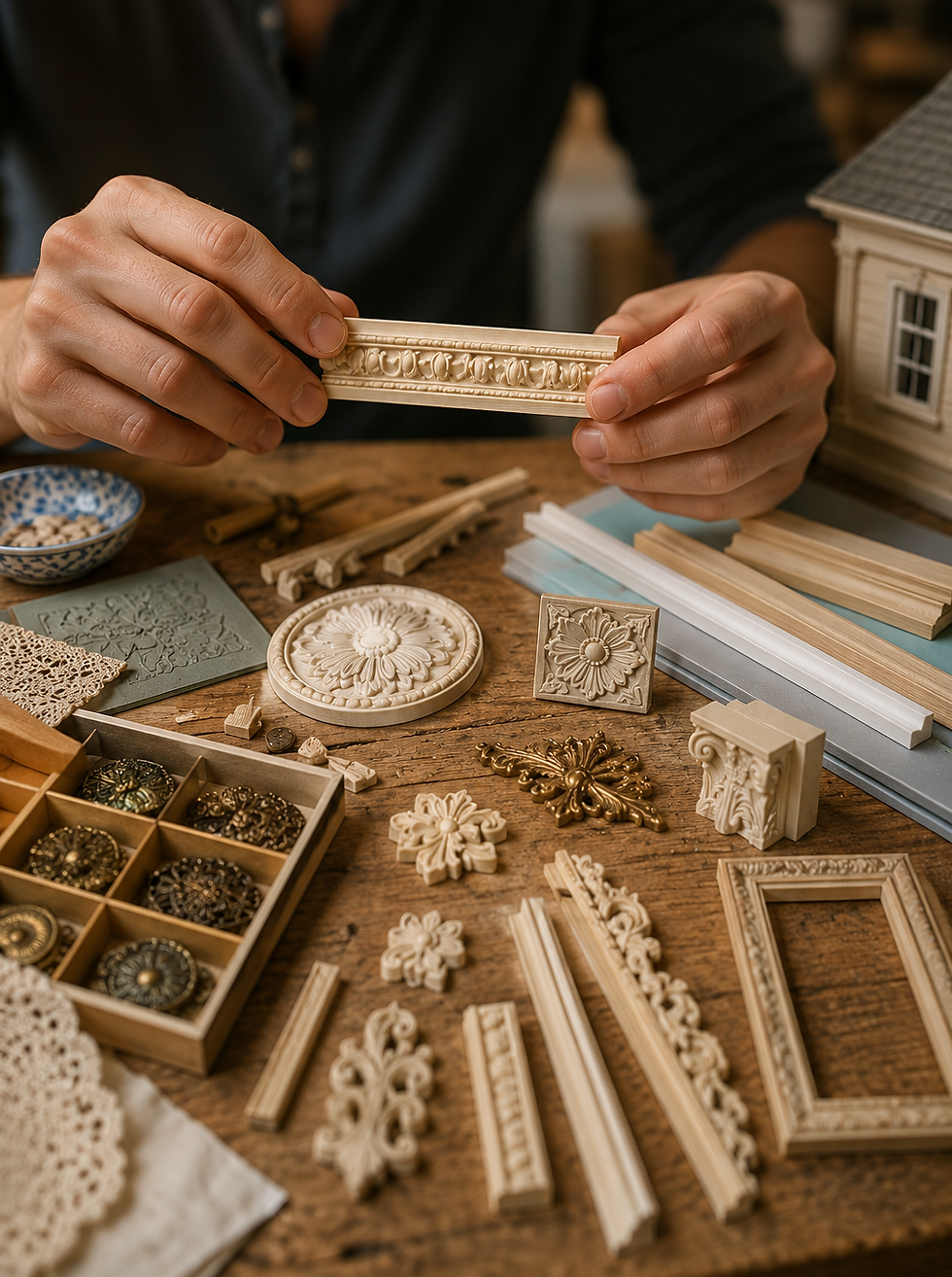
For 1:12 scale, remember that 1 inch equals 1 foot. A real 6-inch chair rail becomes 1/2 inch tall. A 3-inch trim strip becomes 1/4 inch tall. In dollhouse work, 1:12 is a common scale with lots of available parts and interior materials.
Keep details slightly bolder than real life. Miniature trim that is perfectly to scale can disappear after paint. At tiny sizes, delicate detail sometimes needs to raise its hand and say, “Hello, I exist.”

Step Two: Clean and Seal the Master
Silicone records everything: tool marks, dust, crumbs, fingerprints, and the tragic little fuzz from your sweater.
Clean the master with a soft brush. If it is porous, seal it with clear acrylic spray, shellac, or matte medium. Let it dry completely. Not mostly dry. Not “I waved it near a fan and hoped.” Completely dry.

This matters because damp sealers, certain paints, sulfur clays, latex, and some plastics can interfere with silicone curing. A small test patch can save you from making a mold that stays sticky forever, which is less “crafting triumph” and more “cursed pancake.”
Step Three: Build the Mold Box
For a flat detail like chair rail or crown moulding, make a shallow box about 1/4 to 1/2 inch larger than the master on all sides.
LEGO bricks are excellent because they are straight, reusable, and make you feel like your childhood has been promoted to management. Foam board works too. Hot glue the edges so silicone cannot leak. Silicone leakage is slow, sneaky, and always looks personally offended when you notice it.

Stick the master to the bottom using double-sided tape, a dab of hot glue, or a tiny amount of sulfur-free clay. Press it down firmly so silicone cannot creep underneath.

Step Four: Apply Mold Release If Needed
For most sealed masters, silicone may release without help. But if your master is very detailed, porous, painted, or sentimental, use a light mold release.
Do not flood it. A thick release coat can soften details. Think “mist,” not “salad dressing.”
Let the release dry before pouring silicone. Trapped wet release can cause curing problems, and nobody wants a mold with the texture of a tired gummy worm.
Step Five: Mix the Silicone
Follow the exact ratio on your silicone package. Some are 1:1 by volume. Some are 10:1 by weight. Some are clearly designed by people who believe math builds character.
Scrape the sides and bottom of your mixing cup. Mix slowly to reduce bubbles. If you whip silicone like cupcake batter, you will get bubbles like cupcake batter, except these cupcakes cost more and taste worse.

For tiny trim molds, pour a thin stream from high above the mold box into one corner. Let the silicone flow over the master by itself. This helps push air out of details.
Tap the mold box gently on the table. Use a toothpick to tease bubbles away from deep grooves.

Step Six: Let the Silicone Cure
Cover the mold with a plastic container or box to keep dust away. Let it cure for the full recommended time.
Do not poke it every fifteen minutes. I say this as a person who has absolutely poked things every fifteen minutes.
Once cured, peel away the mold box and gently remove the master. If the edges are ragged, trim the silicone with sharp scissors.
Now admire your mold. You have made a tiny architectural waffle iron.
Step Seven: Choose Your Casting Material
You have two main options.
The first is a commercial wood-like casting product such as WoodCast or a similar moldable wood pulp. This is the easiest route if you want a material that sands, carves, paints, stains, and behaves more like wood than resin. WoodCast’s instructions describe pressing small amounts into the mold, using acetone to keep it pliable, smoothing the back, drying for several hours or overnight, and trimming with a craft knife.

The second is a homemade wood-fiber paste. It will not be identical to a commercial formula, but it can make very useful miniature trim.
Step Eight: Homemade Wood-Fiber Paste
Here is my safer, water-based studio version:
Mix:2 parts fine wood flour or very fine sawdust1 part lightweight spackle or joint compound1 part PVA glue or wood glueA few drops of acrylic mediumA pinch of cornstarch or talc if the mix is stickyA tiny splash of water only if needed
You want a soft putty that holds shape when pressed. If it smears like frosting, add wood flour. If it crumbles like ancient toast, add a little glue.

For a warmer wood color, add a drop of raw umber acrylic paint. For pale trim, leave it natural and prime later.
This homemade mix dries harder and less flexible than commercial WoodCast-style material, but it works nicely for straight trims, wall panels, rosettes, frames, and decorative appliqués.
I do not recommend inventing your own acetone-based sealed compound unless you already understand solvent safety and material compatibility. Acetone vapors can ignite, and the SDS guidance for acetone emphasizes ventilation, protective equipment, closed containers, and keeping it away from ignition sources.

Step Nine: Press the Material Into the Mold
Dust the mold lightly with cornstarch if the paste is sticky, then tap out the excess. You do not want a powdered donut. You want a whisper.

Press small bits into the deepest areas first. Use a silicone tool, toothpick, or gloved finger. Work from one end to the other. For long trim, press down firmly along the full length.
Overfill slightly, then scrape the back flat with an old gift card or palette knife. A flat back makes installation much easier.
If the piece is thin, let it firm up in the mold before removing. If the detail is deep, let it dry fully.
Step Ten: Remove and Refine the Casting
Flex the silicone gently away from the casting. Do not yank the casting like you are starting a lawn mower.
Trim flash with a sharp craft knife. Sand the back flat. For long strips, use a sanding block so the trim stays straight.
If a corner chips, do not panic. Tiny damage often looks like age once painted. This is why miniature artists and haunted houses understand each other so well.
Step Eleven: Paint, Stain, and Finish
Prime porous castings first. A thin coat of matte acrylic primer keeps paint from soaking unevenly into the surface.
For painted wood trim:Base coat with warm ivory, antique white, soft taupe, walnut brown, or muted black. Add a thin brown wash into the crevices. Dry brush the raised details with a lighter shade.

For stained wood:Use diluted acrylic ink, stain marker, or watered-down raw umber. Apply lightly. Let it dry. Add more only if needed.
For gilded details:Base coat in red oxide or dark brown, then lightly touch the raised areas with gold wax or metallic paint.
Washes and dark lining are especially useful on tiny raised detail because they settle into recesses and help the eye read depth. Miniature painting guides describe dark lining and recess shading as ways to define small details and create visual separation.

Step Twelve: Attach the Castings
For wood, use wood glue or tacky glue. For painted surfaces, use a small amount of super glue or thick PVA. For foam, avoid solvent-heavy glues unless you enjoy accidental craters.
Hold long trim in place with painter’s tape while it dries. For curved surfaces, bend the casting gently while it is still slightly flexible. If using commercial material, follow the product directions for warming and shaping.

Caulk tiny gaps with acrylic paint mixed with a speck of lightweight spackle. Then touch up the paint. This little step makes trim look built-in instead of “attached during a late-night glue incident.”
Ten Miniature Applications for Cast Details
Crown Moulding
Cast long strips of decorative moulding and run them where the wall meets the ceiling. Even a simple room suddenly looks expensive enough to have opinions about tea service.
Use deeper trim in grand parlors and thinner trim in bedrooms or attic rooms.

Chair Rail
A chair rail divides wallpaper, painted walls, or wainscoting. In 1:12 scale, try 3/8 to 1/2 inch from the floor for a low rail, or about 3 inches up for full-height wall paneling.
Use it to hide wallpaper seams. This is not cheating. This is architecture being helpful.

Raised Wall Panels
Cast thin strips and small corner blocks to make Georgian, Victorian, French, or Art Deco wall panels. Lay the panel pattern out in pencil first, then glue the pieces over the lines.
Keep spacing consistent. Uneven wall panels look like the house sneezed.

Rosettes and Corner Blocks
Small square or round castings can sit at the corners of door frames, picture frames, ceiling coffers, and wall panels. One mold can make dozens. This is how you become the tiny landlord of symmetry.

Ceiling Medallions
Press a round jewelry finding or decorative button into silicone, cast it, and place it above a chandelier. Paint it white for plaster, gold for drama, or aged bronze for a slightly mysterious library.

Fireplace Surrounds
Use cast trim to build mantel shelves, side pilasters, floral centerpieces, and carved-looking edges. A plain fireplace becomes the kind of fireplace that expects someone to dramatically read a letter beside it.

Door and Window Pediments
Add a cast flourish above doors or windows. A simple triangular pediment, scroll, or floral plaque instantly makes a room feel older and more designed. This is great for Victorian townhouses, French apartments, Gothic studies, and fantasy interiors.

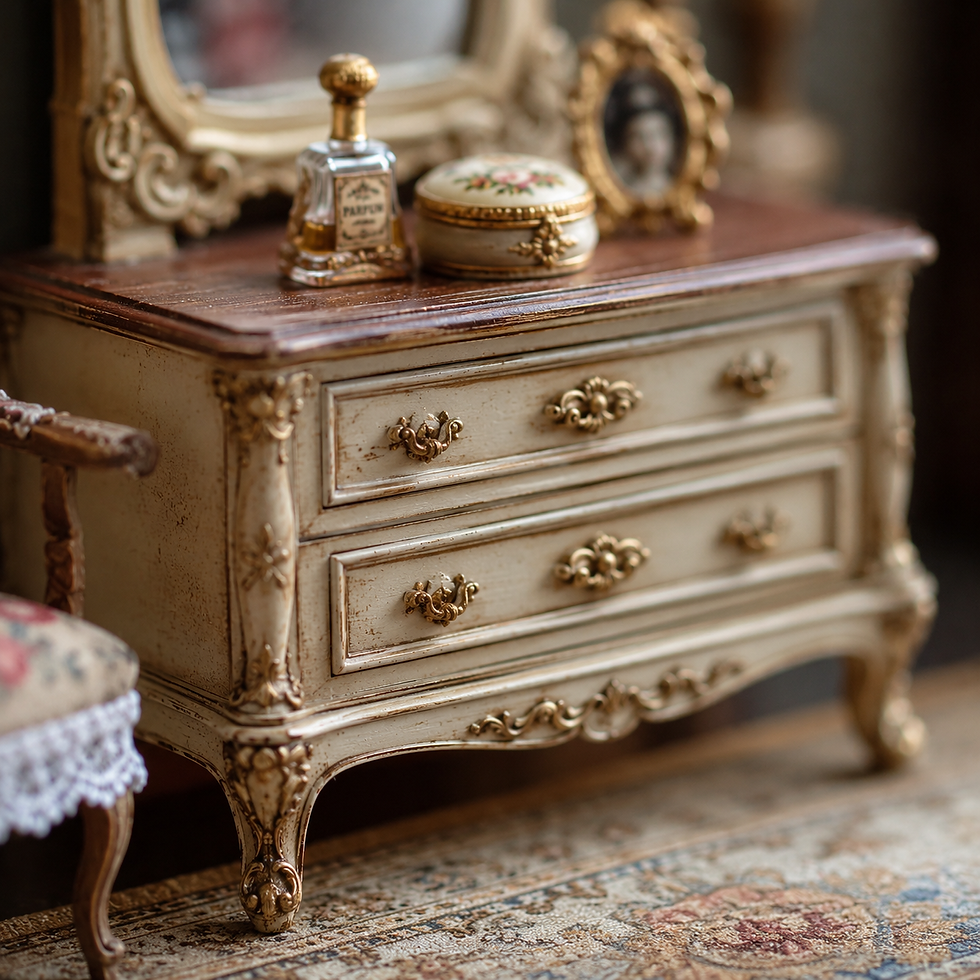
Furniture Appliqués
Add small castings to armoires, beds, dressers, cabinets, vanities, and sideboards. Paint them to match the furniture, then glaze the recesses. A plain cabinet can become a miniature antique with one well-placed flourish and a little confidence.
Stair Brackets
Cast small scroll brackets and place them under stair treads or along stringers. This is a wonderful way to make staircases look custom without carving twenty identical pieces by hand, which is how madness gets a mailing address.

Picture Frames and Mirrors
Cast narrow trim strips and cut mitered corners for frames. Add rosettes to the corners if your miniature mirror wants to be admired before reflecting anything.

Bonus Idea: Storefront Signs
Cast raised letters, borders, or scrolls for shop signs. Paint the sign dark green, navy, black, or oxblood red, then dry brush raised letters in cream or gold.

Bonus Idea: Garden and Exterior Details
Use weather-resistant casting material for exterior plaques, window lintels, garden urn details, faux carved stone, or tiny architectural salvage leaning against a shed.
Seal exterior pieces well if the model will be handled often.

Troubleshooting
Problem: The silicone stays sticky against the master.Fix: You may have cure inhibition. Seal the master, test a small patch first, and avoid sulfur clay, latex, incompatible paints, and uncertain 3D prints unless your silicone brand says they are safe.
Problem: The casting breaks when removed.Fix: Let it dry longer, make the casting slightly thicker, or use a more flexible commercial compound. Remove by bending the silicone away from the piece, not pulling the piece straight up.
Problem: Details look soft.Fix: Press material into the deepest parts first. Use smaller amounts. Scrape the back flat only after the front is fully packed.
Problem: Air bubbles ruin the mold.Fix: Pour silicone in a thin stream into one corner. Brush a little silicone over the master first, then pour the rest.
Problem: Trim will not sit flat.Fix: Sand the back on a flat sanding block. For long pieces, tape them to a ruler while drying.
Problem: Paint looks blotchy.Fix: Prime first. Wood-fiber materials absorb paint like thirsty little goblins.

Closing – Until Next Time in the Small World
There you have it: one tiny detail becomes many tiny details, and suddenly your dollhouse has crown moulding, wall panels, rosettes, fireplace trim, and the general attitude of a miniature estate that has never once done its own laundry.
Try a simple mold first. A chair rail. A rosette. A little frame corner. Then once you get the hang of it, make a whole drawer of architectural embellishments and pretend you are not delighted by the phrase “tiny trim inventory.”
Leave a comment with the detail you’d cast first, and if you use this technique in your own miniature build, tag #smallworldminiatures so I can come admire it like a nosy neighbor with excellent taste.
#smallworldminiatures #miniaturemaking #dollhouseminiatures #miniaturetutorial #miniaturemoldmaking #siliconemold #miniaturecasting #dollhouseDIY #dollhouseideas #miniaturedetails #miniaturetrim #miniaturecrownmolding #chairrail #dollhousemoulding #miniaturearchitecture #roomBox #diorama #scaleModeling #miniatureartist #tinyhouseart #miniaturedecor #dollhouseinteriors #miniaturefurniture #crafttutorial #handmadeMiniatures #miniatureworld
Social Media Post
Tiny crown moulding? Chair rails? Rosettes? Yes, we’re giving dollhouses the fancy little details they deserve. This new guide walks through making silicone molds and casting wood-like miniature embellishments—without needing a carving degree or a tiny butler. Follow the link in bio to read the full post.








Comments