


Make a Miniature Flower Sofa: Velvet Petals, Leaf Arms and a Little Botanical Drama

My Vision for This Small World
My miniature flower sofa turns a bloom into a place to sit, with overlapping dusty-rose petals for the back and moss-green leaves curling into arms. Little gold-colored feet lift the soft silhouette above the rug. Plain upholstery lets the curved edges and shadows between the petals carry the decoration. The result brings a wonderfully theatrical shape into a cozy conservatory, with just enough room left for someone very small to curl up.
Some links earn me a commission from qualifying purchases and help keep this tiny world growing. As an Amazon Associate I earn from qualifying purchases.
Anavrin’s Cats Crossing book nook brings a playful feline twist to the bookshelf. A charming gift for anyone who loves cats, books and a tiny world to explore. Ready to give your shelf a tiny new adventure? Use EOUFQ5ZWKCSNGM for 10% off select Anavrin products.

What Makes This Miniature Flower Sofa Work?
The tallest petal sits near the center of the back, with lower petals stepping outward. That gentle rise gives the sofa its flowering shape. The layers overlap enough to feel connected, but their tips remain distinct. If every petal were the same height, the back would read more like a fence in a particularly nice fabric.
The seat provides a calm, rounded surface beneath all that movement. Its edge has a narrow trim line, which helps it look tailored rather than like a loose pillow balanced on a box. The cover image shows a compact seat; you can plan your version as an intimate loveseat or widen it for a more generous two-seat sofa.
The green arms extend the botanical idea without covering the pink petals. Fine pale-gold lines suggest veins across their surfaces. Keep those lines delicate: their job is to make the leaves legible, not to turn them into striped cushions.
Underneath, the feet add a small flash of warm metallic color. You can use simpler wooden feet, finished in antique gold, and still retain the same mood. Let the petal back carry most of the visual complexity.

Botanical Inspiration, Scaled Down
This design recalls the plant forms associated with Art Nouveau: the V&A describes its natural-world inspiration through organic shapes, tendrils and flowing lines. Here, that sensibility becomes a playful piece of furniture rather than a reproduction of a particular historical sofa.
Look at an actual flower before drawing your templates. Notice how petals overlap near the center, how their tips change direction, and how the outer leaves support the blossom visually. You are borrowing that rhythm, not making a botanical specimen with a seating capacity.
If you have explored the miniature sofa styles through the decades guide, this is another way to think about silhouette. Instead of beginning with a familiar furniture period, begin with a natural shape and decide which parts can become structure, padding or decoration.

Make Your Own Magic: Plan a Miniature Flower Sofa
A little AI-assisted imagination helped this flower sofa bloom. Begin with a small paper mock-up and a fabric test piece so you can adjust the proportions to your room and materials. Fabric thickness makes a real difference when several petals overlap. Even a sofa this glamorous needs a fitting.
Suggested scale: 1:12 for the planning example below. At this scale, divide a full-size measurement by twelve.
Main techniques: layered-card construction, simple upholstery, overlapping decorative panels and a painted metallic finish.
Difficulty: an intermediate craft project, mainly because neat curved upholstery and the petal arrangement require patient fitting. A beginner-friendly version uses fewer, broader petals and simple block feet.
Anavrin’s Bukchon Hanok Village book nook invites you to enjoy traditional architectural charm at shelf size. It’s a lovely next destination for a collection of miniature places.

Supplies
Home and reclaimed materials
Start with clean, flat packaging card for paper patterns and test pieces. Smooth, uncreased card is more useful than corrugated packaging for the small upholstered panels. Use thin cotton scraps to rehearse the wrapping process, and save a little felt for padding or a concealed underside finish.
A sturdy existing miniature seat can become a donor base if its proportions suit the room. Choose one with sound joints and enough room behind its seat for a supported petal back. Keep valuable or fragile older furniture intact rather than sacrificing it to an experiment.
Store-bought materials
For the structure, choose firm chipboard or thin basswood for the seat platform, plus small wood strips or blocks for concealed supports. These materials have different cutting and joining needs; build a simple card version if you do not have suitable woodworking tools.
For the petals and leaves, use smooth card that holds a shaped outline without becoming floppy. Thin felt provides restrained padding. If you prefer foam, test its compatibility with the adhesive and upholstery first; a foam that behaves well in one project may be unsuitable for another.
For the covering, look for a fine, short-pile velvet or velour in dusty rose, with a moss-green companion for the leaves. A thin cotton is the easier alternative. Large loops, heavy backing and thick upholstery fabric can make small shapes bulky.

For the details, gather fine matching thread or a narrow cord for the petal edges, optional pale-gold thread for leaf veins, simple miniature feet and a metallic acrylic finish suited to the feet's material. Use a water-based craft adhesive whose instructions specifically cover the materials you are joining, and test it on scraps before working on visible surfaces.

Tools
You will need paper, a pencil, small sharp scissors, tweezers and a suitable protected cutting surface. Use a craft knife only where necessary, with the work supported and your fingers clear of the blade path. Add a small brush for adhesive, another for paint, and light clips or weights for parts that can be held without crushing the fabric.
Keep the adhesive and paint instructions beside you. Drying and curing depend on the specific product, application and conditions; do not transfer a timing claim from one glue to another. This is a decorative miniature with small detachable parts, not a child's seating toy.
Anavrin’s Midnight In Venezia book nook brings a little Venetian romance to a reading corner. Let it become the small escape waiting between your favorite books.

1. Draw the Footprint and Rehearse the Flower
Begin with the room. Place a paper footprint where the sofa will stand and compare it with the table, doors and other furniture. For an adjustable 1:12 starting layout, draw a base five inches wide and about 2.2 inches deep. A seat box around 0.7 inch high, feet around 0.4 inch high and a padded cushion around 0.3 inch thick give a finished seat height near 1.4 inches. Mark those layers on your side sketch, then adjust them against other furniture in the room before cutting structural parts.
Draw a front elevation with a rounded seat and the tallest petal near the middle. Sketch a few broad petals in the rear layer, then smaller overlapping petals nearer the seat. Cut them in paper and arrange them loosely before deciding how many you need. Make the middle petal tallest, then trim matching left-and-right pairs progressively lower. Fold each paper template lengthwise to check its two sides, and keep a straight lower attachment tab beneath the decorative curve. You can vary the visible petal shape without changing that useful tab.
Now view the mock-up from the side. Allow room for the hidden support, the thickness of the petals and their fabric wraps. Keep the seat usable rather than filling its entire depth with petals. Save the paper shapes only when the silhouette works from the front, side and three-quarter view.

2. Build a Firm Seat Base and Hidden Back Support
Construct a shallow, rigid seat box with a smooth platform for the cushion. Keep the underside accessible until you know where the feet will attach. When using card, laminate compatible layers and allow them to dry flat before assembly; when using wood, follow the adhesive manufacturer's joint and clamping instructions.
Add a back support fixed to the seat structure. Bond it to the rear edge and brace the joint with two small triangular card gussets or wooden corner blocks, one near each end. Keep these below the visible petal shapes and behind the cushion. Its outline should sit below the decorative petal tips so it will disappear behind the flower. The support carries the panels; the soft upholstered petals should not be expected to hold the furniture together by themselves.
Test the paper petals against this base before adding fabric. Dry-position the unpainted feet beneath the stable part of the structure to check the footprint, then set them aside for Step 8. Check the seat box itself on a flat surface for twist. If the frame twists or the back flexes excessively, correct it now. Adding velvet will make a weak frame prettier, but it will still be weak.

3. Make One Upholstered Test Petal
Choose a medium-size paper petal and transfer it to smooth card. Round the tip slightly rather than leaving an extremely sharp point that will be difficult to cover. Cut a thin felt layer slightly inside the card outline and anchor it with a light application of compatible adhesive. Keep the lower attachment tab bare on both sides; this will join directly to the back support rather than through padding or velvet.
Cut a fabric piece with enough allowance to wrap around the decorative edges while leaving the lower tab exposed. Test the allowance on this single petal rather than cutting the whole set immediately. Apply a restrained amount of compatible adhesive to the concealed wrapping area and bring the fabric around gradually, working from opposite sides so the shape stays centered.
Near the curved edges, reduce excess fabric carefully without cutting into the visible face. Check for wrinkles, adhesive bleed-through and an overly thick tip. Once the test piece has dried according to the product instructions, assess it in the same light you will use for the finished sofa. Revise your template or covering method before making the remaining petals.

4. Cover the Petals as a Coordinated Set
Lay the fabric out in a single orientation and mark its direction on the backs of your pattern pieces. Velvet changes appearance with the direction of its pile. Fischbacher's upholstery guidance emphasizes consistent nap direction and using fabric from the same roll; at miniature scale, a simple side-by-side test helps avoid an accidental patchwork of light and dark petals.
Anavrin’s Golden Gai book nook adds lively little-street character to your shelf. A delightful choice for a miniature enthusiast who enjoys discovering details around every corner.

Cover the remaining panels using the successful test method. Keep the padding modest and the lower attachment zones thin. A neat outer edge is more valuable here than an extra layer of stuffing.
If you want piping, try fine thread or cord around the test petal first. Choose a diameter that reads as a small seam rather than a rope. An easier version omits separate piping and relies on the softly wrapped edge. Keep each detail fine enough to suit the scale.
Let each covered panel dry before handling it repeatedly. Store finished panels so that weights and clips do not press directly into the visible pile.

5. Arrange the Back from Rear to Front
Return to your paper layout and dry-fit the upholstered pieces against the support. Fabric adds thickness, so expect to make small spacing adjustments. Work from the central area outward and keep comparing the overall silhouette rather than concentrating on one beautiful petal at a time.
Attach the rear layer to the concealed support first. Bond each bare lower tab directly to the support with a material-appropriate adhesive. Fit a short retaining strip over the tabs if your layout leaves room behind the forward layer; it should contact the bare card rather than press on the visible upholstery. Do not rely on a tiny petal tip or a bead of glue on velvet pile as the structural connection.
Add the forward layer after the rear attachments are secure. Overlap the lower portions so the backs and attachment points disappear, while leaving enough exposed edge for each petal to read separately. A little variation in angle makes the flower feel natural; an uncontrolled lean can make the sofa appear lopsided.
Finally, cover any visible rear structure with a fitted backing panel. Keep the underside tidy, too. A miniature will eventually be picked up by someone who wants to know how it works.

6. Shape the Leaf Arms
Use mirrored paper templates for the two leaf arms. Give each a generous hidden attachment area at its base, and avoid a long unsupported point projecting beyond the furniture. Cover the card with a thin padded layer and green fabric, using the same test-first approach as the petals.
Optional leaf veins can be suggested with fine thread, applied sparingly to the fabric surface after testing for staining and stiffness. Keep the veins simple enough to remain readable. Before fixing the arms, place the uncovered cushion between them to check clearance. Keep both attachment bases at the same height, and leave the leaf tips outside the usable seat area. Attach each finished leaf to a firm part of the frame; it is decorative, not a handle for moving the sofa.

7. Tailor the Seat Cushion
Make the seat cushion from a firm core with a thin soft layer. Fit it between the leaves and in front of the petals before covering it. Shape a slightly rounded front edge, wrap the fabric smoothly and place joins where they will be concealed. Trace the final opening rather than copying the original base outline: upholstery and leaf arms reduce the available space. Test the fabric-wrapped cushion before gluing its underside, and trim bulk at hidden corners. A fitted card panel can conceal the underside joins. Keep the cushion removable until the final fitting, so you can reach the petal bases and correct any crowded areas.

8. Add the Feet and Finish the Edges
Choose feet with flat, useful attachment surfaces. Small wooden blocks or ready-made miniature feet are easier to fix securely than irregular jewelry findings. Position them beneath the rigid base, not under the decorative fabric extensions, and check that all four meet the work surface.
Anavrin’s Lijiang Ancient Town book nook is a lovely treat for someone drawn to layered rooftops and lantern-lit streets. Give your bookshelf a little place worth lingering over.

For a warm antique-gold effect, test the chosen metallic acrylic on spare material and follow its preparation instructions. Finish the feet before bringing wet paint near the velvet. For wooden feet, use “gold-painted wood” in captions or supply descriptions so fellow makers know how to create the same little gleam.
Once the finish is ready for handling, attach the feet with an adhesive suitable for both surfaces. Add a neat underside cover if needed, leaving any useful structural joints accessible until fully set. Fit the cushion and inspect the seams under ordinary room light. Remove loose threads carefully rather than coating the whole sofa in extra glue.
9. Style the Sofa and Photograph Its Shape
Give the flower some breathing room. A low table, a small stack of books and one vase can establish a setting without hiding the leaf arms. In a conservatory, repeat the green in nearby foliage and let the pink remain the main color statement. In a darker library, the same sofa could become a soft pool of color among wood and book spines.
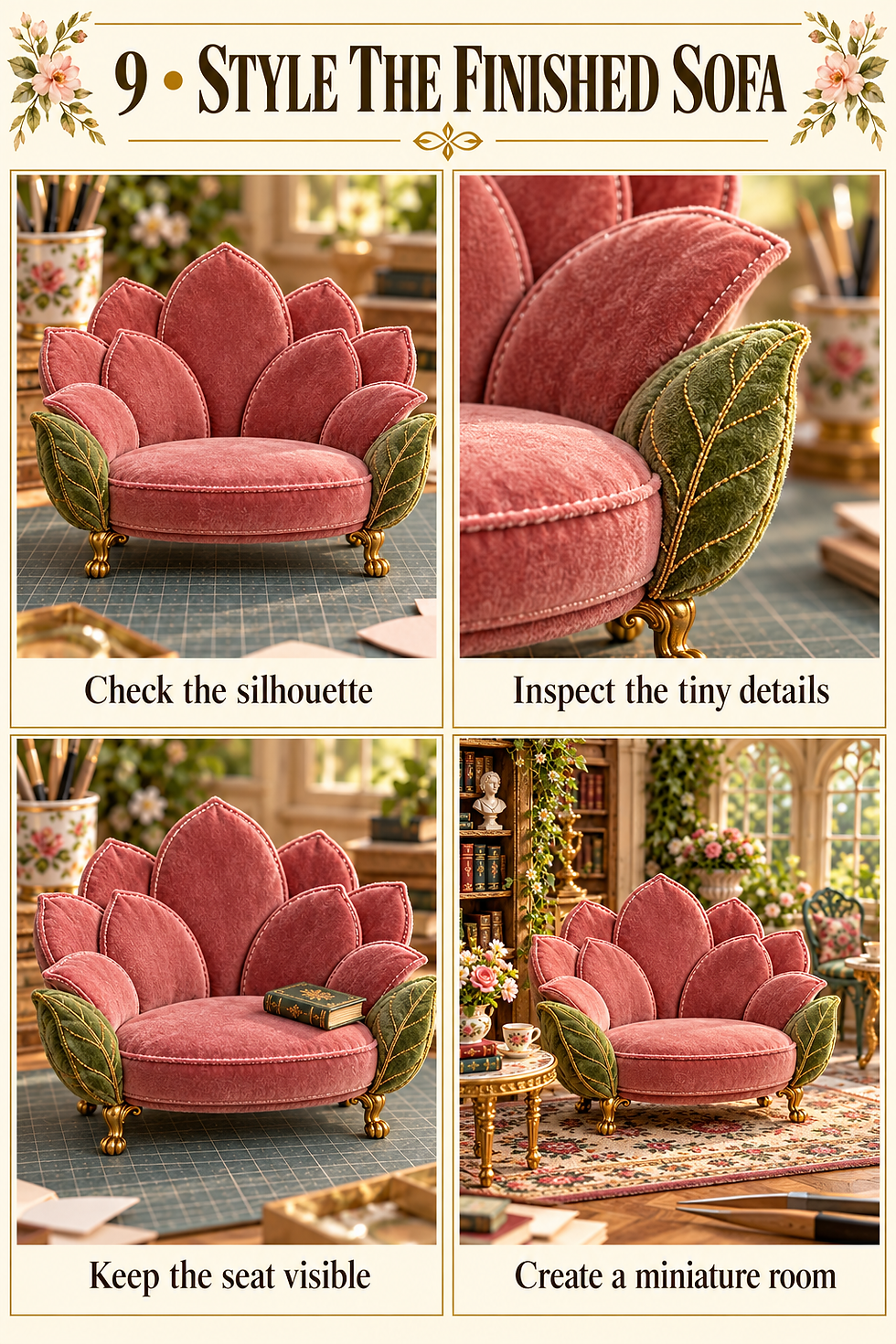
Photograph from a low three-quarter angle so the layers and seat depth remain visible. Use soft light from one side and a plain light card opposite if the leaf arms disappear into shadow. Avoid placing a bright reflection on the gold feet or flooding the velvet with direct flash.
Take a separate close-up of one petal edge and one leaf arm. For a workshop image, show the actual tabletop setup and the miniature's physical boundaries. A shallow depth of field can be attractive, but keep enough of the sofa sharp for readers to understand its construction.

Small Problems, Sensible Fixes
The petals look like stuffed mittens. Reduce the padding and use thinner fabric. Keep the edges and attachment zones flatter than the centers.
One petal looks a different color. Check its pile direction under consistent light before assuming the fabric is a different shade. Re-cover a test piece rather than trying to hide the difference with paint.
The flower has swallowed the seat. Move the supporting back outward if the structure allows, reduce the forward overlap, or revise the templates. Check the back and petal spacing before adjusting the cushion depth, so the seat and flower settle comfortably together.
The arms bend when touched. Strengthen their concealed bases and improve their contact with the frame. Treat the leaf tips as delicate decorative details.
Glue shows through the fabric. Stop and test a smaller application or a different compatible covering method on scraps. A clear-drying adhesive can still change a fabric's appearance.
The sofa rocks. Check the rigid base for a twist and compare the feet on a flat surface. Correct the structural cause before covering the underside.
Anavrin’s Eternal Midnight Paris book nook brings theatrical Parisian atmosphere to a favorite shelf. It’s an inviting gift for someone whose collection could use a little after-dark charm. This limited-edition kit is excluded from the offer.

Three Ways to Change the Mood
For a quiet rose-garden version, keep the dusty-pink petals and soften the green toward sage. Use a simple cream setting and a single floral cup nearby.
For a jewel-box library, try deep raspberry petals, forest-green leaves and warm antique gold. Dark shelves and small gilt frames make an inviting background without requiring more ornament on the sofa itself.
For a fresh spring room, explore pale peach or creamy yellow with olive leaves. Test the colors together in the actual room before cutting the upholstery. Small fabric scraps tell you more than a paint name on a screen.
Until Next Time in the Small World
My favorite detail is the way the leaf arms turn a familiar piece of furniture into a little garden. You could simplify the feet, change the room or choose a completely different fabric, and that flower silhouette would still do the work.
Would you choose dusty rose, deep raspberry or a pale spring yellow for yours? Tell me in the comments, and share your miniature experiments with #smallworldminiatures. There is always room in this tiny world for one more delightfully impractical-looking, carefully planned sofa.








Comments