



A Gaudí-Day in the Greenhouse: A Whimsical Miniature Art Nouveau Plant Shop That Blooms After Dark
Updated: Oct 12

Opening – First Impressions in Miniature
You know that feeling when you spot a miniature and your brain instantly goes, “I would move in there immediately”? That’s me with this Gaudí-style Art Nouveau miniature plant and floral shop. The curves are doing acrobatics. The windows are glowing like a cozy secret. And the whole place looks like it smells faintly of jasmine, terracotta dust, and excellent life choices.
Also—if you keep reading—I’m going to walk you through a full “make your own magic” build guide later in the post (the inspirational kind, not the “measure 3.7mm or perish” kind). For now, just enjoy this tiny architectural daydream with me.

Miniature Backstory – The Tiny Tale
Locals call it “La Botánica de la Curva”, founded in 1908 on the very day a traveling architect allegedly sneezed mid-sketch and accidentally invented three new types of archways.
The shop started as a humble stall selling rosemary bundles and “mood geraniums” (plants that look disappointed in you if you don’t water them on schedule). Over time, it grew into a full-blown floral sanctuary where wedding bouquets are engineered like couture gowns and houseplants are adopted like slightly judgmental pets.
The current proprietor—Maribel “Mossfingers” Soria—is famous for two things:
She can revive a dying fern using only encouraging whispers and a tiny teacup of rainwater.
She refuses to sell cacti to people who say, “I just want something I can ignore.”

And then there are the regulars:
Tío Pollen, an elderly gentleman who claims he’s “allergic to modern architecture” and dramatically sneezes whenever he sees a straight line.
The Balcony Committee, a rotating cast of potted succulents who gossip via subtle leaf angle changes.
Señor Caracol, a snail who moves so slowly he’s technically been “checking out” for three years.
Easter egg to spot: Rumor says Maribel hid a tiny ceramic sun tile somewhere on the building as a good-luck charm—because in this neighborhood, you don’t open a shop without bribing the universe a little.
(Keep that in mind during the tour… because this building absolutely has “secret tiny detail” energy.)
A Guided Tour of the Build
Let’s step closer—careful, your imagination may trip over how charming this is.
The first thing you notice is the architecture behaving like warm bread dough—soft, rounded, and joyfully refusing to be squared up. The façade ripples with organic movement, like the whole shop is mid-stretch after a long nap in the sun.

The stucco-like exterior has that hand-touched, weather-kissed feeling—speckled with playful color like it was lightly splattered by an artist who got distracted by a bouquet halfway through. Little mosaic-style accents dance across the walls, and the roof looks like it was tiled by someone who said, “Yes, but what if the roof also had personality?”

Then the windows: big, rounded, and glowing amber from inside, as if the shop is permanently set to “golden hour.” The doors and frames lean into that deep sea-green that makes everything feel Mediterranean and dreamlike.

And oh—the plants. The glorious clutter. Pots everywhere, spilling down steps and clustering on balconies like the building is wearing a necklace made of terracotta and joy. There are spiky succulents, soft trailing greens, tiny flowering bursts—each one staged like it’s auditioning for a botanical soap opera.

The overall mood is “I’m just popping in for a tiny bouquet,” and then three hours later you’re still inside talking to a plant named Ernesto.
Inspirations – From the Big World to the Small
This miniature sits proudly in the style family tree of Antoni Gaudí and the wider Art Nouveau movement—where straight lines are strongly discouraged and everything is allowed to look alive.
You can feel echoes of:
Casa Batlló (Barcelona): that aquatic, bone-and-coral vibe, with windows and curves that feel grown rather than built.
Casa Milà (La Pedrera): the undulating stone-like surfaces and roofline swagger—architecture as sculpture.
Park Güell: the cheerful mosaic energy and whimsical, nature-forward ornamentation.
And beyond Gaudí, it nods toward other Art Nouveau legends:
Victor Horta (Belgium): the flowing, plant-like structural rhythm—design that moves like vines.
Hector Guimard (France): those iconic metro entrances where ironwork becomes botanical calligraphy.

What’s magical here is how those big-world influences translate in miniature scale: curves become more intimate, color becomes more concentrated, and “ornament” becomes “story.” In a full-size building, you admire the craftsmanship. In a miniature, you feel like you could knock on the door and get offered tea.
Artist Tips – Make Your Own Magic
Picture it: you’re at your workbench. The playlist is dramatic. The glue is open. Your snack is suspiciously close to your paint water. This is your moment.
Before we begin—this is inspiration, not a carbon-copy blueprint. Your version will (and should) come out with its own quirks. Honestly, half the fun is when a curve turns out better than you planned… or when your “two perfect windows” become “three charming windows and one that looks like it’s seen things.” That’s part of the miniature lifestyle. Let your results vary. Let the tiny world surprise you.
Shopping List
The “Use What You’ve Got” Pantry Raid (first!)
Chipboard/cereal box cardboard (walls, templates)
Toothpicks / coffee stirrers (trim, railings, trellis bits)
Aluminum foil (impressed texture, leaf shaping)
Egg carton (organic stone/stucco texture when torn and layered)
Clear plastic packaging (window glazing)
Bottle caps + beads (pots, finials, knobs)
Old gift cards (spreaders for paste, clean edges)
Tea strainer mesh (grates, screens, tiny vent textures)

Purchasable equivalents (Click the affiliate links to purchase on Amazon)
Tools

Deep Dive: Build Steps (Inspiration Edition)
Safety first (tiny world, real tools)
Cut away from your hands, always.
Ventilate if you’re sanding foam, using sprays, or heating anything.
If you’re using a hot wire cutter: treat fumes like villains—don’t invite them into your lungs.
Wear eye protection when drilling tiny parts (the “ping!” is real).
Planning & scale notes
Choose a scale (1:12 dollhouse, 1:24, or even “storybook scale”).
Sketch the silhouette: Gaudí-style = asymmetry with confidence.
Plan 1–2 “hero angles” for photos (front 3/4 view is king).
Keep door height consistent; let curves go wild around it.

Bones (base structure)
Build a simple core box first (foam board or XPS).
Add curved “bulges” using stacked foam/card layers—think: ribs, not bricks.
Smooth transitions with lightweight spackle or modeling paste.
Don’t chase perfection. Gaudí wouldn’t. Neither should you.

Windows and doors
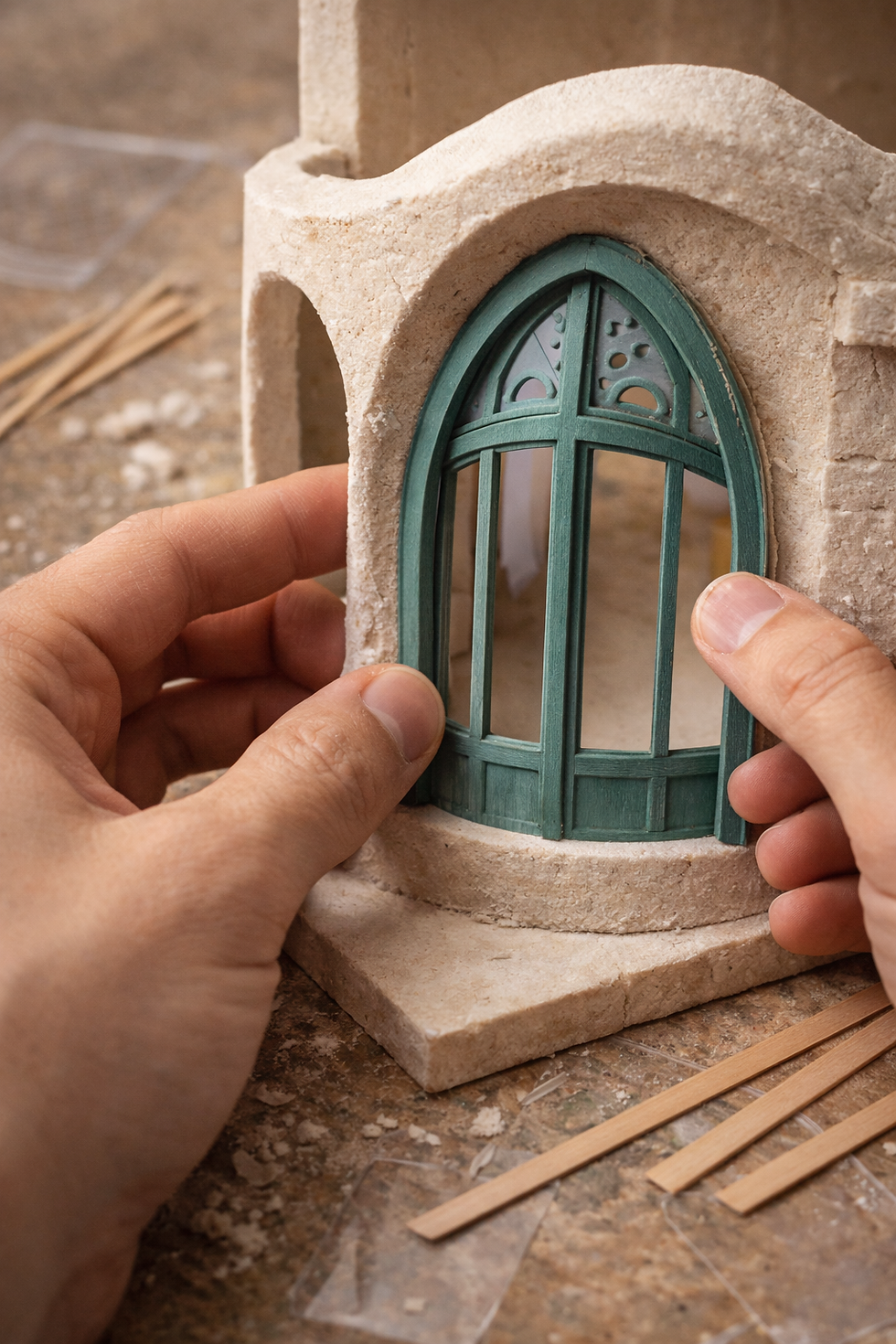
For that Art Nouveau softness, use arched or oval openings.
Frames: coffee stirrers or thin basswood bent gently (or laminated in thin strips).
Window “glass”: clear packaging plastic. Add a micro haze with a tiny rub of matte varnish if you want dreamy diffusion.
Paint frames in a sea-green mix: 2 parts deep teal + 1 part dark green + a touch of black, then highlight with lighter teal.
Finishes, base color, materials, weather stack
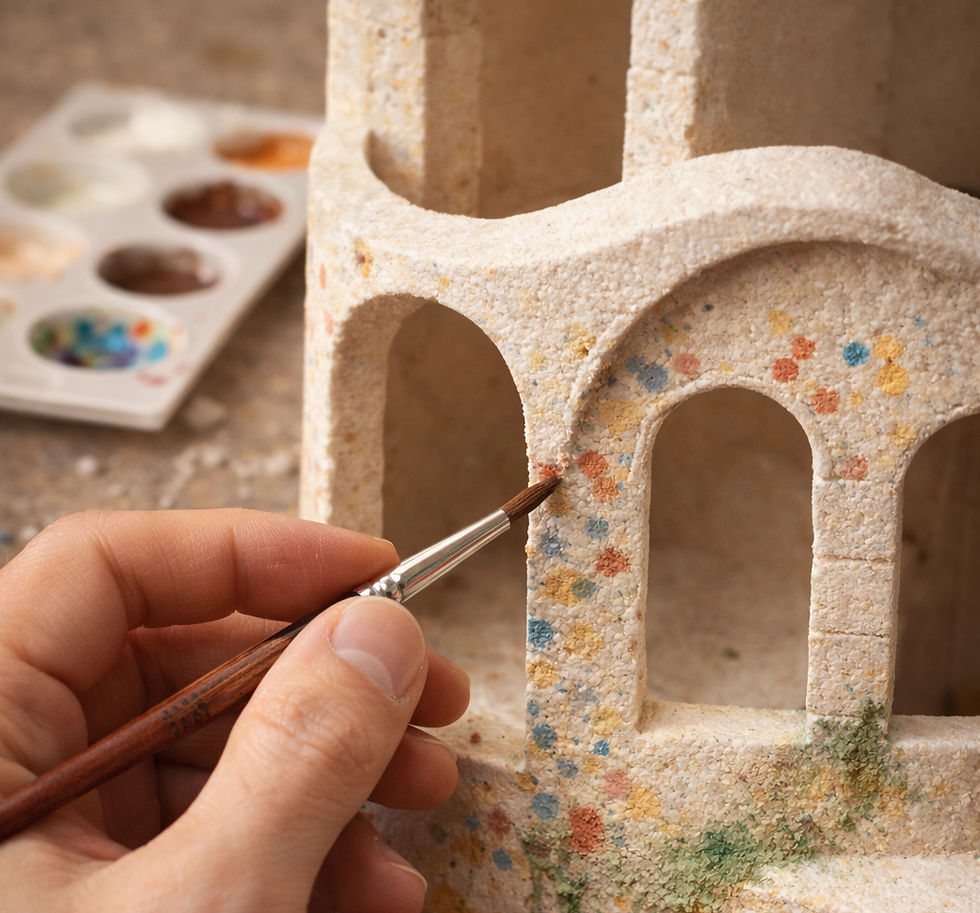
Stucco base: warm ivory
Try: 3 parts warm white + 1 part raw umber + a whisper of peach.
Speckled mosaic charm: dot on coral, cobalt, sunny ochre, and muted turquoise—keep it playful, not polka-party.
Weathering:
Wash in crevices: 1 part burnt umber + 6–8 parts water (or acrylic medium).
Drybrush highlights: warm white with a pinch of sand color.
Add subtle green staining near pots and drains (thin olive glaze).
How to make the tiles (several good options):
Air-dry clay “pillow tiles” (fast + charming):Roll out a thin sheet (think “credit-card thin”), let it firm up for 10–20 minutes, then slice tiny squares/rounded squares with a hobby blade. Press each tile gently with your fingertip so it gets that soft, handmade “Gaudí loaf” puff. Let dry fully.
Baked polymer clay tiles (crisper edges + durable):Same method as above, but bake on a smooth tile/ceramic sheet so they stay flatter. Great if you want consistent thickness and less chipping.
Painted card tiles (super budget + surprisingly good):Cut tiny squares from cereal box cardboard, seal with diluted glue, then paint in roof tones. This reads beautifully at 1:12 once you grout and weather.

Placement trick (the secret sauce):
Work in small zones and follow the curve like shingles: start at the lower edge and “climb” upward in staggered rows.
Mix colors as you go—don’t group all the blues together. Think: salt-and-pepper, not a checkerboard.
Utilities and/or greebles
Tiny drainpipes, vents, brackets, hooks—these make it feel real.
Use wire, toothpicks, bits of sprue, or jewelry findings.
Paint metal bits with a dark base and a soft rust stipple: brown + orange + a touch of black.

Furniture/soft goods
Inside the shop: suggest shapes more than details.
Tiny shelves, a worktable, maybe a micro bouquet station.
Fabric scraps become awnings or curtains—tea-dyed cloth is instant vintage.

Lighting (keep it simple)
Use USB-powered warm white micro LEDs (look for 2700K–3000K).
Diffuse harsh points with parchment paper or thin white plastic behind windows.
Hide wires in the base or behind a “planter wall.”
Story clutter/Easter eggs
Mini watering can, scissors, seed packets, a tiny chalkboard sign.
Add one secret: a sun tile, a tiny snail, a hidden shop cat silhouette—something viewers discover on their second look.

Unifying glaze/filter + finish
When everything looks “separate,” unify with a thin dusty glaze:
1 part tan + 10 parts water/medium, brushed lightly over lower areas.
Seal with matte varnish, then selectively gloss windows and wet pots.
Photo tips (make it look life-sized)
Background: simple plaster wall, soft gradient paper, or outdoor greenery blur.
Light: one warm key light + a softer fill.
Shoot low, near “street level” to sell the illusion.
Add foreground leaves for cinematic framing (instant realism).

Troubleshooting (problem → fix)
My stucco looks like cottage cheese. → Sand lightly when dry, then add a thinner skim coat.
My curves look lumpy. → Use layered thin pieces instead of one thick slab; smooth with paste in stages.
Paint feels too bright/toy-like. → Add a dusty glaze and deepen shadows with a thin brown wash.
Plants look fake. → Mix textures (tufts + punched leaves + fine foam). Vary greens with yellow/olive glazes.
Windows look flat. → Add a thin highlight on frames and a tiny gloss hit on the glass edges.
Lighting is too “interrogation room.” → Diffuse the LEDs and switch to warmer temperature.
Closing – Until Next Time in the Small World
So that’s La Botánica de la Curva—a Gaudí-kissed miniature plant shop where the walls wiggle with joy, the roof tiles gossip in color, and the succulents definitely have opinions.
Now I want to hear from you: what’s your favorite detail? The glowing windows? The balcony jungle? The “this building is secretly alive” vibes? Drop it in the comments—and if you build your own Art Nouveau miniature storefront, tag it with #smallworldminiatures so I can cheer wildly from my tiny sidewalk.
If you want more mini tours, build guides, and behind-the-scenes chaos, sign up for the newsletter—and take a stroll through our online shop while you’re at it.
Until next time—keep your blades sharp, your glue capped, and your plants only slightly judgmental.
—Brandon
#miniature #miniatures #miniatureart #miniaturebuilding #dollhouseminiatures #miniaturediorama #artnouveau #gaudiinspired #miniatureflorist #miniatureplants #tinyworld #handmademiniatures #modelmaking #scalemodel #miniaturearchitecture #dioramabuild #terrainbuilding #miniaturecollector #miniaturephotography #crafting #makersgonnamake #creativehobby #tabletopscenery #tinyshop #fantasyminiatures #miniaturegarden #mixedmediaart #miniaturedesign







Comments