



Tinsel, Fallout, and a Twelve-Inch Snowdrift: A 1950s Post-Apocalyptic Living Room Miniature Diorama
Updated: Aug 25, 2025
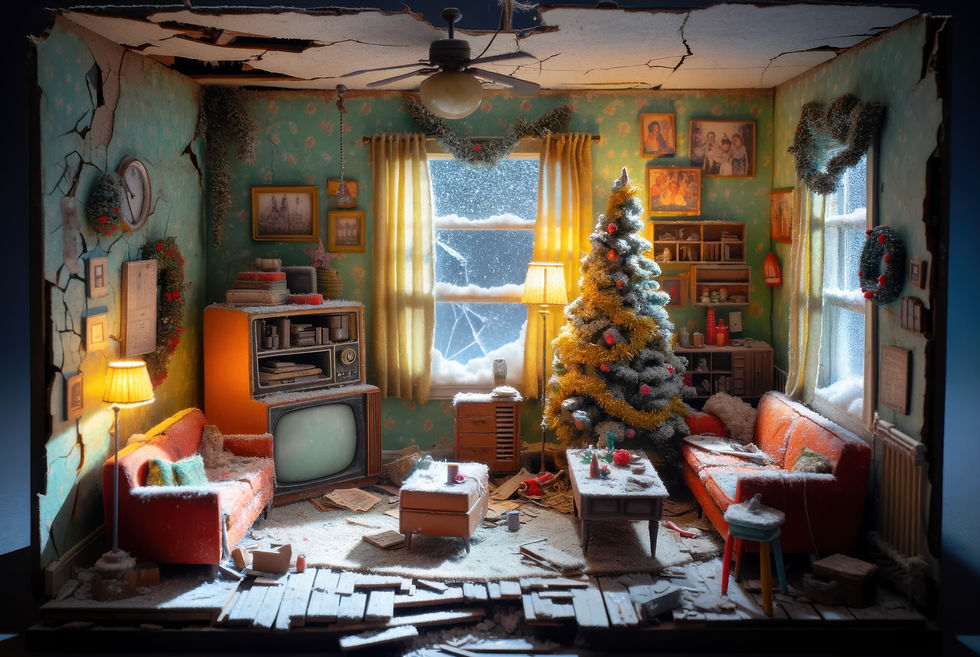
Hi, I’m Brandon from Small World Miniatures, and today I’m giving the red-carpet treatment to a scene that looks like Grandma’s 1958 Christmas party collided with a soft-spoken winter apocalypse and then decided to keep the tinsel anyway. Think miniature mid-century living room, cracked plaster wallpaper in minty florals, a heroic aluminum-tinsel tree, and a vintage TV that still believes “I Love Lucy” might come back after the next blizzard. The floorboards heave, the ceiling sags, and miniature frosted windows are rimmed with snow like a cake that forgot when to stop. It’s a post-apocalyptic dollhouse diorama with manners—and yes, it brought cookies.
Before we go any further, a quick shout-out about the image you’re seeing here: you’re looking at a web-optimized photo—perfect for browsing, not meant for forensic zooming on the electrical tape behind the lamp. If this scene hits your nostalgia button (and your bunker décor needs a little cheer), you can order a pro, high-res canvas print—gallery-wrapped, true-to-color—with FREE U.S. shipping. Hang it above your real-world radiator to remember the season when we all learned snow can drift across the living room if you believe hard enough (and if the window’s cracked). https://www.smallworldminiatures.com/product-page/post-apocalyptic-christmas-in-the-1950s-diorama-canvas-print

The Tiny Tale (Backstory)
Once upon a time, in the tidy town of Evergreen Heights, apartment 3B belonged to Nellie Finch, a switchboard operator with a fondness for lemon bars and Bing Crosby on the radio. Every day, Nellie fluffed the tree, straightened the ornaments, and reminded her nieces to take off their galoshes. One day, the big storm rolled in—the kind of storm weather announcers describe with eyebrows. Because of that, the old radiator sputtered, the ceiling plaster started talking in hairline Venn diagrams, and the windowpanes split like rock candy. Because of that, neighbors began dropping by for warmth, stories, and the last of the party buffet, which was mostly red-and-green Jell-O and a heroic thermos of cocoa. Until finally, the living room became the neighborhood’s unofficial Holiday Refuge Room, a place where the tree stayed lit, the TV hummed (on generator fumes and hope), and someone always remembered to sweep the snow off the ottoman—well, almost always.

You’ll see little traces of the locals everywhere. The bookshelf hosts Pastor Greer’s emergency hymnals. A photo cluster on the right wall immortalizes Evergreen Heights’ bowling team, “The Split Happens.” Over the TV, there’s a framed litho of the town gazebo—if you look closely, the gazebo clock is set to 11:58, the minute the storm snapped the first power line. And hidden in the tree, one ornament is a tiny silver acorn—Nellie’s good-luck charm. (Easter egg alert: there’s also a teaspoon-sized pink flamingo ornament half-buried in snow on the coffee table. If you spot it without squinting, you’re officially in the club.)
Composition & Materials: A Walkthrough
Let’s stroll left to right like we’re tracking footprints in the drift.
Left wall: A standing lamp throws warm 3200K light across a tomato-red sofa. The wallpaper is that sea-foam-mint floral you’d swear you’ve seen in your aunt’s den—here it’s cracked in stair-step fractures, the kind modelers get by layering spackle over tissue on foam board and then flexing just enough to suggest old plaster. A school clock keeps time the way a goldfish keeps secrets. Wreaths are wire armatures with micro-foliage; the berries look like ground foam dusted with a pinch of carmine pastel.

Center left: The TV console is a star—wood-tone casing, speaker mesh, knobs that say “volume, vertical hold, destiny.” The snowy stack of magazines and records on top sells the lived-in vibe. The picture tube’s pale green glow reads as a thin pour of minty white + two drops of phthalo green (about 10:1) sealed in gloss, and the dusting of frost over the bezel is likely matte varnish + baking soda sifted through a tea strainer.
Mid-room: An ottoman is wearing a little snow beret, the coffee table is a battlefield of cups, letters, and a candle that wishes it were taller. The floorboards—their buckled, askew geometry—are probably coffee-stir sticks over foam, some lifted with a wedge and shimmed so the gaps feel dangerous-but-adorable.
Center right: The miniature Christmas tree is a glorious survivor: gold tinsel garland, pops of cherry-red ornaments, and a slouchy star. Flocking looks layered—fine sawdust + microballoons misted with PVA and finished with snow paste so the outermost layer catches light. Behind it, the frosted window shows winter’s bite: the crackle pattern implies PVA on clear acetate, scored lightly and brushed with chalky white to sit in the grooves.
Right wall: A second sofa, equally confident in its orange upholstery, faces the tree like a rival contestant. The shelf unit carries tumblers and the last of the punch. A wreath and garlands keep insisting it’s still a party. Along the baseboard, the radiator is the unspoken hero, modeled from styrene strips and greeblies, weathered to iron with graphite rub over a raw umber base.

Ceiling & edges: The ceiling fan’s globe lamplight unifies the room. Ragged edges along the ceiling reveal the armature—very likely XPS foam with a card-stock skin, distressed to show sagging joists. That exposed structure, paired with vignette-style black side walls, focuses your eye like a theater set.
Everything’s dusted with that perfect day-after blizzard powder—enough texture to hide footprints, not so much that it reads as flour. It’s a miniature that manages to be cold and cozy at once, and that’s a magic trick worth unpacking.
Artist Tips – Make Your Own Magic
You’re about to build a room that smells like cinnamon and radiator steam, even if your workshop smells like cyanoacrylate. Grab your stir sticks—we’re making tiny winter.
Quick Wins (do these first for instant results)
Snow that photographs well: 2 parts baking soda + 1 part matte Mod Podge + ½ part microballoons; sift on while tacky, mist with isopropyl to lock.
Cracked plaster cheat: Tissue + diluted PVA under a thin spackle skim; dry, flex the foam gently, seal with matte.
Frosted glass in seconds: Brush Pledge/clear gloss on acetate, let it half-cure, then drag a toothpick to “crack” it; fog with white pastel.
TV tube glow: Base mint white (10:1 white:phthalo green), add a dot of blue in the corners, gloss coat.
Tinsel sparkle: Gold or silver pipe cleaner trimmed down; hit just the tips with lemon yellow ink for warmth.

Deep Dive Build (step-by-step)
Planning & Scale Notes: Choose your scale—1:12 reads best for living rooms stuffed with props. Sketch a box 10–12" wide with a viewing window 8–9". Note your focal triangle (TV → tree → cracked window). List story beats: “party leftovers,” “snow intrudes,” “plaster fatigue,” “hope.”

Bones (Base Structure): Build a U-shaped room from ½" XPS foam on a MDF base. Wall height 8–9". Score base for floorboard layout. Ceiling is optional—but a partial lid with a fan gives you a cinematic roofline.
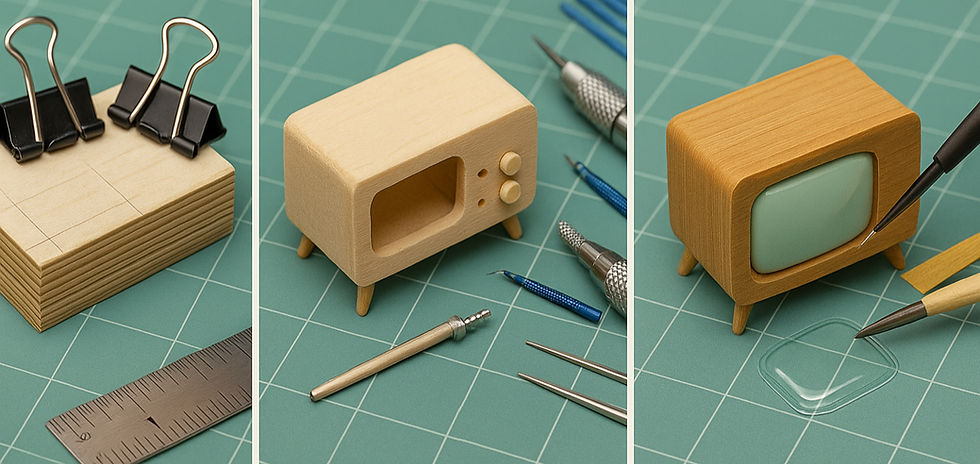
Hero Piece (Focal Point): Make the TV console first. Laminate basswood or layered card; add styrene knobs. The screen is vac-formed blister plastic back-painted. Give it a bevel with a strip of masking-tape “gasket.”
Utilities & Greebles: Radiator from stacked styrene I-beams and rod. For the fan, use a bead for the globe, toothpick arms, and card blades with a subtle bend. Greeble the bookshelf with off-cuts; jars from sprue nubs dipped in Tamiya Clear.

Furniture & Soft Goods: Sofas: Purchase pre-made or carve from foam, wrap in thin faux-leather (old notebook cover) or painted kraft paper. Cushions from makeup sponge with stitched seams drawn in pencil. Curtains from tea-stained muslin; pinch pleats with diluted PVA.

Base Colors & Materials
Walls: sea-foam green (mix: 5 white : 1 phthalo green : ½ yellow ochre).
Sofa orange: cadmium orange + a whisper of burnt sienna; glaze with sepia in creases.
Wood: raw umber base, yellow ochre drybrush, final walnut ink glaze.
Metal: black → graphite rub for burnished radiators and fan hub.
Weathering Stack (10 steps, primer → varnish)
Primer: neutral gray rattle can, light passes.
Pre-shade: black/brown in corners and under trim.
Basecoat: opaque color layers (walls, sofa, wood).
Chipping medium or hairspray where plaster/paint will fail.
Topcoat: lighter tint; lift with damp brush for chips.
Oil pin wash: burnt umber around panels and floor gaps.
Streaking: vertical oil streaks; soften with odorless thinner.
Drybrush: light ivory on edges and wood grain.
Pigments: cold gray around snow entry points; fix with alcohol.
Matte varnish: overall seal; spot gloss for the TV and melted snow.
Lighting (simple & cozy): Use USB-powered mini LED strands. Warm lights (2700–3200K) for lamps and tree; a cooler (5000K) strip behind the window to sell the blizzard. Diffuse with parchment paper. Route wires through a hollow base channel; hide junctions behind the TV.

Snow & Frost Effects: Lay a thin PVA map where drifts settle—corners, sill, ottoman, coffee table. Sprinkle the snow mix (see Quick Wins). Add clear gloss puddles along floorboard seams. For fresh fluff on the tree, touch with gloss PVA and puff microballoons from a straw.

Story Clutter & Easter Eggs: Toss in rolled magazines (print at 50–60% scale), a 1958 calendar stuck on December, and a tiny pink flamingo ornament on the coffee table under a sugar drift. Hide a miniature matchbook from “Split Happens Lanes.”

Distress & Decay Pass
Break it on purpose—but in scale. You’re aiming for “the party survived, the building didn’t.”
Map the damage first: Lightly pencil a decay map—heaviest at the ceiling edge/roofline, window wall, and floor seams. Keep 30–40% of the room clean so the wreckage has contrast.
Plaster failure: Over your wall topcoat, dab hairspray/chipping medium where plaster would pop. Lift chips with low-tack tape and a toothpick. Sprinkle a rubble mix (crumbled spackle + tea leaves + sawdust, misted with 50/50 PVA–water) under breaks.
Torn wallpaper curl: Dampen the paper edge with clean water; tease it up with a blade; stain the underside with a thin raw umber wash (1:10). Add a gentle curl with a quick waft of warm air (hair dryer, low and distant).
Exposed lath/joists: Glue coffee-stir sticks as lath behind missing plaster, spaced ~⅛" apart. Streak with a vertical black/burnt umber oil mix, then knock back with a drybrush of light tan.
Buckled floorboards: Slip a thin wedge under a few boards; shade gaps with a Payne’s gray pin wash. Add clear gloss along seams for “meltwater” meniscus.
Window damage: Scribe hairline cracks in acetate; lean a tiny “fallen shard” on the sill. Dust edges with chalky white for frost; seal matte.
Soot, rust, and water tracks: From the fan canopy, radiator valve, and window mullions, pull downward streaks with a 1:8 burnt umber + Payne’s gray oil mix; soften with thinner. Dot sap green + a touch of black (1:10) into cold corners for mildew, then feather.
Soft goods age: Scuff cushion corners with 1000-grit, add a single loose “thread” (frayed brush fiber). Light tea stain tide lines at curtain bottoms.
Snow logic: Heavier drifts in corners, under cracks, and on sills; almost none mid-floor. Pepper with a few plaster crumbs so the snow feels invaded, not sprinkled.
Restraint pass: Squint. If decay steals the story, glaze back with base colors and selective matte to reclaim the focal triangle.

Unifying Glaze/Filter + Finish: To harmonize colors, mist a very thin cool gray filter (airbrush: 1 drop neutral gray + 10 drops thinner). It widens the temperature gap between warm lamps and cold snow. Final dusting of pastel on high points, then a last matte coat.
Photo Tips: Shoot at f/11–f/16 for depth; use one warm key light and a cool backlight through the window. A 5-in white card makes a perfect bounce. Place the camera low—eye level with the sofa—to make the room feel human scale.

Troubleshooting (problem → fix)
Snow turns yellowish: Your varnish reacted. Switch to water-based matte; isolate with an acrylic barrier before pigments.
Frost looks chalky blobs: You applied too wet. Let gloss half-cure, then dust pastel—don’t paint white directly.
Cracked plaster too dramatic: Sand lightly and repaint; add hairline pencil veins instead of deep fissures.
LED hotspots visible: Diffuse with two layers of tracing paper; increase the distance between LED and shade.
Furniture looks toy-like: Break symmetry—sag a cushion, stain a cup ring, add a stray thread to the armrest.
Mini Shopping List (clever reuse first)
Coffee-stir sticks (or basswood strips) – for floorboards.
Cereal-box card (or mat board) – TV case, shelving.
Old notebook cover (or faux-leather sheet) – sofa upholstery.
Blister-pack plastic (or clear styrene sheet) – TV tube & windows.
Sawdust/tea leaves (or Woodland Scenics flock) – tree flock & debris.
Baking soda + microballoons (or AK Snow/Vallejo Snow) – snow mix.
Makeup sponge (or foam sheet) – cushions.
Pipe cleaners (or metal tinsel garland) – tree tinsel.
Toothpicks & beads (or styrene rod & domes) – ceiling fan.
Muslin scrap (or model fabric) – curtains.
Graphite pencil (or powdered graphite) – metallic burnish.
USB micro-LED string (or 12V LED kit) – lighting.
Safety first: Ventilate when spraying or using oils, wear nitrile gloves, and throw on eye protection when you start snapping styrene like a tiny lumberjack.
Inspirations – From the Big World to the Small
This little room sits in the family tree of mid-century modern Americana. The Eames approach to warm, functional living shows up in the pared-down shapes of the cabinets and the honest material “read”—wood looks like wood, plastic leans into its sheen. The rounded TV cabinet whispers Saarinen’s love for smooth, organic lines. For mood, think Edward Hopper meets Wes Anderson—lonely light pools, curated clutter, and a color script that nudges memory rather than replicates it. In miniature, we borrow the gesture of mid-century design (bold hues, simple geometry, optimism) and then contrast it with weathering—the way real time softens edges and settles dust in corners. That friction—the cheerful orange sofa under a cracked mint wall—is why the scene sings.

If you’re hunting other mini builds for cross-pollination, look up miniature mid-century TV consoles, miniature cracked plaster walls, and tiny Christmas tree dioramas. Your goal isn’t duplication; it’s understanding the style DNA—then mutating it just enough to fit your story.
Closing – Until Next Time in the Small World
Somewhere in Evergreen Heights, Nellie’s tree is still shedding a polite blizzard onto the coffee table, and the bowling team is promising to fix that window “right after one more cup of cocoa.” If this snowy 1950s miniature living room diorama warmed your apocalypse, tell me your favorite tiny detail in the comments—was it the TV glow, the floofy tinsel, or the pink flamingo doing its best impression of a snowplow?
Share your own winter builds with #smallworldminiatures so I can cheer you on (and gently encourage you to add one more cup ring to the table). Want more behind-the-scenes tricks, tool tests, and build-along chaos? Sign up for the newsletter—I send notes when new tutorials and print drops go live.
Hashtags
#SmallWorldMiniatures #MiniatureDiorama #MiniatureArt #DollhouseMiniatures #PostApocalypticArt #MidCenturyModern #MiniatureLivingRoom #ScaleModel #MiniatureChristmas #TinyDetails #ModelMaking #DioramaArt #Weathering #MiniatureFurniture #CraftTips #HandmadeMiniatures #ArtOfMiniatures #DioramaCommunity #ModelBuilder #MiniaturePhotography #FoamCraft #Kitbash #MiniatureSnow #MiniatureLighting #ScaleModeling #MiniatureStorytelling #CozyApocalypse #1950sDesign #MidcenturyMood #TinyHomeVibes








Comments