



Under Quiet Suns: A Mandalorian-Inspired Sci-Fi Cabin Miniature Diorama in Desert Concrete
First Impressions in Miniature
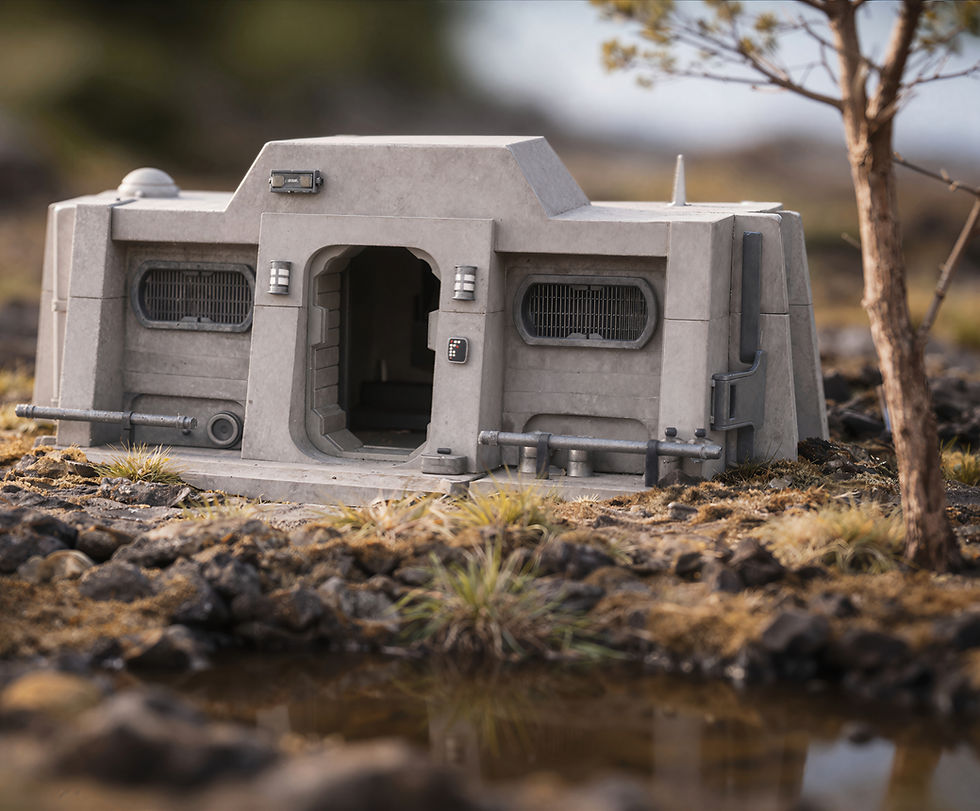
This miniature gives you that calm, mysterious frontier stare like it already knows your ship needs repairs, your boots are dusty, and your snack situation is getting desperate.
I love this little sci-fi home because it lands in that sweet spot between brutalist bunker, desert hideout, and humble “please don’t ask what’s in the back room” frontier cabin. The concrete form feels solid and ancient, the black vents and utility lines give it just enough machine logic, and the rocky shoreline in front makes the whole thing feel like it was dropped onto some far-off world where rent is surprisingly reasonable but the weather is emotionally complicated. And yes, I’m a lifelong sci-fi guy, so a Mandalorian-inspired miniature like this hits me right in the childhood part of my brain that always dreamed the future would be cooler, stranger, and full of practical concrete houses with mysterious doorways.

Stick with me, because later in this post I’m going to walk you through how I’d approach building something in this spirit yourself. Not as sacred canon blueprints handed down from a star temple, but as a real-world miniature guide you can actually use.
Why This Photo Needs VIP Treatment
This image is optimized for the web, which is perfect for admiring it on your screen while pretending you’re just “taking a quick look” before losing forty-five minutes to tiny architecture. But if you want the rich detail, the soft desert light, and those moody concrete textures to really sing, this piece deserves the high-res treatment as a professional canvas print.

That version is the fancy one. The “clear a wall and act casual when guests ask where you got it” one. And yes, FREE U.S. shipping makes it even easier to welcome a little sci-fi serenity into your actual full-size home. https://www.smallworldminiatures.com/product-page/mandalorian-inspired-sci-fi-cabin-miniature-canvas-print
The Story Behind the Cabin
One reason I love this miniature so much is that it instantly pulls me back into The Mandalorian, one of my favorite parts of the Star Wars universe. The series follows Din Djarin, a lone Mandalorian bounty hunter traveling through the galaxy after the fall of the Empire. What starts as a rough-and-tumble sci-fi western turns into something much more heartfelt when he meets Grogu—and yes, I still lovingly think of him as baby Yoda.

What makes the show fit so well into Star Wars lore is where it sits in the timeline. It lives in that fascinating stretch after Return of the Jedi, when the Empire is gone but the galaxy is still unstable, dangerous, and full of unfinished stories. It also connects beautifully to the bigger Star Wars world through Mandalorian culture, scattered clans, and the long history of Mandalore itself.
That’s why this little cabin works so well as inspiration. It has that same grounded, frontier-world feeling the show does—weathered, practical, quiet, and just mysterious enough to feel like someone important stepped out only a minute ago.
A Guided Tour of the Build
What I love first is the silhouette. This isn’t a fussy building. It’s a chunky, low, practical form with enough stepping in the massing to keep it interesting but not so much that it starts showing off. The central entry block pushes forward like a quiet statement. The taller roof volume behind it gives the cabin a little authority. Not palace authority. More like “I own a toolkit and don’t scare easily” authority.
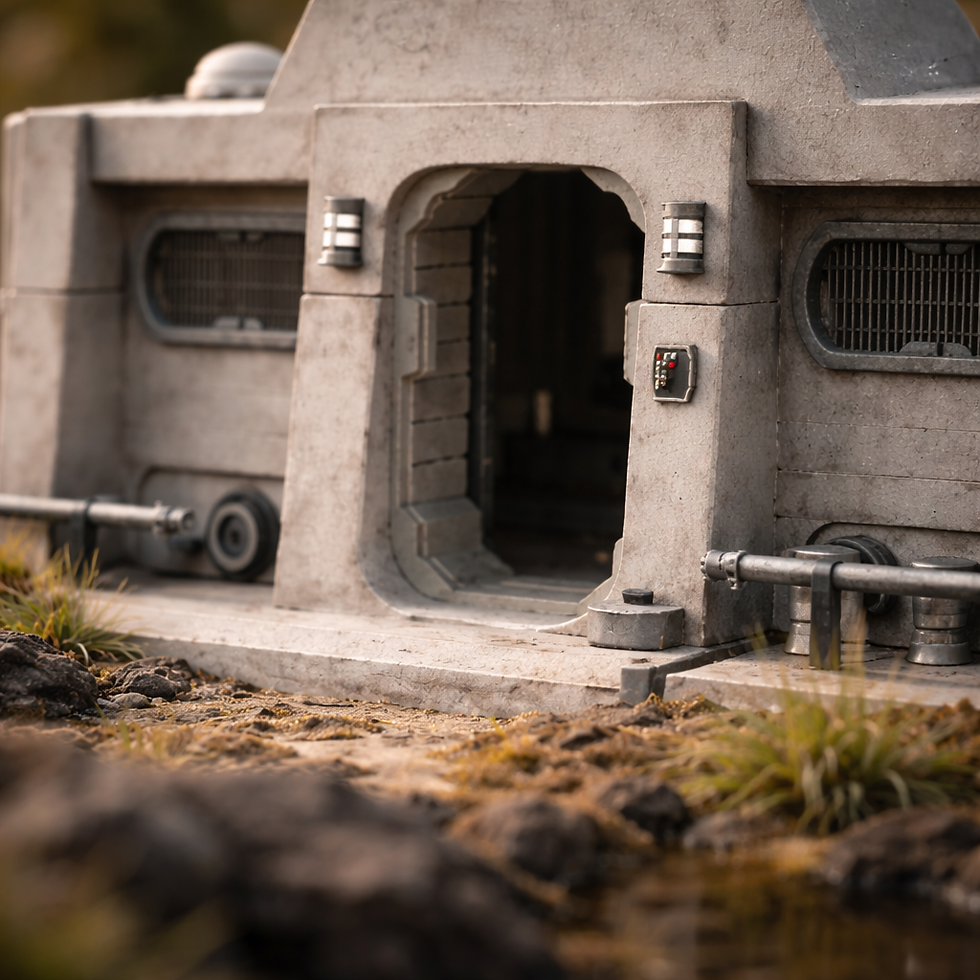
Then your eye drops to the surface. The concrete reads beautifully here—soft, pale, sun-baked, slightly powdery, with just enough tonal variation to suggest years of wind, heat, and grit. It doesn’t look pristine, which is exactly right. A house on a remote world shouldn’t feel fresh from a luxury development brochure. It should feel settled. Earned. A little weathered around the edges, like it has opinions.

The dark vent grilles are a great counterpoint to all that pale mass. They behave almost like eyes, giving the facade a face without making the building cartoonish. The doorway is the real mood-maker, though. That deep shadow in the center is what sells the mystery. You don’t need to see the whole interior. In fact, it’s better if you don’t. Your brain does the fun part and fills in crates, tools, a low hum, and maybe one suspiciously expensive helmet sitting just out of frame.

The site work does a lot of storytelling, too. Those black rocks feel volcanic and ancient. The scrubby grasses soften the scene without making it cute. The water at the front edge is such a smart touch because it gives the model contrast: hard against soft, matte against reflective, built against natural. And that tree on the right? Perfect. It keeps the environment from reading as a set dressing afterthought. Suddenly this is not just a building. It is a place with wind, seasons, shade, and the occasional creature making regrettable choices near the pond.

Inspirations – From the Big World to the Small
This little cabin may live in sci-fi territory, but its architectural family tree has real roots.
The first branch I see is Frank Lloyd Wright’s Taliesin West. Not because this model copies Wright directly, but because it shares that desert-born instinct to stay low, stay grounded, and let architecture feel like it belongs to heat and horizon.
Taliesin West has that wonderful sense of shelter made from landscape logic rather than decoration. This miniature does something similar. The massing feels protective. The overhangs and recesses feel useful, not ornamental. In miniature scale, that matters even more, because every line has to earn its keep.

The second influence I’d place nearby is Paolo Soleri’s Arcosanti. Again, not as a one-to-one match, but in the broader spirit of desert futurism. Arcosanti has those sculptural concrete forms that feel both ancient and speculative, as if archaeology and tomorrow shook hands. That’s exactly the emotional territory this tiny cabin occupies. It feels futuristic, but not glossy. Civilized, but weather-beaten. Advanced, but still very much at the mercy of dust, sun, and improvised repairs.
The third name I’d bring into the room is Tadao Ando. This is less about formal resemblance and more about material attitude. Ando understands that concrete can feel serene, spiritual, and deeply atmospheric when light is allowed to do the heavy lifting. That’s a lesson miniaturists can borrow all day long. On a model like this, the concrete surface is not just a color. It’s a stage for shadows, edge wear, and soft daylight. When the finish is handled well, the whole piece becomes quieter and more convincing.
Artist Tips – Make Your Own Magic
You are not building an exact replica here. You are chasing a feeling: frontier calm, sci-fi practicality, and the kind of structure that looks like it has survived wind, grit, and at least three generations of questionable repairs. Treat this as inspiration, not a sacred reproduction guide. I write these blog posts myself, but some of the illustrations on Small World Miniatures begin life in my little AI holodeck, and every now and then the robots get wonderfully weird and invent a pipe that goes nowhere or a doorway that probably violates physics. So use this guide as a map, not a legal document filed with the galactic zoning office.
Shopping List
I always like to start with the scavenger-hunt version first, because half the fun of miniature making is looking at ordinary junk and thinking, “Congratulations, you are now a vent.”

Around-the-house finds
Cereal box card or chipboard for templates and mockups
Packaging foam or dense shipping inserts for terrain tests
Plastic straws, old pen barrels, cotton swab sticks, and cable insulation for pipes
Tea bag mesh, produce bag mesh, or old speaker fabric for vent grilles
Sand, coffee grounds, aquarium gravel, bark chips, and dried moss for terrain texture
Clear blister packaging for lenses or protective covers
Easy store-bought equivalents
Model train mesh or etched grilles
Fine ballast, pumice, terrain paste, static grass, and tufts
Acrylic gel medium or resin water product
Paint and finish basics
Black gesso or primer
Warm light gray, neutral gray, beige, off-white, charcoal, and a touch of brown-green
Matte medium, glazing medium, and matte varnish
Weathering powders or soft pastel dust
Lighting and photo helpers
USB mini LED strand or a single warm micro LED
Tracing paper or frosted tape for diffusion
Small tripod or phone stand
Printed desert backdrop, neutral paper sweep, or simply a real outdoor setting with shallow depth of field
I’ve linked Amazon affiliate links where it makes sense. Buy through those and you help keep the tiny power grid humming, which is much appreciated by me and, presumably, Brim the kettle droid.
Deep Dive
1. Start with planning, scale, and safety:
Pick a scale that gives you room to breathe. For a cabin like this, 1:24 or 1:35 feels great if you want it to read as a handcrafted collectible without swallowing your desk. Sketch the overall facade first: broad shape, doorway placement, vent positions, side utility lines, and terrain edge. Keep the proportions chunky. This architecture wants mass, not fuss.Safety-wise, put on a dust mask when sanding foam or MDF, ventilate if you’re spraying primer or varnish, and wear eye protection when cutting rod or wire. Tiny buildings are cute. Tiny lung problems are not.
2. Build the bones before you chase the details:
Mock the whole structure in cheap card first. Seriously. It will save you from discovering too late that your doorway is the size of a pantry for ants. Once the proportions feel right, transfer the shapes to foam board, PVC foam sheet, basswood laminate, or layered chipboard.The key move here is stepping the facade. Let the entry block project forward. Give the upper central mass a slight rise. Keep the wings lower and broader. You want the silhouette to read in two seconds from across the room.

3. Cut the doorway and front openings with depth in mind:
The front portal is your hero cutout. Make it tall, recessed, and a little more rounded than a standard house door. This isn’t suburban science fiction; it’s frontier sci-fi, so the shapes should feel practical but softened by wear. For the vent openings, build a shallow recess, then insert mesh or finely spaced strip material behind a frame. Even if the vents are purely decorative, treat them like they matter. Fake utility becomes believable architecture when repeated consistently.

4. Create the site plan early, especially the shoreline:
This build lives or dies by the relationship between structure and ground. Set the cabin slightly back on the base so you have room for a rocky foreground and that reflective water edge. Use torn bark, lava rock, cork, pumice, or sculpted foam painted dark charcoal to suggest volcanic stone. Add sparse grass tufts in clumps, not evenly distributed like a suburban lawn. This is rugged terrain. Nature should look opportunistic here, not landscaped. The water can be a shallow depression sealed with gloss medium or resin, but even a simple gloss puddle can work if the composition is strong.

5. Dial in the concrete finish with a layered paint stack:
For the main wall color, start with something like 4 parts warm light gray, 1 part beige, and a small touch of black. You want pale concrete, not refrigerator gray. Stipple and sponge the first coat instead of brushing it perfectly smooth. That gives the surface a mineral softness. Then glaze in very thin passes of slightly darker gray near recesses, under ledges, around vents, and near the base where dust and moisture would gather. Drybrush a whisper of off-white across edges that catch hard sun. If it starts looking chalky, knock it back with a translucent warm-gray filter. Concrete should feel quiet, not frosted.

6. Make the doorway the focal point:
The dark doorway is what makes the whole facade breathe. Paint the interior recess almost black, but not dead black. I like a sooty charcoal with a little brown in it so it feels like depth, not a hole punched in reality.If you want to sell the illusion even more, place a faint interior wall or suggestion of machinery just beyond the threshold, blurred in shadow. Add a tiny keypad or control plate beside the door with a few muted color notes. That tiny hit of color against all the grays is gold. Or red. Or slightly crusty amber. You get the idea.

7. Add utilities and greebles, but stay disciplined:
Sci-fi builders sometimes get excited and glue thirty-seven mysterious tubes onto a wall until the house looks like it lost a fight with a spaghetti factory. Resist.This design works because the utility details are sparse and believable. Use pen barrels, styrene tube, trimmed beads, and bits of wire for lower pipes and side runs. Keep them close to the wall and let them support the story of the building rather than overpower it. A couple of tanks, a capped line, a junction box, a drain, a vent hood—that’s plenty.

8. Use one supporting detail as the “second hero”:
The doorway is your first hero. The second hero can be the vent grilles, the side pipework, or the little environmental story at ground level. On a build like this, I’d choose the contrast between severe concrete and lively terrain.That means the grasses, stones, and shoreline need attention. Paint rocks in deep blacks and warm browns, then drybrush just enough gray to catch edges. Let mossy notes creep in sparingly. The goal is not fantasy neon. It’s “this place has seen water, sun, and time.”

9. Light it simply and warmly:
A tiny warm LED hidden inside the entry or just behind an interior partition can transform this build. Keep the color temperature cozy rather than icy—something in the warm white range feels best against concrete. This structure already reads cool through form and palette. A tiny bit of warmth gives it soul. Use tracing paper, frosted tape, or a scrap of milky plastic as diffusion if the light source looks too pinpoint. And keep wiring simple. A USB-powered mini LED solution is your friend. Easy is good. Easy means you might actually finish the project.

10. Add story clutter and Easter eggs with a light hand:
This cabin does not want a yard sale of props. It wants a few objects that suggest life. A low stool. A tiny canister. A coiled hose. A patched utility cap. Maybe one small basin or crate. This is also where you hide your Easter eggs. A panel with odd colored buttons. A pipe repair wrapped in a slightly different metal tone. Three stones near the entry that only make sense to you. These details are tiny rewards for the viewer who leans in.

11. Unify everything with a final dust glaze and matte finish:
When all the parts look like separate departments of government rather than one building, it’s time for the unifying pass. Mix a very thin dusty glaze from warm gray and a whisper of earth tone, then feather it lightly across lower walls, pipe bases, threshold areas, and terrain transitions.Follow with matte varnish on most surfaces, keeping only the water glossy and perhaps one or two protected lenses satin. That finish control is a big part of what makes a miniature feel convincing.
12. Photograph it like a real place, not a craft project:
Get low. Let the camera sit near scale eye level. Use shallow depth of field so the background softens and the model immediately reads as cinematic. A printed desert backdrop works, but so does a real outdoor setting if you can control the angle and keep modern distractions out of frame.Morning or late-afternoon light is your best friend. If you’re shooting indoors, bounce soft light from one side and keep the shadows gentle. The trick is to let the concrete planes and dark entry do the storytelling. Don’t blast it flat.

Troubleshooting
Problem: The concrete looks like flat gray cardboard.Fix: Add tonal variation with stippling, thin glazes, and a warmer undertone. Concrete needs subtle temperature shifts.
Problem: The sci-fi details feel random.Fix: Reduce the number of greebles and repeat one or two design languages, like rounded pipe elbows or the same dark metal finish.
Problem: The terrain is stealing the show.Fix: Lower the contrast in the rocks and keep the brightest highlights on the structure and doorway.
Problem: The model feels toy-like instead of collectible.Fix: Increase shadow depth in recesses, mute saturated colors, and vary surface finish so everything is not equally matte or equally shiny.
Problem: The doorway looks like a black sticker.Fix: Build at least one layer of physical recess and introduce a hint of interior shape or warm reflected light.
Problem: The scene is cluttered.Fix: Remove one-third of the small props. Tiny worlds usually get stronger when you edit ruthlessly.
Until Next Time in the Small World
I love this miniature because it captures one of my favorite sci-fi feelings: not the flashy “future of chrome and endless buttons,” but the quieter version—the future where someone still has to patch a pipe, sweep the threshold, and watch the light hit a concrete wall at the end of a long day.
That’s probably why this little Mandalorian-inspired cabin grabs me so hard. I’ve loved science fiction since I was a kid because it promised a cooler tomorrow. Not always a cleaner tomorrow, apparently, because this place has a healthy amount of dust and basalt and suspicious plumbing. But definitely a cooler one.
If you made a version of this, I’d love to know what detail you’d obsess over most: the shadowy doorway, the vent grilles, the shoreline, the utility lines, or the idea that Brim the kettle droid is still very serious about lantern luck. Drop a comment and tell me your favorite part. And if you build your own frontier hideout, share it with #smallworldminiatures so I can see what world you dreamed up.
And while you’re here, sign up for the newsletter, take a wander through the online shop, and give that canvas print another look. This tiny desert outpost cleans up very nicely on a wall.
#smallworldminiatures #miniature #miniatures #miniatureart #diorama #dioramaart #scifiminiature #scifidiorama #starwarsinspired #mandalorianinspired #desertarchitecture #brutalistdesign #concretearchitecture #modelmaking #miniaturemaking #scale_model #collectibleart #fantasyart #sciencefictionart #architecturalmodel #tinyworld #worldbuilding #makersgonnamake #weathering #terrainbuilding #artcollectors #interiordesigninspiration #cinematicart








Comments