



Spring Lanterns and Petals: A Fantasy Taiwanese Miniature Floral Shop in Bloom
Updated: Oct 12

First Impressions in Miniature
Every now and then a miniature shows up and I immediately stop whatever I’m doing and lean in like a nosy neighbor. This is one of those pieces. It has that dreamy fantasy Taiwanese mood I adore: lantern glow, curving rooflines, warm wood, and enough flowers to make a pollen-count app faint. The whole shop feels like spring decided rent was too high in the real world and moved into a tiny wooden storefront instead.

What grabs me first is the structure. Yes, the blossoms are glorious. Yes, the foliage is showing off. But that roofline is doing some serious heavy lifting. Those layered tiles and lifted eaves give the whole scene its music. Then the flowers come in like the chorus. Stick with me, because later in this post I’ll walk through how I’d approach building something inspired by this look without losing my mind, my tweezers, or my last good paintbrush.
The Tiny Tale of Full Bloom House
In the old quarter of Moonmist Lane, tucked between a teahouse and a shop that only sells paper umbrellas when it rains, stands Full Bloom House, a floral shop said to have opened in 1912 during a spring so fragrant the neighborhood goats refused to leave. According to local gossip, the founder, Madam Lin Pei-hua, could coax blossoms out of almost anything.
Wilted stems, stubborn vines, grumpy cuttings, broken hearts, dramatic poets—you name it.
The shop became famous for arrangements made to match the mood of the customer. Newly in love? Peonies and tangerine buds. Starting over? White orchids, fern curl, and one brave red camellia. Need to apologize for something extremely stupid? Chrysanthemums, jasmine, and a basket large enough to hide your shame.

Over the years, Full Bloom House earned a reputation for two things: impossible flowers and highly specific advice. People came for bouquets and left with snacks, life lessons, and the occasional scolding. The locals swear the roof blooms a little brighter at the start of every spring festival, as if the building itself wants to dress up for the season. Some say that’s just climbing jasmine and good timing. Others insist Madam Lin made a deal with a mountain spirit who was charmed by her osmanthus buns.
Either way, the shop still glows each evening, paper lanterns swaying over the porch while the scent of blossoms drifts into the lane. And if you look closely, you might spot the tiny hanging star charm near the right side of the shop. Neighborhood legend says it was left there by a fisherman who traded the florist a basket of sea lavender for luck. Since then, nobody in Moonmist Lane removes it. Not even during typhoon season. That little charm matters later, so keep an eye on it.
A Guided Tour of the Build
What I love here is how the whole composition invites you to arrive slowly. You come in off the stone path, pass the little gate, and the miniature starts unfolding in layers. The low fence and entry steps create a polite pause before the porch, like the shop is taking your coat before it dazzles you.

The wood structure is the anchor. Deep brown, slightly weathered, warm without going flat. It gives the shop a sense of age and steadiness, which is exactly what a riot of spring color needs. Without that darker timber frame, all those flowers would fly off into visual confetti.
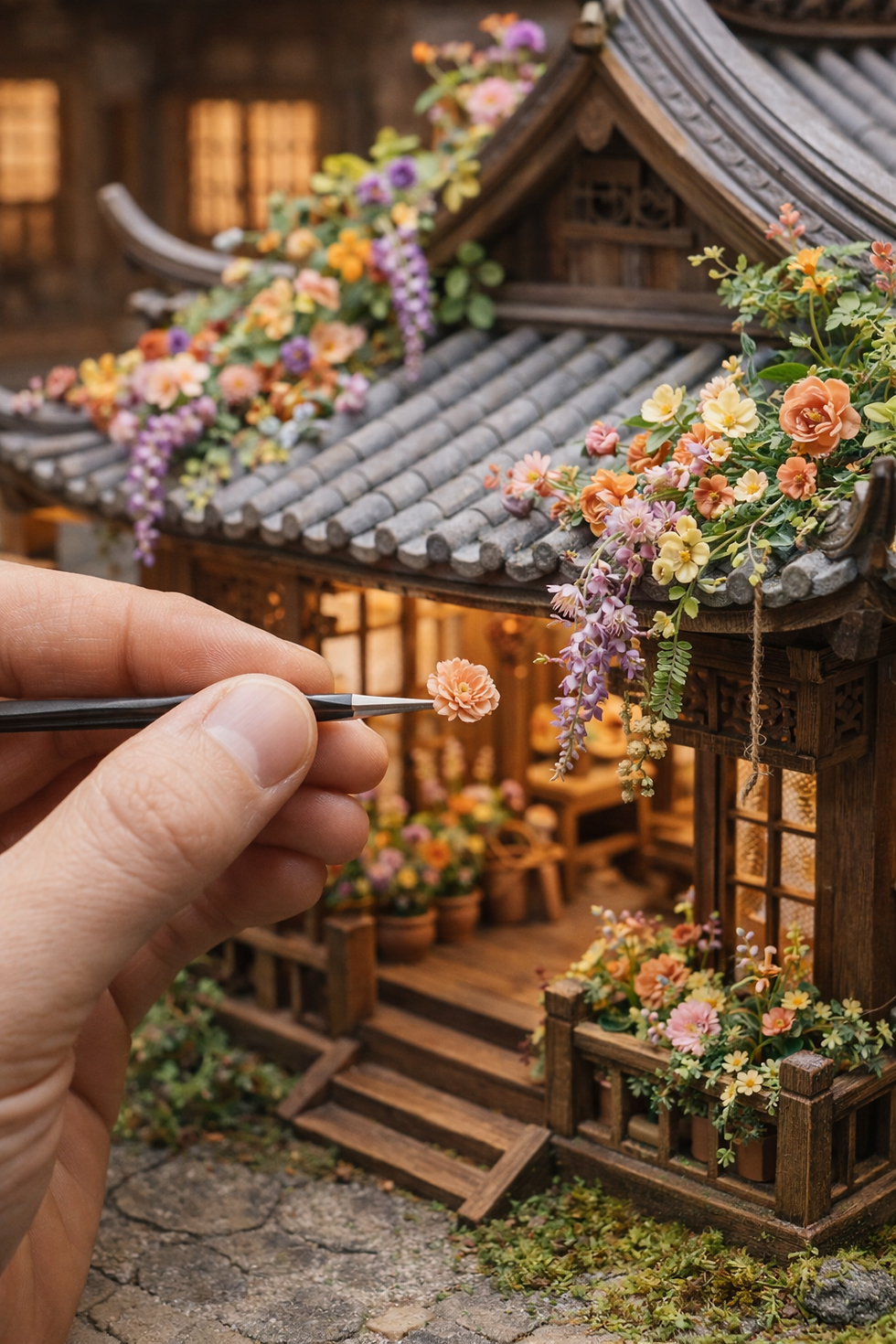
Then there’s the roof: elegantly arched, tiered, and a little theatrical in the best way. The gray tiles temper the color story, giving the eye somewhere cool to rest before it jumps back into the coral, peach, pink, gold, and violet blossoms spilling from the eaves. I especially love the way the plantings don’t just sit around the building. They invade it. They cascade over the roofline, crowd the railings, gather at the steps, and soften every hard edge.

The lanterns are the final trick. Warm orange, pale cream, soft green—they hang like punctuation marks, telling your eye where to pause. Inside, the glow turns the shop from pretty to enchanting. Suddenly it isn’t just a building. It feels inhabited. You can practically hear a little bell at the door and the rustle of paper wrapping around a bouquet.

Inspirations From the Big World to the Small
One reason this miniature works so well is that it doesn’t feel copied from one exact building. It feels remembered, which is often more powerful. It draws from a family tree of real-world Taiwanese atmosphere and then lets fantasy take the wheel.
I’m reminded first of Bangka Longshan Temple in Taipei, especially in the way layered rooflines and ornamental uplift create rhythm rather than mere shelter. On a full-size building, those curves give dignity and ceremony. In miniature, they do the same thing, but faster. Even a small bend in the eave instantly announces character.
I also think of Jiufen’s lantern-lit streets and teahouse facades, where steps, glow, timber, and layered ornament create that unforgettable sense of intimacy. Not everything in Jiufen is floral, obviously, but the mood is there: compressed space, warmth spilling outward, and detail stacked on detail until the whole scene feels deliciously dense.

And then there’s Sanxia Qingshui Zushi Temple, with its famously intricate carving and decorative richness. A miniature like this borrows that spirit without needing to duplicate every real-world detail. That’s the trick. At small scale, you don’t reproduce everything. You choose the details that carry the strongest emotional signal: the lifted roof corner, the carved panel, the lantern, the threshold, the burst of seasonal color.
That matters because Taiwan, to me, is one of those places where architecture is never just architecture. It’s light, weather, food smells, people talking, scooters zipping past, plants growing wherever they can, and layers of history living right on top of each other. I spent about a month in Taiwan last year, and I absolutely loved it.

The food alone nearly convinced me to stay forever. But what really stuck with me was the warmth of the place—not just the climate, but the feeling. This miniature captures that spirit beautifully, even through a fantasy lens.
Make Your Own Magic
Before you start measuring things with the intensity of a moon-landing engineer, let me say this: treat what follows as inspiration, not sacred blueprint. I write these blog posts, but some of the little illustrative bits I use in my process are AI-assisted, and every so often the digital gremlins get a little weird and decide a flower stem needs to exit through another dimension. So take the vibe, steal the logic, and let your own version become its own little world.
Shopping List
Structure: Cereal box chipboard, shipping-box card, coffee stirrers, chopsticks, bamboo skewers, and leftover takeout-lid plastic all earn their keep here. If you want the store-bought route, grab basswood strip, sheet styrene, mat board, and clear acetate.
Roof: Corrugated cardboard with the paper peeled, thin foam sheets, air-dry clay rolled over a dowel, or cut cardstock strips all work. If you’d rather save time, look for pre-made dollhouse roof tile sheets, half-round styrene strips, or embossed roofing paper.

Flowers and foliage: Raid the craft drawer first: dried herbs, tea leaves, old brush bristles, preserved moss, floral wire, tissue paper, seed beads, and snippets of sponge. If you want ready-made help, pre-made floral minis, railroad flower tufts, laser-cut paper plants, dollhouse potted blooms, and miniature bonsai armatures are all fair game. No medal is awarded for making every leaf by hand.
Paint and finish: Warm brown acrylics, neutral grays, mossy greens, peach, coral, pink, cream, matte varnish, brown wash, and a soft dusting pigment or pastel.
Lighting: USB fairy lights, warm white micro LEDs, thin wire, and tracing paper or vellum for diffusion.
I’ll link buyable versions through affiliate links when I post this for the site. If you shop through them, you help keep the lanterns lit in this tiny neighborhood.
1. Start with scale, mood, and common sense
This kind of scene sings at 1:24 if you want a full exterior with landscaping, or 1:12 if you want to go wild on interior merchandise. Either way, sketch the footprint first. Think in layers: path, gate, porch, main volume, roof, floral overflow. Give the structure room to breathe before you drown it in pretty things. Safety note: sharp blades, sanding dust, super glue fumes, and hot tools are all very real, even when the final product looks adorable. Ventilate, cut away from your fingers, and keep snacks nowhere near your paint water. Learn from my crimes.
2. Build the bones before you flirt with details
Use thick card, foam board, or basswood to block out the base, floor, wall panels, and porch platform. Keep the main shop volume simple and let the roof do the fancy talking. A good rule is a slightly taller wall height than you first think you need; the dramatic eaves read better that way. Add the porch, steps, railings, and little entry gate early, because these pieces establish the rhythm of the whole build. If the bones feel elegant while still unpainted, you’re on the right track.

3. Let the roof be the star of the show
This build lives or dies on the roofline. Cut your roof substrate first, then gently curve it so the eaves lift at the corners. For tiles, I’d use repeating strips about 4 to 6 mm wide in smaller scales, layered upward like shingles but with slightly rounded profiles.

A simple paint mix works wonders: 2 parts neutral gray, 1 part brown, and the tiniest touch of green for age. Drybrush with pale stone gray, then glaze a thin mossy wash into lower areas. Keep the ridge a little darker so the silhouette stays crisp.

4. Windows and doors should feel airy, not chunky
This isn’t the moment for thick toy-like frames. Use thin stripwood or cardstock laminated in layers to build delicate lattice doors and window panels. Clear acetate behind the frame gives you glass without the headache. Paint the frames in a warm, deep wood tone: 2 parts burnt umber, 1 part walnut, and a little black. Then lightly edge-highlight with tan. If scratch-building every panel makes you want to lie on the floor and stare at the ceiling, pre-made dollhouse doors and laser-cut windows are perfectly respectable shortcuts.

5. Finish the timber and ground before the flowers arrive
Get your material story locked in first. I’d basecoat the wood in rich brown, wash it deeper in the recesses, and then drybrush a faded cedar tone on edges and sun-hit areas. The path wants soft stone grays with warm beige variation, not flat concrete monotony. Add the faintest greenish grime where moisture would collect. Around the base, layer soil texture, static grass, moss, and tiny weeds sparingly at first. The mistake is doing too much too early. Give yourself a believable stage before the floral performers burst in.

6. Treat the flowers as architecture
This is where people either make magic or make a colorful mess. Don’t plant randomly. Build floral shapes in tiers: low pots at the path, medium planters on the porch, and dramatic cascades at the roofline. Use repeated color families so the chaos still feels designed. I’d anchor this shop with peach, coral, soft pink, butter yellow, and a few violet accents. Mix handmade flowers with pre-made floral minis without shame. In fact, I recommend it. Handmade hero blooms plus pre-made filler is one of the smartest compromises in the hobby.
7. Foliage is your secret weapon
Leaves are what make flowers believable. Use ferny textures, small rounded leaves, trailing vines, and one or two branchy forms for contrast. That little tree at the side is especially important because it spreads the composition outward and stops the shop from feeling like a colorful blob. Paint greens in families too: blue-green, olive, spring green, and a dusty sage. Real plants aren’t one green, and miniatures shouldn’t be either. Tuck foliage into corners, under railings, and around posts to soften joins and hide sins. It’s horticulture and camouflage.

8. Add the focal pieces and small storytelling props
Every busy scene needs a few things the eye remembers. Here, I’d choose the roof crest, the front steps, the lantern cluster, and one standout arrangement near the door as the hero pieces. Then add little props: clay pots, wrapped bundles, a stool, a watering can, maybe a tray waiting for delivery. This is also where I’d include that tiny hanging star charm from the story. It’s the kind of detail people notice on the second look, and second looks are how miniatures become places instead of objects.

9. Lighting makes the whole thing exhale
Warm light is non-negotiable here. Cool LEDs will murder the romance stone dead. Use warm white micro LEDs or USB-powered fairy lights and diffuse them with vellum inside the lanterns so they glow instead of glare. One or two lights inside the shop plus a few lantern sources outside is plenty. Keep wiring simple and hide it under the base or behind rear walls. You are not wiring a stadium. You are creating evening mood in a flower shop. That’s a different religion.
10. Pull everything together with a final glaze and photo pass
Once all the parts are in, unify the scene. A very thin warm-brown glaze on the wood, a soft dusty pass on the stone, and tiny touches of moss green near damp areas will make everything feel related. Finish with matte varnish, except for a few glassy accents on pots or lanterns if you want sparkle. For photos, use a neutral or softly blurred backdrop in sandy gray, misty green, or warm plaster tones. Shoot at porch height if you can. The lower camera angle helps the shop feel inhabited instead of merely observed.

11. Troubleshooting the usual tiny disasters
Roof looks too flat? Lift the eaves more and deepen the shadow under the ridge.Flowers look like candy sprinkles? Reduce the color count and add more green between blooms.Wood feels plastic? Push darker wash into recesses and drybrush less evenly.Scene feels cluttered? Remove one-third of the pots and keep your best groupings.Lanterns too bright? Add another layer of vellum or move the LED farther back.

Until Next Time in the Small World
What I love most about this miniature is that it feels generous. The shop glows. The flowers spill out into the lane. The roof lifts like it’s trying to greet you. It has the warmth I remember from Taiwan, filtered through a fantasy lens and packed into a footprint small enough to sit on a table. That’s a pretty wonderful trick.
And somewhere in Moonmist Lane, I’m choosing to believe Madam Lin is still fussing over a bouquet, muttering that you can tell a lot about a person by the flowers they ignore.
I’d love to know what detail grabs you first here. Is it the roof? The lanterns? The riot of blossoms? The little star charm? Drop your favorite in the comments, share your own tiny creations with #smallworldminiatures, and sign up for the newsletter if you want more miniature tours, build inspiration, and behind-the-scenes rambling from me. While you’re here, wander through the online shop. There’s always another small world waiting.
#smallworldminiatures #miniature #miniatures #miniatureart #miniatureworld #dollhouseminiatures #diorama #dioramaart #miniatureflorist #floralshop #taiwanesestyle #fantasyminiature #springdecor #tinyworld #scaleart #modelmaking #rooftiles #miniatureflowers #miniaturegarden #lanternlight #architecturelovers #asianarchitecture #fantasydecor #artisanminiatures #collectibleart







Comments