



Gumdrop Eaves & Garden Dreams: A Polymer-Clay Cottage Miniature You Can Practically Smell the Cookies From
Updated: Oct 12

First Impressions in Miniature
Confession: I love a house that looks like it bakes its own cookies. This polymer-clay cottage has gumdrop roof tiles, a petite picket fence, and window boxes spilling over like confetti at a parade. The style leans storybook-meets-cottagecore, with a few nods to a miniature Victorian bay window and those scalloped miniature terracotta roof tiles that make you want to boop the shingles. Every corner says, “Welcome! Please pet the topiary.”
What grabbed me first is the color orchestra. Pastel coral shingles roll across the roof like pastry, while teal shutters wink beside arched windows. The porch curls with vines that look hand-piped. Down in the garden, pebbled stepping stones scatter toward a tiny birdhouse and a (clearly well-managed) vegetable patch. This is a polymer-clay diorama built to charm, but it’s also a smart piece of engineering: clay is heavy, so the core is MDF—steady, square, and perfectly happy to hold a whole neighborhood of flower pots.

If this is your first time seeing polymer-clay architecture done at this scale, you’re in for a treat. I’ll walk you through the tour, and later I’ll share how you can plan a no-paint build of your own—clay colors only, with the house itself as the hero piece. Stick around; there’s a full tutorial section below.
Miniature Backstory – The Tiny Tale
Welcome to Puddleduck Lane, No. 7, established (or discovered?) in 1903-ish, when a traveling seed merchant named Mabel Greenfingers parked her bicycle under the biggest topiary on the lane and decided to stay. The house was once a bakery so small the oven door doubled as a window on windy days. Mabel turned the bakery into a home, the home into a garden, and the garden into a rumor that the roses could hum.

Village characters abound. There’s Sir Peep, the robin who runs the neighborhood watch from the mailbox perch. Biscuit, the tabby cat next door, is known for rearranging the flower pots into constellation patterns. And once a year, locals swear they see a postcard addressed to “Future You” peek out of the letter slot.
Easter egg to hunt: count the pastel garden stones near the front walk—there are seven. Legend says they’re for the seven days Mabel cured the roof tiles in the sun, one row per day, singing a tune that, allegedly, taught the vines to climb. Keep this lore in mind during the build tour; you’ll notice how the house still “bakes” in warm colors and invites a little magic into mundane spaces.
A Guided Tour of the Build
Let’s walk from left to right like we’re nosy neighbors with good intentions.
Left Garden & Tree: A clipped topiary ball pops against the lawn—those dense micro-dots look almost like sponge sugar. Potted herbs ring the base, and you can almost smell the mint. A birdhouse on a post tilts just so, like it’s gossiping with the tulips. The stepping stones meander toward the porch in pebble-shaped ovals, slightly shiny at the edges, as if the morning dew hasn’t read the “no drinks on the path” sign.
Front Facade: The front door is a soft teal, arched and proud, with a tiny brass-look knob and an old-fashioned letter slot. Above it, a miniature awning wears a lace of trim and sprigs of climbing vine. Two arched windows flank the door—notice the way the shutters are not perfectly symmetrical? That wonkiness gives it personality. The miniature bay window to the right bows forward just a breath, catching sunlight on the flower box like a stage spotlight.
Porch & Veranda: The porch posts are white, slender, and slightly rounded—more cake-icing than lumber. A small bench waits on the veranda with a potted something-green perched like a guest who came early and brought a snack. The porch roof gently pitches downward with petite clay tiles—each one thumb-pressed, each one catching a shadow in the scallop.
Right Wing & Side Garden: Vines climb the corner seam like a celebratory ribbon, leading your gaze to the side addition with a deeper, warmer roof. Down by the fence is a wee toolshed with a coral-pink roof; it looks so proud of its paint…except there is no paint, only color-mixed clay (more on that later). The white picket fence creates a rhythm of verticals, then breaks for a gate that encourages your imagination to squeak it open.
Roof & Chimney: The roof is a festival of scales, laid like fish drifting into sleep. Coral, peach, buttercream—then a lilac chimney pops up with a storybook stone pattern and double terracotta stacks. It’s the kind of chimney that makes you believe hot cocoa has a sound.
Ground & Border: The base is a lush green lawn with texture underfoot. Flower clusters scatter along the border, each bead a bud, each bud an excuse to slow down. Look closely near the front step: a tiny wooden crate, a watering can, and a couple of round planters sit ready for their next small-scale chore. I’m convinced there’s a half-finished to-do list tucked behind that mailbox.
Inspirations – From the Big World to the Small
If you squint, you can trace the family tree. There’s storybook architecture from the 1920s (think the Spadena “Witch’s House” in Beverly Hills) playing dress-up with Cotswold cottage vibes—tumbled roofs, friendly asymmetry, romance over rigor. The curving vines and playful color echo Antoni Gaudí’s love of organic lines—scaled way down and sweetened for company. In miniature culture, you’ll see cousins in polymer-clay cottages that choose clay for color right out of the box rather than painting, and in 1:24 garden scenes where every blossom is a bead.

What’s shared DNA here? Exaggerated roof pitch, arched windows, hand-worked ornament, and a garden that feels curated yet wild. Why it matters: storybook and Arts-and-Crafts elements celebrate craft over perfection. At miniature scale, we get to amplify that—make the roof more lollipopped, the shutters more fluttery—so the feeling reads from across the room. The adaptation trick is restraint: keep primary forms simple, then let texture and clay color do the heavy lifting.
Artist Tips – Make Your Own Magic
The featured scene is an AI-generated concept illustration. Use this guide as inspiration for interpreting it with real materials; your results will vary.
You want cookie-warm whimsy without opening a single paint bottle? Perfect. This approach relies on MDF bones for strength and polymer clay for every visible surface. The hero piece is the house, so everything else supports it.
Mini Shopping List (lean & clever)
MDF sheets (6 mm base, 3 mm walls) — or repurpose a smooth cutting board as a base in a pinch.
Polymer clay in cream, coral, teal, greens, white — or use leftover clay scraps for underlayers.
Floral wire (22–26 g) — paperclips work for short pins.
PVA glue — school glue is fine for MDF seals.
Toothpicks & bamboo skewers — instant dowels and clay tools.
Aluminum foil — armatures and roof support.
USB micro-LED string — fairy lights from holiday décor work great.
Baking parchment — window diffuser and nonstick clay surface.
Corner clamps or painter’s tape — right angles while gluing.
Needle tool/craft knife — an old mechanical pencil without lead makes a great scribe.
Small magnets (optional) — detachable roof for access.

Quick Wins
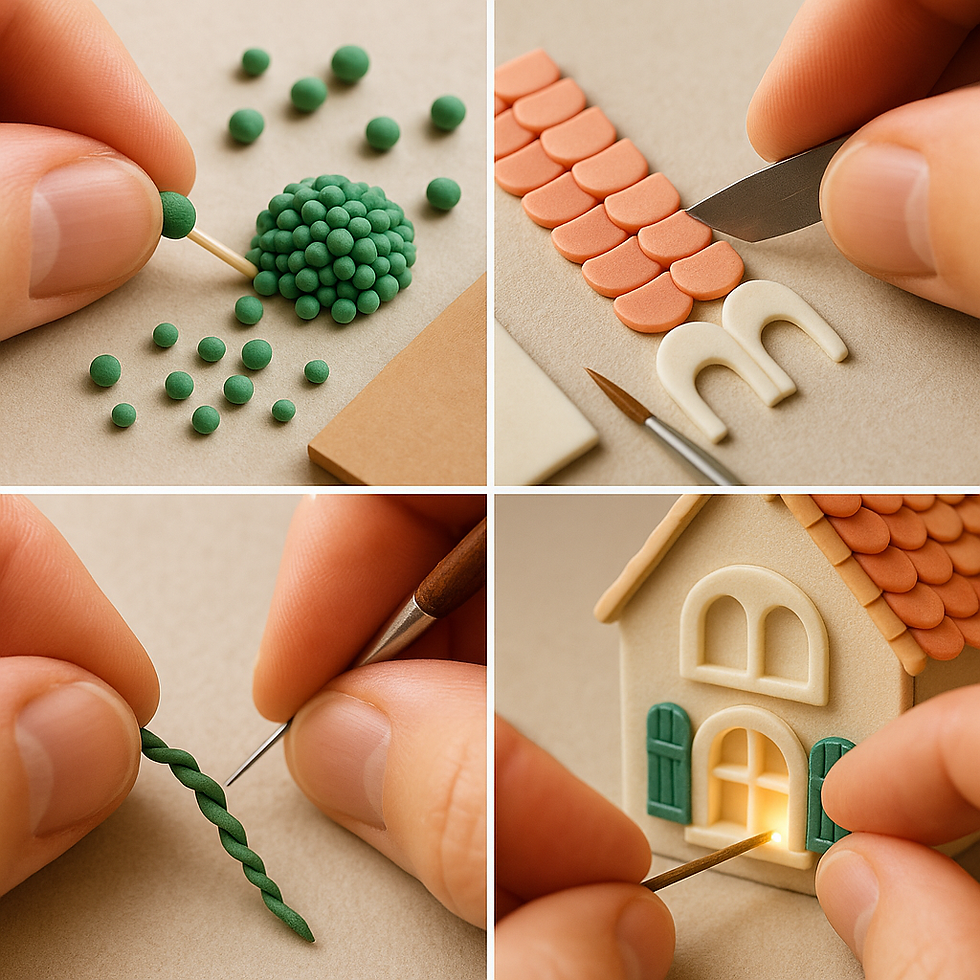
Instant garden fullness: Roll micro-balls of clay in three greens; press clusters with a toothpick → fast shrubs with depth.
Roof rhythm: Cut one strip of scalloped tiles, then slice into 8–10 mm segments → consistent shingles without a template.
No-measure windows: Press arch shapes over a 30 mm bottle cap → matching curves for upstairs windows in 1:24.
Vines with volume: Twist two skinny snakes of green around a wire → stable climbing vine you can drape and bake in place.
Soft light glow: Slip a USB mini LED strand behind translucent curtains → instant 2700–3000 K evening coziness.

Deep Dive
1) Planning & Scale Notes: Pick a 1:24 scale (half-inch) to keep materials manageable. A 6 m real-world cottage becomes a 250 mm wide facade; roof peak around 220–240 mm high. Sketch the front elevation with door at ~70 mm tall and main windows 30–35 mm wide. Decide clay color families now (warm roof, cool shutters, cream walls) so you can mix once and reuse.

2) Bones (Base Structure): Use MDF for heft—6 mm sheet for the base plate and 3 mm for walls and roof planes. MDF won’t twitch under the weight of baked clay. Cut panels with a fine-tooth blade; seal edges lightly with a 3:1 PVA-to-water mix to keep swelling down. Dry-fit with corner clamps, then glue and pin with toothpicks or 1 mm bamboo skewers. Add a 10–12 mm MDF perimeter strip under the base as a riser to hide wiring later.

3) Hero Piece (The House Itself): Block out the massing: a simple rectangle plus a smaller side wing. Roof angles at 45° read storybook without getting awkward. Before clay, scribe door and window openings in MDF so you have crisp edges to press clay into. The door lives front and center—give it a 2 mm reveal so the clay door sits slightly proud, like a real wood door.

4) Utilities & Greebles: This is where the magic multiplies. Roll 0.5–1 mm clay snakes for vines; press with a needle tool to texture bark. Make the mailbox, lantern, and birdhouse as separate bake-ahead bits (bake 10–12 minutes at your clay’s rated temperature, cool, then attach with liquid clay and rebake). Use floral wire (22–26 gauge) for the birdhouse post and any porch supports you want super-rigid beneath the clay icing.

5) Furniture & Soft Goods: Keep it light: a porch bench, a planter, a little welcome mat. For curtains, cut thin muslin or tea-dyed tissue, then stiffen with diluted PVA and pleat while it dries. Mount those inside the windows to conceal LED wires and sell the “lived-in” look.

6) Color & Material Map: Condition polymer clays into your palette. Mix warm roof shades by kneading coral with a pinch of white for highlights and a speck of brown for depth; aim for three values so your tiles read dimensional without paint. For the façade, a buttercream base clay; shutters in a blue-green (think sea glass). Keep windows and trim in plain white clay for pop. Make test chips (2 mm thick, 20 × 30 mm) and bake them; clay darkens slightly in the oven, so choose with that in mind.

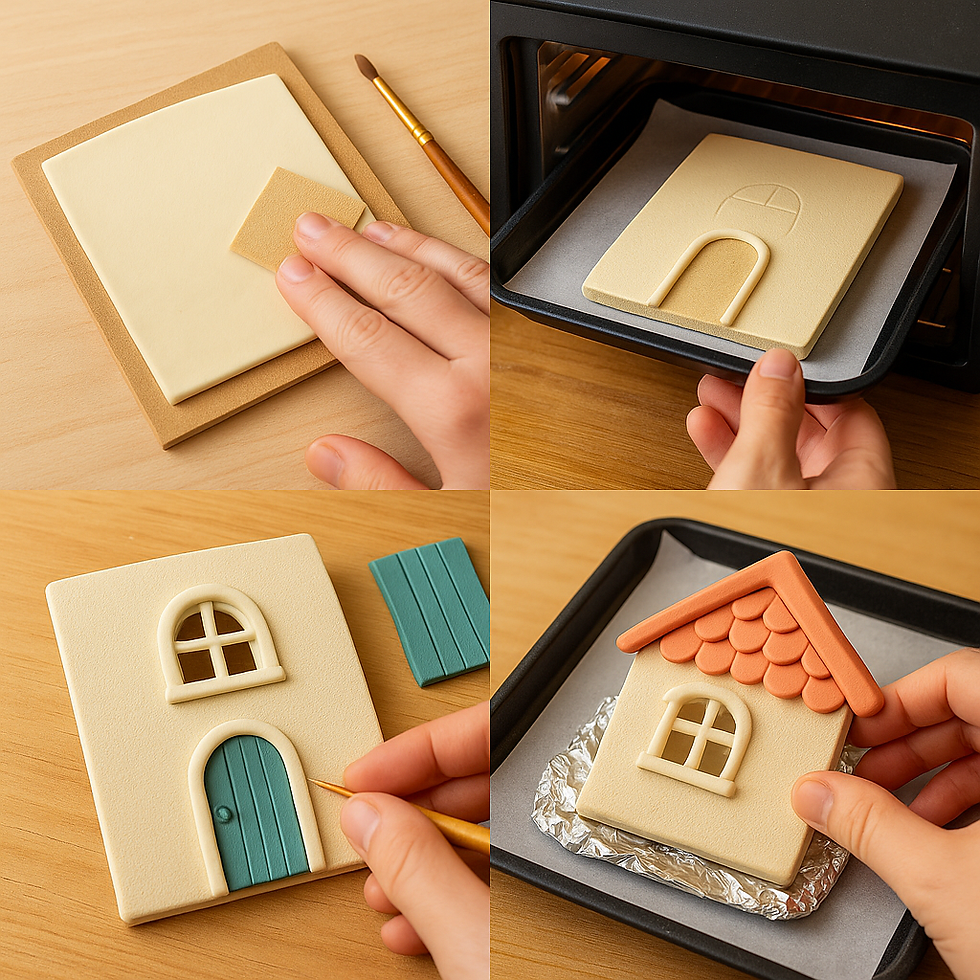
7) Build & Bake Rhythm: Polymer clay loves staging. Cover the wall panels with 1–2 mm sheets of clay, texture lightly with fine sandpaper for a stucco feel, and partial bake the whole wall while it’s flat—about 10–12 minutes at the manufacturer’s temperature. Cool, then add door/trim details and rebake. Roof tiles go last: work in rows, overlap by ~2 mm, and support the roof plane with crumpled foil during baking to prevent sag. Multiple short bakes are your friend; they won’t harm previously baked clay.
8) Lighting (Simple & Cozy): Run a USB-powered micro-LED string along the ceiling line inside. Keep color temperature 2700–3000 K for candle-glow warmth. Diffuse hotspots by placing a strip of baking parchment or thin white polymer-clay “curtains” behind windows. Hide the USB lead under the base riser and out the back. If you’re splicing individual LEDs, add a 220–330 Ω resistor at 5 V, and insulate joins with heat-shrink. (If that sentence raised your heart rate, use the pre-wired fairy-light strand and breathe easy.)
9) Story Clutter & Easter Eggs: A garden isn’t a garden without a little gossip. Add a mini letter labeled “Future You” peeking from the mailbox. Shape seven pastel stones near the front path, echoing Mabel’s founding week. Tuck a tiny croissant on the porch bench for bakery lore. These micro-stories pull the eye and reward repeat viewing.

10) Unifying Touch (No Varnish Needed): Because we’re not painting or sealing, unity comes from palette discipline and repeated motifs: use the same three greens for all foliage, repeat the coral of the roof on the shed, echo the shutter teal in a flower pot rim. The natural polymer-clay satin is lovely—let it be.

11) Photo Tips & Backdrop Ideas: Shoot at f/5.6–f/8 to keep most of the façade sharp without losing depth. If you’re on a phone, switch to telephoto to avoid distortion. Bounce a warm LED desk lamp off a white card on the shadow side. For background, try a soft gradient from warm butter to pale mint—an analog to the house palette that keeps attention on the model. Stage props: a narrow plank “tabletop” and a blurred sprig of greenery at the edge of frame to suggest a larger garden.


12) Troubleshooting
Clay cracks on large wall sheets → Fix: roll to 1.5–2 mm thickness, lay on cardstock before transferring, and partial-bake flat.
Roof sags during bake → Fix: support with balled aluminum foil underneath; bake tiles in shorter bursts.
MDF edge swells under glue → Fix: pre-seal with 3:1 PVA-water, let dry before assembly.
LED hotspots in windows → Fix: add a second layer of diffuser (parchment or frosted plastic), or aim LEDs at the ceiling, not the glass.
Heavy clay details slide before bake → Fix: score the clay underlayer, use liquid clay as “mortar,” and pin with short bits of wire where possible.

Safety Note: Cure polymer clay only at the manufacturer’s temperature in a well-ventilated area; avoid overbaking. Wear gloves when cutting MDF and sanding edges, and eye protection when drilling. Keep IPA and solvents away from heat, and insulate any electronic joins.
Until Next Time in the Small World
If you hear humming when you look at this cottage, that’s just the roses warming up. I hope No. 7 Puddleduck Lane made you grin and gave you the itch to sketch your own no-paint, clay-color cottage with MDF bones and a porch that begs for tiny tea time. Tell me your favorite detail in the comments—was it the seven stepping stones, the lilac chimney, or the croissant that definitely wasn’t there when we started? Share your builds with #smallworldminiatures so we can all applaud your tiny zoning decisions. And if you want more whimsical architecture delivered to your inbox, hop on the newsletter—signup is waiting at the bottom of the page.
#smallworldminiatures #miniaturehouse #polymerclayminiature #miniaturediorama #mdfminiature #dollhouseexterior #miniaturegarden #storybookarchitecture #cottagecoreminiature #handmademiniatures #miniatureart #tinyhomeart #dollhouseinspo #miniaturetutorial #miniaturephotography #scaleModeling #1to24scale #craftwithclay #miniaturefurniture #fairyliving #minigardendesign #dioramainspiration #hobbycrafts #artisttips #cozyminiatures #miniaturedetails #dollhousecommunity #miniaturemaker #miniatureworld #whimsicalart







Comments